Results by title
2 books match the query 'Mesch, Rachel'

Hellé
A NovelMarcelle Tinayre
Swan Isle Press, 2026
The first major English translation of Marcelle Tinayre’s Belle Époque novel that interrogates the struggle of coming of age as a young woman in a changing modern world.
Raised in the countryside by her reclusive classicist uncle, Hellé’s ideals are put to the test when she encounters the decadence and frivolity of Parisian society. Yet there she also meets the young political theorist and resolute socialist Antoine Genesvrier, who urges Hellé and her uncle to join him in supporting the city’s poor and advocating for social justice. Meanwhile, Hellé’s head is turned by the poet Maurice Clairmont, hailed by Parisian society as “the new Byron” and eager to win over Hellé with his beauty and charm. Caught between her love of beauty and her burgeoning social concern, Hellé must choose between two men, two ideals, and two worlds, while also staying true to herself. Tinayre infuses Hellé’s voice with the classical allusions of her uncle’s education and her love for the natural world, creating a fresh, engaging narrative that awakens both the mind and heart.
In this first major English translation, Grace Ashton brings exquisite resonance of tone, register, and spirit to Marcelle Tinayre’s perennially relevant novel.
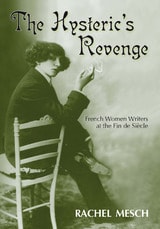
The Hysteric's Revenge
French Women Writers at the Fin de SiecleRachel Mesch
Vanderbilt University Press, 2006
This book argues, however, that the fear of sexual abandon--though real--veiled an even more insidious fear: that women might be capable of intellectual equality with men and thus pose a threat to the most basic structures of French patriarchal society. In demonstrating the pervasiveness of this anxiety through analysis of nineteenth-century medical texts, literary criticism, and fiction, The Hysteric's Revenge brings into relief a critical relationship between the female mind and body that is essential to understanding the discursive position of the turn-of-the-century woman writer.
The novels presented here confront this mind/body problem through a wide variety of styles and genres that challenge conventional fin-de-siecle notions of femininity. From the compelling autobiography of Liane de Pougy--one of Paris's most renowned courtesans--to Colette's frank discussions of female pleasure in one of her early novels, to the violent creativity of Rachilde's androgynous heroine, Mesch demonstrates how both canonical and non-canonical writers promoted women's intellectual authority through the development of a sexual counter-discourse. In engaging the relationship between women's minds and bodies, these novels challenge the conclusions of a century of doctors who sought to prove a physiological basis for female intellectual inferiority. At the same time, they point the way towards later French feminists who sought to subvert patriarchal structures through literary explorations of sexuality.