Results by title
4 books match the query 'Messages'

In the Street
Chalk Drawings and Messages, New York City, 1938-1948Helen Levitt
Duke University Press, 1987
So wrote James Agee in 1939. He shared this fascination with children’s street drawings and messages with his friend Helen Levitt. Here now are over one hundred of her photographs, made in the years between 1938 and 1948. Most of these pictures have never before been published. They have been selected and arranged by the photographer and carefully reproduced.
Robert Coles has written especially for this book an essay on the imaginative live of children and of a time when “. . . children still had some visual independence, some keen-eyed interest in laying pictorial claim to the world around them. . . . I have not seen scenes such as Helen Levitt offers in my wanderings through America’s city streets twenty and thirty and forty years after these were taken. They offer, then, a look backward—though they are also timeless in certain aspects. For children will never really stop being tempted by their imaginative faculties to show and tell—to let others see what they find themselves conceiving in thought and fantasy and dream.”
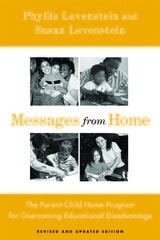
Messages From Home
The Parent-Child Home Program For Overcoming Educational DisadvantagePhyllis Levenstein and Susan Levenstein
Temple University Press, 2008
The Parent-Child Home Program, a pre-preschool home visiting program, has grown greatly since the first edition of Messages from Home was published in 1988. This expanded and updated edition shows the continued success of this program-spearheaded by the late Phyllis Levenstein-which prepares at-risk children for school success, overcoming educational disadvantage.
Since The Parent-Child Home Program was founded in the 1960s, it has enriched the cognitive, social, and emotional school readiness of tens of thousands of children. The Program's methods, its theoretical underpinnings, and its impressive results are presented in detail. The success stories of both parents and children make inspiring reading. The combination of lively writing and data-driven scientific rigor give it both broad appeal and academic relevance.
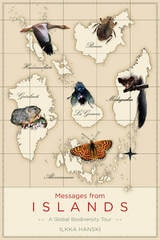
Messages from Islands
A Global Biodiversity TourIlkka Hanski
University of Chicago Press, 2016
Beginning each chapter on a particular island, Hanski dives into reflections on his own field studies before going on to pursue a variety of ecological questions, including: What is the biodiversity crisis? What are extinction thresholds and extinction debts? What can the biodiversity hypothesis tell us about rapidly increasing allergies, asthma, and other chronic inflammatory disorders? The world’s largest island, Greenland, for instance, is the starting point for a journey into the benefits that humankind acquires from biodiversity, including the staggering biodiversity of microbes in the ecosystems that are closest to us—the ecosystems in our guts, in our respiratory tracts, and under our skin. Conceptually oriented but grounded in an adventurous personal narrative, Messages from Islands is a landmark work that lifts the natural mysteries of islands from the sea, bringing to light the thrilling complexities and connections of ecosystems worldwide.
Messages from the Wild
An Almanac of Suburban Natural and Unnatural HistoryBy Frederick R. Gehlbach
University of Texas Press, 2002
Seeking a closer connection with nature than the manicured lawns of suburbia, naturalist Fred Gehlbach and his family built a house on the edge of a wooded ravine in Central Texas in the mid-1960s. On daily walks over the hills, creek hollows, and fields of the ravine, Gehlbach has observed the cycles of weather and seasons, the annual migrations of birds, and the life cycles of animals and plants that also live in the ravine.
In this book, Gehlbach draws on thirty-five years of journal entries to present a composite, day-by-day almanac of the life cycles of this semiwild natural island in the midst of urban Texas. Recording such events as the hatching of Eastern screech owl chicks, the emergence of June bugs, and the first freeze of November, he reminds us of nature's daily, monthly, and annual cycles, from which humans are becoming ever more detached in our unnatural urban environments. The long span of the almanac also allows Gehlbach to track how local and even global developments have affected the ravine, from scars left by sewer construction to an increase in frost-free days probably linked to global warming.
This long-term record of natural cycles provides one of only two such baseline data sets for North America. At the same time, the book is an eloquent account of one keen observer's daily interactions with his wild and human neighbors and of the lessons in connectedness and the "play of life" that they teach.