Results by title
4 books match the query 'Meteorites'
Meteorites and the Early Solar System
John F. Kerridge
University of Arizona Press, 1988
First published in November 1988, this work provided a coherent narrative about the known understandings of meteorites and the early solar system.
From the original publication:
From the original publication:
Although the Earth was formed, together with the other planets, at the birth of the solar system, geological activity has since erased all but a hint of the processes that accompanied its formation. If we wish to explore the processes that occurred in the earliest solar system, and the nature of the environment in which they took place, we must turn to the record contained in more primitive material. Many meteorites appear to satisfy that criterion, and much effort has been applied in identifying those meteorites, or their constituents, that have retained a reliable record of the early solar system. This book provides a synthesis of what has been learned so far about the earliest stages of solar system history through the study of meteorites, and what, given our current level of understanding, remains to be learned.
Contents 1. Introduction 2. Source Regions 3. Secondary Processing 4. Irradiation Effects 5. Solar System Chronology 6. Chondrites and the Early Solar System 7. Elemental Composition of Chondrites 8. Magnetic Fields in the Early Solar System 9. Chondrules10. Primitive Material Surviving in chondrites11. Micrometeorites12. Inhomogencity of the Nebula13. Survival of Presolar Material in Meteorites14. Nucleosynthesis15. Nucleocosmochronology16. Summary
Contents 1. Introduction 2. Source Regions 3. Secondary Processing 4. Irradiation Effects 5. Solar System Chronology 6. Chondrites and the Early Solar System 7. Elemental Composition of Chondrites 8. Magnetic Fields in the Early Solar System 9. Chondrules10. Primitive Material Surviving in chondrites11. Micrometeorites12. Inhomogencity of the Nebula13. Survival of Presolar Material in Meteorites14. Nucleosynthesis15. Nucleocosmochronology16. Summary
[more]
Meteorites and the Early Solar System II
Edited by Dante S. Lauretta and Harry Y. McSween
University of Arizona Press, 2006
They range in size from microscopic particles to masses of many tons. The geologic diversity of asteroids and other rocky bodies of the solar system are displayed in the enormous variety of textures and mineralogies observed in meteorites. The composition, chemistry, and mineralogy of primitive meteorites collectively provide evidence for a wide variety of chemical and physical processes. This book synthesizes our current understanding of the early solar system, summarizing information about processes that occurred before its formation. It will be valuable as a textbook for graduate education in planetary science and as a reference for meteoriticists and researchers in allied fields worldwide.
[more]
Protostars and Planets V
Edited by Bo Reipurth, David Jewitt, and Klaus Keil
University of Arizona Press, 2007
Increasing discoveries of new planets beyond our solar system are invigorating the quest for new knowledge and understanding of the birth of stars and planets. This new volume in the Space Science Series, with 249 contributing authors, builds on the latest results from recent advances in ground and space-based astronomy and in numerical computing techniques to offer the most detailed and up-to-date picture of star and planet formation, including the formation of our own solar system. This book emphasizes the cross-disciplinary aspects of the field, with a particular focus on the early evolution of our solar system. Protostars and Planets V is the new foundation for further advancement in the fields of stellar and planetary formation, making it an indispensable resource for researchers and students in astronomy, planetary science, and the study of meteorites.
[more]
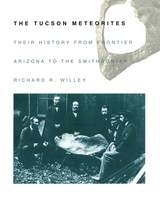
The Tucson Meteorites
Their History from Frontier Arizona to the SmithsonianRichard R. Willey
University of Arizona Press, 1997
The Tucson Meteorites—the two known fragments totaling more that a ton of primordial space matter—were discovered during the first half of the nineteenth century on the desolate Mexican frontier that later became Arizona. In this book, Richard R. Willey recounts the bizarre history of these meteorites and explores the mystery, unresolved to the present day, of where they fell to earth and whether more fragments remain to be found in the mountains of southern Arizona.
Willey tracks the meteorites through years of confiscation and disputed ownership to the Smithsonian Institution. "I had seen passing allusions to the Meteorite in occasional writings on Tucson’s colorful history," he recalls, "but little that hinted at the social, political, and military involvement that the Meteorite had enjoyed in the Southwest of yesteryear, nor of the mystery surrounding other, yet unfound ‘enormous masses’ of the Meteorite." The book features both historical illustrations and photographs of the meteorite fragments and also includes data on their physical characteristics. Willey’s story will leave readers with an enhanced appreciation of life on the early Arizona frontier and of the facts surrounding the fate of the Tucson Meteorites in that frontier setting.
Willey tracks the meteorites through years of confiscation and disputed ownership to the Smithsonian Institution. "I had seen passing allusions to the Meteorite in occasional writings on Tucson’s colorful history," he recalls, "but little that hinted at the social, political, and military involvement that the Meteorite had enjoyed in the Southwest of yesteryear, nor of the mystery surrounding other, yet unfound ‘enormous masses’ of the Meteorite." The book features both historical illustrations and photographs of the meteorite fragments and also includes data on their physical characteristics. Willey’s story will leave readers with an enhanced appreciation of life on the early Arizona frontier and of the facts surrounding the fate of the Tucson Meteorites in that frontier setting.
[more]