Results by title
58 books match the query 'Meteorology & Climatology' and 8 start with a
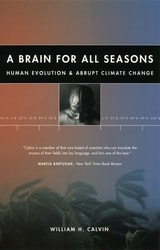
A Brain for All Seasons
Human Evolution and Abrupt Climate ChangeWilliam H. Calvin
University of Chicago Press, 2002
Our ancestors lived through hundreds of such abrupt episodes since the more gradual Ice Ages began two and a half million years ago—but abrupt cooling produced a population bottleneck each time, one that eliminated most of their relatives. We are the improbable descendants of those who survived—and later thrived.
William H. Calvin's marvelous A Brain for All Seasons argues that such cycles of cool, crash, and burn powered the pump for the enormous increase in brain size and complexity in human beings. Driven by the imperative to adapt within a generation to "whiplash" climate changes where only grass did well for a while, our ancestors learned to cooperate and innovate in hunting large grazing animals.
Calvin's book is structured as a travelogue that takes us around the globe and back in time. Beginning at Darwin's home in England, Calvin sits under an oak tree and muses on what controls the speed of evolutionary "progress." The Kalahari desert and the Sterkfontein caves in South Africa serve as the backdrop for a discussion of our ancestors' changing diets. A drought-shrunken lake in Kenya shows how grassy mudflats become great magnets for grazing animals. And in Copenhagen, we learn what ice cores have told us about abrupt jumps in past climates.
Perhaps the most dramatic discovery of all, though, awaits us as we fly with Calvin over the Gulf Stream and Greenland: global warming caused by human-made pollution could paradoxically trigger another sudden episode of global cooling. Because of the accumulation of greenhouse gases in the atmosphere, the oceanic "conveyor belt" that sends warmer waters into the North Atlantic could abruptly shut down. If that happens again, much of the Earth could be plunged into a deep chill within a few years. Europe would become as cold and dry as Siberia. Agriculture could not adapt quickly enough to avoid worldwide famines and wars over the dwindling food supplies—a crash from which it would take us many centuries to recover.
With this warning, Calvin connects us directly to evolution and the surprises it holds. Highly illustrated, conversational, and learned, A Brain for All Seasons is a fascinating view of where we came from, and where we're going.
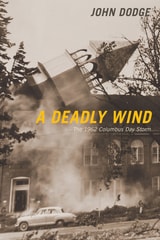
A Deadly Wind
The 1962 Columbus Day StormJohn Dod
Oregon State University Press, 2018
The Columbus Day Storm of 1962 was a freak of nature, a weather outlier with deadly winds topping one hundred miles per hour. The storm killed dozens, injured hundreds, damaged more than fifty thousand homes, and leveled enough timber to build one million homes. To find an equally ferocious storm of its kind, fast-forward fifty years and cross the continent to Superstorm Sandy’s 2012 attack on the East Coast. While Superstorm Sandy was predicted days in advance, the Columbus Day Storm caught ill-equipped weather forecasters by surprise.
This unrivalled West Coast windstorm fueled the Asian log export market, helped give birth to the Oregon wine industry, and influenced the 1962 World Series. It remains a cautionary tale and the Pacific Northwest benchmark for severe windstorms in this era of climate change and weather uncertainty. From its genesis in the Marshall Islands to its final hours on Vancouver Island, British Columbia, the storm plowed an unparalleled path of destruction.
In A Deadly Wind, veteran journalist John Dodge tells a compelling story spiced with human drama, Cold War tension, and Pacific Northwest history. This is a must-read for the tens of thousands of storm survivors, for history buffs, and for anyone interested in the intersection of severe weather events and climate change.
A Field Guide to Snow
Matthew Sturm
University of Alaska Press, 2020
In A Field Guide to Snow, veteran snow scientist Matthew Sturm answers those questions and more. Drawing on decades of study, he explains in clear and simple ways how and why snow works the way it does. The perfect companion a ski trip or a hike in the snowy woods, A Field Guide to Snow will give you a new appreciation for the science behind snow’s beauty.
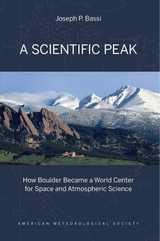
A Scientific Peak
How Boulder Became a World Center for Space and Atmospheric ScienceJoseph P. Bassi
American Meteorological Society, 2015
A Scientific Peak chronicles Boulder’s meteoric rise to eventually become “America’s Smartest City” and a leader in space and atmospheric sciences. In just two decades following World War II, a tenacious group of researchers, supported by groups from local citizenry to the State of Colorado, managed to convince the US government and some of the world’s scientific pioneers to make Boulder a center of the new space age. Joseph P. Bassi introduces us to the characters, from citizens to scientists, and the mix of politics, passion, and sheer luck at the start of Boulder’s transformation from “Scientific Siberia” to the research mecca it is today.
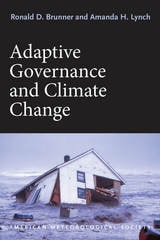
Adaptive Governance and Climate Change
Ronald D. Brunner and Amanda H. Lynch
American Meteorological Society, 2010
While recent years have seen undeniable progress in international acknowledgement both of the dangers of climate change and the importance of working to mitigate it, little has actually been done. Emissions continue to rise, and even the ambitious targets set by international accords would fall far short of the drastic cuts that are needed to prevent catastrophe.
With Adaptive Governance and Climate Change, Ronald D. Brunner and Amanda H. Lynch argue that we need to take a new tack, moving away from reliance on centralized, top-down approaches—the treaties and accords that have proved disappointingly ineffective thus far—and towards a more flexible, multi-level approach. Based in the principles of adaptive governance—which are designed to produce programs that adapt quickly and easily to new information and experimental results—such an approach would encourage diversity and innovation in the search for solutions, while at the same time pointedly recasting the problem as one in which every culture and community around the world has an inherent interest.
Air Apparent
How Meteorologists Learned to Map, Predict, and Dramatize WeatherMark Monmonier
University of Chicago Press, 1999
"Clever title, rewarding book. Monmonier . . . offers here a basic course in meteorology, which he presents gracefully by means of a history of weather maps." —Scientific American
"Mark Monmonier is onto a winner with Air Apparent. . . . It is good, accessible science and excellent history. . . . Read it." —Fred Pearce, New Scientist
"[Air Apparent] is a superb first reading for any backyard novice of weather . . . but even the veteran forecaster or researcher will find it engaging and, in some cases, enlightening." —Joe Venuti, Bulletin of the American Meteorological Society
"Monmonier is solid enough in his discussion of geographic and meteorological information to satisfy the experienced weather watcher. But even if this information were not presented in such a lively and engaging manner, it would still hook most any reader who checks the weather map every morning or who sits happily entranced through a full cycle of forecasts on the Weather Channel."—Michael Kennedy, Boston Globe
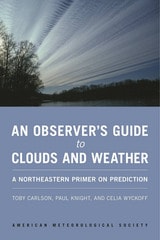
An Observer's Guide to Clouds and Weather
A Northeastern Primer on PredictionToby Carlson, Paul Knight, and Celia Wyckoff
American Meteorological Society, 2014
This informative and accessible guide walks readers through the basics of making weather predictions through understanding cloud types and sky formations. It explains, in nontechnical terms, the science behind the weather, connecting fundamental meteorological concepts with the processes that shape weather patterns. Readers will learn how to develop their powers of observation and hone their ability to make quick forecasts without complicated tools. Whether you're an amateur weather enthusiast or a beginning meteorology student, An Observer’s Guide to Clouds and Weather will help anyone who prefers looking up to looking it up.
Authors of the Storm
Meteorologists and the Culture of PredictionGary Alan Fine
University of Chicago Press, 2007
Whether it is used as an icebreaker in conversation or as the subject of serious inquiry, “the weather” is one of the few subjects that everyone talks about. And though we recognize the faces that bring us the weather on television, how government meteorologists and forecasters go about their jobs is rarely scrutinized. Given recent weather-related disasters, it’s time we find out more. In Authors of the Storm, Gary Alan Fine offers an inside look at how meteorologists and forecasters predict the weather.
Based on field observation and interviews at the Storm Prediction Center in Oklahoma, the National Weather Service in Washington, D.C., and a handful of midwestern outlets, Fine finds a supremely hard-working, insular clique of professionals who often refer to themselves as a “band of brothers.” In Fine’s skilled hands, we learn their lingo, how they “read” weather conditions, how forecasts are written, and, of course, how those messages are conveyed to the public. Weather forecasts, he shows, are often shaped as much by social and cultural factors inside local offices as they are by approaching cumulus clouds. By opening up this unique world to us, Authors of the Storm offers a valuable and fascinating glimpse of a crucial profession.