Results by title
19 books match the query 'Methodist Church'
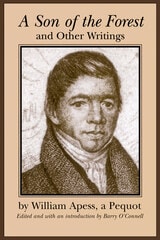
"A Son of the Forest" and Other Writings
William Apess
University of Massachusetts Press, 1997
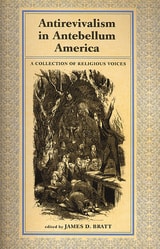
Antirevialism in Antebellum America
A Collection of Religious VoicesBratt, James D
Rutgers University Press, 2005
But revivalism has always generated opposition, too, even in its century of glory. In Anti-Revivalism in Antebellum America, James D. Bratt offers extensive introductions to primary anti-revivalist documents. These works range from the Philadelphia Methodist John F. Watson's protests against camp meetings in 1819, to Elizabeth Cady Stanton's "Eighty Years and More," written in 1898, in which she recalls her youthful encounter with revival preaching and her rebound into political activism and religious agnosticism. Through the recovered voices of antebellum religious critics, Bratt shows how American culture was already being reshaped a generation before the Civil War and how evangelical religion stood at the center of a "culture war."
If revivals typified the era when Americans launched and defined their new nation, then objections to these revivals embodied the growing discontent at what the nation had become. An important and long overdue collection, this book urges an understanding of anti-revival literature both in the context of the era when it emerged as well as in terms of the broader dynamic of American life.
Includes selections from Orestes Brownson, Horace Bushnell, Calvin Colton, Orville Dewey, Albert Baldwin Dod, George Elley, Charles G. Finney, John Williamson Nevin, Stephen Olin, Phoebe Palmer, Daniel Alexander Payne, Ephraim Perkins, Elizabeth Cady Stanton, Joseph Smith, Harriet Beecher Stowe, La Roy Sunderland, John Fanning Watson, Ellen G. White, and Friedrich C. D. Wyneken.
Crisis of Conscience
Arkansas Methodists and the Civil Rights StruggleJames T. Clemons
Butler Center for Arkansas Studies, 2007
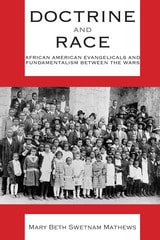
Doctrine and Race
African American Evangelicals and Fundamentalism between the WarsMary Beth Swetnam Mathews
University of Alabama Press, 2017
Doctrine and Race examines the history of African American Baptists and Methodists of the early twentieth century and their struggle for equality in the context of white Protestant fundamentalism.
By presenting African American Protestantism in the context of white Protestant fundamentalism, Doctrine and Race: African American Evangelicals and Fundamentalism between the Wars demonstrates that African American Protestants were acutely aware of the manner in which white Christianity operated and how they could use that knowledge to justify social change. Mary Beth Swetnam Mathews’s study scrutinizes how white fundamentalists wrote blacks out of their definition of fundamentalism and how blacks constructed a definition of Christianity that had, at its core, an intrinsic belief in racial equality. In doing so, this volume challenges the prevailing scholarly argument that fundamentalism was either a doctrinal debate or an antimodernist force. Instead, it was a constantly shifting set of priorities for different groups at different times.
A number of African American theologians and clergy identified with many of the doctrinal tenets of the fundamentalism of their white counterparts, but African Americans were excluded from full fellowship with the fundamentalists because of their race. Moreover, these scholars and pastors did not limit themselves to traditional evangelical doctrine but embraced progressive theological concepts, such as the Social Gospel, to help them achieve racial equality. Nonetheless, they identified other forward-looking theological views, such as modernism, as threats to “true” Christianity.
Mathews demonstrates that, although traditional portraits of “the black church” have provided the illusion of a singular unified organization, black evangelical leaders debated passionately among themselves as they sought to preserve select aspects of the culture around them while rejecting others. The picture that emerges from this research creates a richer, more profound understanding of African American denominations as they struggled to contend with a white American society that saw them as inferior.
Doctrine and Race melds American religious history and race studies in innovative and compelling ways, highlighting the remarkable and rich complexity that attended to the development of African American Protestant movements.
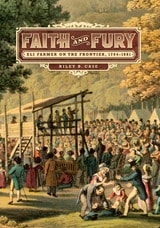
Faith and Fury
Eli Farmer on the Frontier, 1794–1881Riley B. Case
Indiana Historical Society Press, 2018

Hedstroms and the Bethel Ship Saga
Methodist Influence on Swedish Religious LifeHenry C. Whyman. Foreword by Kenneth E. Rowe
Southern Illinois University Press, 1992
The first book-length biographical treatment of Olof Gustaf Hedstrom and his brother Jonas documents their work in spreading Methodism among Swedish immigrants to America. Henry C. Whyman discusses the Bethel Ship Saga, a ministry unique in American immigrant history, and examines the larger picture of the role of religion in nineteenth-century European immigration to the United States.
The Bethel Ship, a floating chapel in New York Harbor, was the vehicle and headquarters for an effective ministry to immigrants arriving in America. Olof Hedstrom, a Methodist minister serving in the Catskill Mountain area, was called to New York to organize and lead this endeavor.
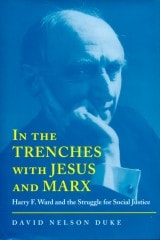
In the Trenches with Jesus and Marx
Harry F. Ward and the Struggle for Social JusticeDavid Duke
University of Alabama Press, 2006
The story of a Social Gospel leader who brought faith, activism, and social justice into the heart of modern American politics.
Radical religious and political leader Harry F. Ward started life quietly enough in a family of Methodist shopkeepers and butchers in London. But his relentless pursuit of social justice would lead him to the United States and a long career of religious activism. Ward served as professor of Christian ethics at the Union Theological Seminary and chairman of the board of the American Civil Liberties Union for two decades. He also became a leader in labor groups, Protestant activist organizations, and New York intellectual circles.
David Duke builds his comprehensive story of this fiery leader from extensive archival sources, including FBI files and private correspondence, sermons, class notes, and other unpublished material. Duke skillfully charts Ward's rise from an idealistic Methodist minister in a Chicago stockyard parish to a prominent national religious leader and influential political figure. Ultimately, Ward's lifelong attempt to synthesize the beliefs of Jesus and Marx and his role as an admirer of the Soviet Union put him on a collision course with McCarthyism in Cold War America. Viewed by some as a prophet and by others as a heretic, traitor, and communist, Ward became increasingly marginalized as he stubbornly maintained his radical positions. Even in his own circle, he went from being a figure of unquestioned integrity who eloquently spoke his convictions to a tragically short-sighted idealogue whose unwavering pro-Soviet agenda blinded him to the horrors of Stalinist oppression.
Harry Ward's long, colorful career intersected nearly every intellectual current in American culture for more than a half century. This biography will be important for scholars of American religious history, students of liberalism and politics, social Christians, and general readers who enjoy a compelling tour into the private and public lives of notable figures of history.
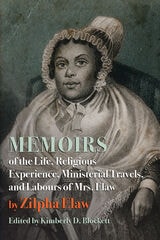
Memoirs of the Life, Religious Experience, Ministerial Travels, and Labours of Mrs. Elaw
Zilpha Elaw
West Virginia University Press, 2021
As a young Black orphan indentured to a Quaker family in Bristol, Pennsylvania, Zilpha Elaw (c. 1793–1873) decided to join the upstart Methodists in 1808. She preached her first sermon a decade later, ignoring her husband and the many church leaders, clergy, and laity who tried to silence her. Elaw’s memoir chronicles the first twenty years of her forty-year itinerant ministry during massive Protestant revivalism in the United States and England.
Elaw preached from Maine to Virginia, attracting multiracial and multidenominational audiences that included powerful men, wealthy White women, poor families, and enslaved communities. She moved from Bristol to Burlington, New Jersey, then to Nantucket, Massachusetts, and finally, in 1840, to London’s East End. In England, Elaw’s celebrity expanded, and at least twice she drew crowds so large they caused human stampedes and multiple injuries.
Blockett’s introduction and extensive annotations draw on newly unearthed information about the entirety of Elaw’s evangelism to provide context for this remarkable story of an antebellum Black woman’s personal and professional mobility.
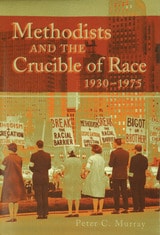
Methodists and the Crucible of Race, 1930-1975
Peter C. Murray
University of Missouri Press, 2004
During the Civil Rights movement, American churches confronted issues of racism that they had previously ignored. No church experienced this confrontation more sharply than the Methodist Church. When Methodists reunited their northern and southern halves in 1939, their new church constitution created a segregated church structure that posed significant issues for Methodists during the Civil Rights movement.
Of the six jurisdictional conferences that made up the Methodist Church, only one was not based on a geographic region: the Central Jurisdiction, a separate conference for “all Negro annual conferences.” This Jim Crow arrangement humiliated African American Methodists and embarrassed their liberal white allies within the church. The Supreme Court’s Brown v. Board of Education decision awakened many white Methodists from their complacent belief that the church could conform to the norms of the South without consequences among its national membership.
Murray places the struggle of the Methodist Church within the broader context of the history of race relations in the United States. He shows how the effort to destroy the barriers in the church were mirrored in the work being done by society to end segregation. Immensely readable and free of jargon, Methodists and the Crucible of Race, 1930–1975, will be of interest to a broad audience, including those interested in the Civil Rights movement and American church history.
Music and the Wesleys
Edited by Nicholas Temperley and Stephen Banfield
University of Illinois Press, 2010

Music from the Hilltop
Organs and Organists at Southern Methodist UniversityBenjamin A. Kolodziej
University of North Texas Press, 2023
Peter Cartwright, Legendary Frontier Preacher
Robert Bray
University of Illinois Press, 2005
Robert Bray tells the full story of the long relationship between Cartwright and Lincoln, including their political campaigns against each other, their social antagonisms, and their radical disagreements on the Christian religion, as well as their shared views on slavery and the central fact of their being "self-made."
In addition, the biography examines in close detail Cartwright's instrumental role in Methodism's bitter "divorce" of 1844, in which the southern conferences seceded in a remarkable prefigurement of the United States a decade later. Finally, Peter Cartwright attempts to place the man in his appropriate national context: as a potent "man of words" on the frontier, a self-authorizing "legend in his own time," and, surprisingly, an enduring western literary figure.
Sparks from the Anvil of Oppression
Philadelphia's African Methodists and Southern Migrants, 1890-1940Robert Gregg
Temple University Press, 1998
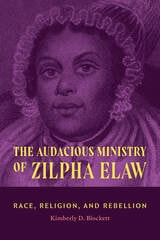
The Audacious Ministry of Zilpha Elaw
Race, Religion, and RebellionKimberly D. Blockett
Duke University Press, 2026
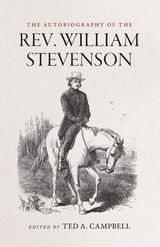
The Autobiography of the Rev. William Stevenson
Ted A. Campbell
Bridwell Press, 2024
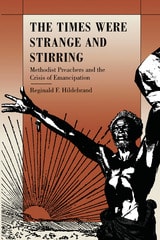
The Times Were Strange and Stirring
Methodist Preachers and the Crisis of EmancipationReginald F. Hildebrand
Duke University Press, 1995
Hildebrand explores the ideas and ideals of missionaries from several branches of Methodism—the African Methodist Episcopal Church, the Colored Methodist Episcopal Church, and the northern-based Methodist Episcopal Church—and the significant and highly charged battle waged between them over the challenge and meaning of freedom. He traces the various strategies and goals pursued by these competing visions and develops a typology of some of the ways in which emancipation was approached and understood.
Focusing on individual church leaders such as Lucius H. Holsey, Richard Harvey Cain, and Gilbert Haven, and with the benefit of extensive research in church archives and newspapers, Hildebrand tells the dramatic and sometimes moving story of how missionaries labored to organize their denominations in the black South, and of how they were overwhelmed at times by the struggles of freedom.
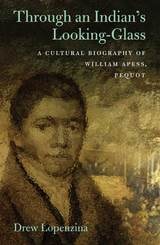
Through an Indian's Looking-Glass
A Cultural Biography of William Apess, PequotDrew Lopenzina
University of Massachusetts Press, 2017
The life of William Apess (1798–1839), a Pequot Indian, Methodist preacher, and widely celebrated writer, provides a lens through which to comprehend the complex dynamics of indigenous survival and resistance in the era of America's early nationhood. Apess's life intersects with multiple aspects of indigenous identity and existence in this period, including indentured servitude, slavery, service in the armed forces, syncretic engagements with Christian spirituality, and Native struggles for political and cultural autonomy. Even more, Apess offers a powerful and provocative voice for the persistence of Native presence in a time and place that was long supposed to have settled its “Indian question” in favor of extinction.
Through meticulous archival research, close readings of Apess's key works, and informed and imaginative speculation about his largely enigmatic life, Drew Lopenzina provides a vivid portrait of this singular Native American figure. This new biography will sit alongside Apess's own writing as vital reading for those interested in early America and indigeneity.
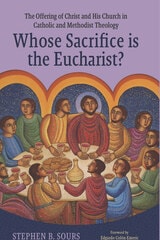
Whose Sacrifice is the Eucharist? The Offering of Christ and His Church in Catholic and Methodist Theology
Stephen B. Sours
Catholic University of America Press, 2024
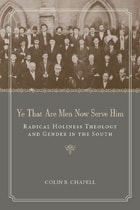
Ye That Are Men Now Serve Him
Radical Holiness Theology and Gender in the SouthColin B. Chapell
University of Alabama Press, 2016
Examines how religious belief reshaped concepts of gender during the New South period that took place from 1877 to 1915 in ways that continue to manifest today
Modernity remade much of the world in the late nineteenth and early twentieth centuries and was nowhere more transformational than in the American South. In the wake of the Civil War, the region not only formed new legal, financial, and social structures, but citizens of the South also faced disorienting uncertainty about personal identity and even gender itself. Ye That Are Men Now Serve Him traces the changes in southern gender roles during the New South period of 1877–1915 and demonstrates that religion is the key to perceiving how constructions of gender changed.
The Civil War cleaved southerners from the culture they had developed organically during antebellum decades, raising questions that went to the very heart of selfhood: What does it mean to be a man? How does a good woman behave? Unmoored from traditional anchors of gender, family, and race, southerners sought guidance from familiar sources: scripture and their churches. In Ye That Are Men Now Serve Him, Colin Chapell traces how concepts of gender evolved within the majority Baptist and Methodist denominations as compared to the more fluid and innovative Holiness movement.
Grounded in expansive research into the archives of the Southern Baptist Convention; Methodist Episcopal Church, South; and the Holiness movement, Chapell’s writing is also enlivened by a rich trove of primary sources: diaries, sermons, personal correspondence, published works, and unpublished memoirs. Chapell artfully contrasts the majority Baptist and Methodist view of gender with the relatively radical approaches of the emerging Holiness movement, thereby bringing into focus how subtle differences in belief gave rise to significantly different ideas of gender roles.
Scholars have explored class, race, and politics as factors that contributed to contemporary southern identity, and Chapell restores theology to its intuitive place at the center of southern identity. Probing and illuminating, Ye That Are Men Now Serve Him offers much of interest to scholars and readers of the South, southern history, and religion.