Results by title
3 books match the query 'Methodist Episcopal Church'
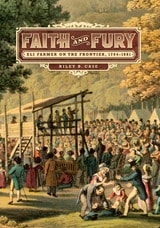
Faith and Fury
Eli Farmer on the Frontier, 1794–1881Riley B. Case
Indiana Historical Society Press, 2018
Some of America’s political and social identity today can be traced to the early frontier. After 1801 religion exploded across settlements in the Old Northwest and Kentucky. Not only were souls saved through camp meetings, but regular people also began applying the words “equal” and “independent” to themselves. The life of Eli P. Farmer, a circuit-riding preacher, politician, farmer, and businessman, is instructive. His autobiography includes accounts of Native Americans, brawls, flatboats, settlers, and revival meetings. Setting his story within the context of the Second Great Awakening, author Riley B. Case shows how Farmer’s life personified this religious movement, which gave birth to American evangelicalism, as well as values that would become idyllic to many Americans: self-sufficiency and individualism.
[more]
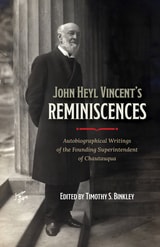
John Heyl Vincent's Reminiscences
Autobiographical Writings of the Founding Superintendent of ChautauquaTimothy S. Binkley
Bridwell Press, 2024
Chautauqua Institution co-founder Rev. John Heyl Vincent was a prolific writer on religion, education, and history. Among Vincent’s numerous published works were a few autobiographical writings. These essays describing family and personal history were forgotten soon after Vincent's death in 1920. More than a century later, thirty-three of his personal narratives have been gathered into a single volume. John Heyl Vincent’s Reminiscences invites readers to learn directly from Bishop Vincent about the experiences that shaped his life, his convictions, and the Chautauqua idea.
[more]
The Poisoned Chalice
Eucharistic Grape Juice and Common-Sense Realism in Victorian MethodismJennifer L. Woodruff Tait
University of Alabama Press, 2011
Examines the introduction of grape juice into the celebration of Holy Communion in the late 19th century Methodist Episcopal Church and reveals how a 1,800-year-old practice of using fermented communion wine became theologically incomprehensible in a mere forty years
This work examines the introduction of grape juice into the celebration of Holy Communion in the late 19th century Methodist Episcopal Church and reveals how a 1,800-year-old practice of using fermented communion wine became theologically incomprehensible in a mere forty years. Through study of denominational publications, influential exegetical works, popular fiction and songs, and didactic moral literature, Jennifer Woodruff Tait charts the development of opposing symbolic associations for wine and grape juice. She argues that 19th century Methodists, steeped in Baconian models of science and operating from epistemological presuppositions dictated by common-sense realism, placed a premium on the ability to perceive reality accurately in order to act morally. They therefore rejected any action or substance that dulled or confused the senses (in addition to alcohol, this included “bad” books, the theatre, stimulants, etc., which were all seen as unleashing unchecked, ungovernable thoughts and passions incompatible with true religion).
This work examines the introduction of grape juice into the celebration of Holy Communion in the late 19th century Methodist Episcopal Church and reveals how a 1,800-year-old practice of using fermented communion wine became theologically incomprehensible in a mere forty years. Through study of denominational publications, influential exegetical works, popular fiction and songs, and didactic moral literature, Jennifer Woodruff Tait charts the development of opposing symbolic associations for wine and grape juice. She argues that 19th century Methodists, steeped in Baconian models of science and operating from epistemological presuppositions dictated by common-sense realism, placed a premium on the ability to perceive reality accurately in order to act morally. They therefore rejected any action or substance that dulled or confused the senses (in addition to alcohol, this included “bad” books, the theatre, stimulants, etc., which were all seen as unleashing unchecked, ungovernable thoughts and passions incompatible with true religion).
This outlook informed Methodist opposition to many popular amusements and behaviors, and they decided to place on the communion table a substance scientifically and theologically pure. Grape juice was considered holy because it did not cloud the mind, and new techniques—developed by Methodist laymen Thomas and Charles Welch—permitted the safe bottling and shipment of the unfermented juice.
Although Methodists were not the only religious group to oppose communion wine, the experience of this broadly based and numerous denomination illuminates similar beliefs and actions by other groups.
[more]