Results by title
11 books match the query 'Metropolitan government'
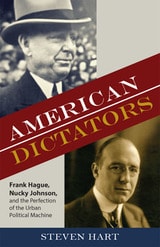
American Dictators
Frank Hague, Nucky Johnson, and the Perfection of the Urban Political MachineHart, Steven
Rutgers University Press, 2013
One man was tongue-tied and awkward around women, in many ways a mama's boy at heart, although his reputation for thuggery was well earned. The other was a playboy, full of easy charm and ready jokes, his appetite for high living a matter of public record. One man tolerated gangsters and bootleggers as long as they paid their dues to his organization. The other was effectively a gangster himself, so crooked that he hosted a national gathering of America's most ruthless killers. One man never drank alcohol. The other, from all evidence, seldom drank anything else.
American Dictators is the dual biography of two of America’s greatest political bosses: Frank Hagueand Enoch “Nucky” Johnson. Packed with compelling information and written in an informal, sometimes humorous style, the book shows Hague and Johnson at the peak of their power and the strength of their political machines during the years of Prohibition and the Great Depression. Steven Hart compares how both men used their influence to benefit and punish the local citizenry, amass huge personal fortunes, and sometimes collaborate to trounce their enemies.
Similar in their ruthlessness, both men were very different in appearance and temperament. Hague, the mayor of Jersey City, intimidated presidents and wielded unchallenged power for three decades. He never drank and was happily married to his wife for decades. He also allowed gangsters to run bootlegging and illegal gambling operations as long as they paid protection money. Johnson, the political boss of Atlantic City, and the inspiration for the hit HBO series Boardwalk Empire, presided over corruption as well, but for a shorter period of time. He was notorious for his decadent lifestyle. Essentially a gangster himself, Johnson hosted the infamous Atlantic City conference that fostered the growth of organized crime.
Both Hague and Johnson shrewdly integrated otherwise disenfranchised groups into their machines and gave them a stake in political power. Yet each failed to adapt to changing demographics and circumstances. In American Dictators, Hart paints a balanced portrait of their accomplishments and their failures.
Majoritarian Cities
Policy Making and Inequality in Urban PoliticsNeil Kraus
University of Michigan Press, 2013
Neil Kraus evaluates both the influence of public opinion on local policy-making and the extent to which public policy addresses economic and social inequalities. Drawing on several years of fieldwork and multiple sources of data, including surveys and polls; initiatives, referenda, and election results; government documents; focus groups; interviews; and a wide assortment of secondary sources, Kraus presents case studies of two Midwestern cities, Minneapolis, Minnesota, and Gary, Indiana. Specifically, he focuses on several major policy decisions in recent decades concerning education, law enforcement, and affordable housing in Minneapolis; and education and riverboat casino development in Gary.
Kraus finds that, on these issues, local officials frequently take action that reflects public opinion, yet the resulting policies often fail to meet the needs of the disadvantaged or ameliorate the effects of concentrated poverty. In light of citizens’ current attitudes, he concludes that if patterns of inequality are to be more effectively addressed, scholars and policymakers must transform the debate about the causes and effects of inequality in urban and metropolitan settings.
Metropolitan Governance
Different Paths in Contrasting Contexts: Germany and IsraelEdited by Hubert Heinelt, Eran Razin, and Karsten Zimmermann
Campus Verlag, 2011
As urban areas have grown and sprawl has spread in recent decades, metropolitan governments around the world have begun to look beyond city borders, establishing regional partnerships to help them deal with issues of transit, resource use, and more. Metropolitan Governance examines this trend through a close comparative study of seven metropolitan areas in Israel and Germany. While not neglecting the reasons behind these changes in governance, the authors pay particular attention to their effects on—and diminishing of—democratic participation and accountability.
Polycentricity and Local Public Economies
Readings from the Workshop in Political Theory and Policy AnalysisMichael D. McGinnis, Editor
University of Michigan Press, 1999
The study of metropolitan political economies in the United States has provided much of the intellectual inspiration for the research of the Workshop in Political Theory and Policy Analysis at Indiana University. The readings collected in Polycentricity and Local Public Economies present an overview of the results of this research program on police services and metropolitan governance as well as enduring lessons for institutional analysis and public policy. Polycentricity and Local Public Economies presents both explorations of broad general concepts and specific empirical analyses. The many interactions between the two modes of analysis provide valuable insights for the reader. Readings in the first section cover basic theoretical concepts and analytical distinctions that apply to the study of institutions generally. The second section includes conceptual pieces specifically addressed to the nature of governance in metropolitan areas, while section three reports on a series of empirical studies of police performance. Section four again broadens the focus to highlight the overall organization of local public economies. The final section discusses conceptual advances that have continuing relevance for research and policy debates.Contributors include William Blomquist, Kathryn Firmin-Sellers, Roy Gardner, Dele Olowu, Elinor Ostrom, Vincent Ostrom, Amos Sawyer, Edella Schlager, Shui Yan Tang, Wai Fung Lam, and James S. Wunsch.
Private Metropolis
The Eclipse of Local Democratic GovernanceDennis R. Judd
University of Minnesota Press, 2021
Examines the complex ecology of quasi-public and privatized institutions that mobilize and administer many of the political, administrative, and fiscal resources of today’s metropolitan regions
In recent decades metropolitan regions in the United States have witnessed the rise of multitudes of “shadow governments” that often supersede or replace functions traditionally associated with municipalities and other local governments inherited from the urban past. Shadow governments take many forms, ranging from billion-dollar special authorities that span entire urban regions, to public–private partnerships and special districts created to accomplish particular tasks, to privatized gated communities, to neighborhood organizations empowered to receive private and public funds. They finance and administer public services ranging from the prosaic (garbage collection and water utilities) to the transformative (economic development and infrastructure). Private Metropolis demonstrates that this complex ecosystem of local governance has compromised and even eclipsed democratic processes by moving important policy decisions out of public sight.
The quasi-public institutions of urban governance generally escape the budgetary and statutory restraints imposed on traditional local governments and protect policy decisions from the limitations and vagaries of electoral politics. Moving major policy decisions into a privatized and corporatized realm facilitates efficiency and speed, but at the cost of democratic oversight. Increasingly, the urban electorate is left debating symbolic issues only tangentially connected to the actual distribution of the resources that affect people’s lives.
The essays in Private Metropolis grapple with the difficult and timely questions that arise from this new ecology of governance: What are the consequences of the proliferation of special authorities, privatized governments, and public–private arrangements? Is the trade-off between democratic accountability and efficiency worth it? Has the public sector, with its messiness and inefficiencies—but also its checks and balances—ceded too much power to these new institutions? By examining such questions, this book provokes a long-overdue debate about the future of urban governance.
Contributors: Douglas Cantor, California State U, Long Beach; Ellen Dannin, Pennsylvania State U; Jameson W. Doig, Princeton U; Mary Donoghue; Peter Eisinger, New School; Steven P. Erie, U of California, San Diego; Rebecca Hendrick, U of Illinois at Chicago; Sara Hinkley, U of California, Berkeley; Amanda Kass, U of Illinois at Chicago; Scott A. MacKenzie, U of California, Davis; David C. Perry, U of Illinois at Chicago; James M. Smith, U of Indiana South Bend; Shu Wang, Michigan State U; Rachel Weber, U of Illinois at Chicago.
Regional Governance and the Politics of Housing in the San Francisco Bay Area
Paul G. Lewis and Nicholas J. Marantz
Temple University Press, 2023
The authors evaluate six potential reforms, arguing that targeted changes to local and regional institutions could generate durable improvements to the region’s housing opportunities. The main lesson from the case of the San Francisco Bay Area is the need to focus on governance when addressing the housing challenge. As the authors effectively illustrate, leaving a solution up to individual cities is unlikely to lead to increased housing supply.
Struggling Giants
City-Region Governance in London, New York, Paris, and TokyoPaul Kantor
University of Minnesota Press, 2012
Throughout the past thirty years a small number of city-regions have achieved unprecedented global status in the world economy while undergoing radical changes. Struggling Giants examines the transformation of four of the most significant metropolises: London, New York, Paris, and Tokyo. This volume analyzes the thorniest issues these sprawling city-regions have faced, including ameliorating social problems through public policies, the effect of globalization on local governance, and the relationships between local, regional, and national institutions.
Three critical themes frame Struggling Giants. The first is the continuing struggle for governability in the midst of regional governmental fragmentation. The second theme is how the city-regions fight to manage powerful political biases. Policy-making is often selective, the authors find, and governments are more responsive to economic exigencies than to social or environmental needs. Finally, these city-regions are shown to be strong economic leaders in part because they are able to change—although the authors reveal that pragmatism and piecemeal policy solutions can still prevail.

The City, Revisited
Urban Theory from Chicago, Los Angeles, and New YorkDennis R. Judd
University of Minnesota Press, 2011
Contributors: Janet Abu-Lughod, Northwestern U and New School for Social Research; Robert Beauregard, Columbia U; Larry Bennett, DePaul U; Andrew A. Beveridge, Queens College and CUNY; Amy Bridges, U of California, San Diego; Terry Nichols Clark, U of Chicago; Nicholas Dahmann, U of Southern California; Michael Dear, U of California, Berkeley; Steven P. Erie, U of California, San Diego; Frank Gaffikin, Queen's U of Belfast; David Halle, U of California, Los Angeles; Tom Kelly, U of Illinois at Chicago; Ratoola Kunda, U of Illinois at Chicago; Scott A. MacKenzie, U of California, Davis; John Mollenkopf, CUNY; David C. Perry, U of Illinois at Chicago; Francisco Sabatini, Ponticia Universidad Catolica de Chile; Rodrigo Salcedo, Pontificia Universidad Catolica de Santiago; Dick Simpson, U of Illinois at Chicago; Daphne Spain, U of Virginia; Costas Spirou, National-Louis U in Chicago.

The New Metropolis
Power, Place, and Inequality in Twenty-First-Century AmericaMargaret Weir
University of Chicago Press, 2027
A path-breaking investigation of changing patterns of inequality and contestation in America’s metropolises.
Since 1990, a new political geography of winners and losers has emerged in metros across America. This new metropolis looks nothing like the old. In many exurbs, suburban mansions abut declining towns and distressed communities. In historic central cities, African American communities reel from institutional stripping, even as gentrification and immigration revitalize once forgotten neighborhoods. The New Metropolis considers why, despite all the changes over the past four decades, we have recreated a metropolis that makes it harder for low-income Americans—especially low-income Americans of color—to thrive and why some efforts to promote equitable opportunity succeed against the odds.
With a focus on Chicago, Atlanta, and Houston, The New Metropolis shows how multi-level political actors and translocal networks build power across political boundaries to determine the pool of local public resources and the scope of local powers. Weir demonstrates how the timing of urbanization set up distinct conflicts over the public sector in Frostbelt versus Sunbelt metropolises, explaining how partisan divisions now supercharge these conflicts.
The New Metropolis shows why the battle over the metropolis sits at the center of American politics. It determines the shape of the public arenas where we make decisions and, ultimately, the kinds of connections Americans have with one another.
The Roots of Latino Urban Agency
Sharon A. Navarro
University of North Texas Press, 2013
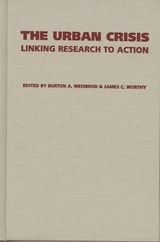
The Urban Crisis
Linking Research to ActionBurton Weisbrod and James C. Worthy
Northwestern University Press, 1997