Results by title
157 books match the query 'Mexican-American Border Region' and 4 start with a
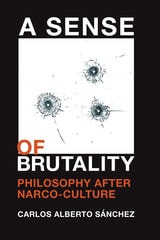
A Sense of Brutality
Philosophy after Narco-CultureCarlos Alberto Sánchez
Amherst College Press, 2020
Contemporary popular culture is riddled with references to Mexican drug cartels, narcos, and drug trafficking. In the United States, documentary filmmakers, journalists, academics, and politicians have taken note of the increasing threats to our security coming from a subculture that appears to feed on murder and brutality while being fed by a romanticism about power and capital. Carlos Alberto Sánchez uses Mexican narco-culture as a point of departure for thinking about the nature and limits of violence, culture, and personhood. A Sense of Brutality argues that violent cultural modalities, of which narco-culture is but one, call into question our understanding of “violence” as a concept. The reality of narco-violence suggests that “violence” itself is insufficient to capture it, that we need to redeploy and reconceptualize “brutality” as a concept that better captures this reality. Brutality is more than violence, other to cruelty, and distinct from horror and terror—all concepts that are normally used interchangeably with brutality, but which, as the analysis suggests, ought not to be. In narco-culture, the normalization of brutality into everyday life is a condition upon which the absolute erasure or derealization of people is made possible.
"The study is original, bringing a wide range of voices into dialogue to present a problem that is pressing and deserving of careful analysis. The study will contribute to the field of Latin American philosophy in important ways... This is the only book by a philosopher on the topic of narco-culture, and I think it’s an important contribution to a topic that should be addressed by philosophers." —Elizabeth Millán, DePaul University
"The study is original, bringing a wide range of voices into dialogue to present a problem that is pressing and deserving of careful analysis. The study will contribute to the field of Latin American philosophy in important ways... This is the only book by a philosopher on the topic of narco-culture, and I think it’s an important contribution to a topic that should be addressed by philosophers." —Elizabeth Millán, DePaul University
[more]

A War that Can’t Be Won
Binational Perspectives on the War on DrugsEdited by Tony Payan, Kathleen Staudt, and Z. Anthony Kruszewski
University of Arizona Press, 2013
More than forty years have passed since President Richard Nixon described illegal drugs as “public enemy number one” and declared a “War on Drugs.” Recently the United Nations Global Commission on Drug Policy declared that “the global war on drugs has failed with devastating consequences for individuals and societies around the world.” Arguably, no other country has suffered as much from the War on Drugs as Mexico. From 2006 to 2012 alone, at least sixty thousand people have died. Some experts have said that the actual number is more than one hundred thousand. Because the war was conceived and structured by US policymakers and officials, many commentators believe that the United States is deeply implicated in the bloodshed.
A War that Can’t Be Won is the first book to include contributions from scholars on both sides of the US–Mexico border. It provides a unique breadth of perspective on the many dimensions of the societal crisis that affects residents of both nations—particularly those who live and work in the borderlands. It also proposes practical steps toward solving a crisis that shows no signs of abating under current policies. Each chapter is based on well-documented data, including previously unavailable evidence that was obtained through freedom-of-information inquiries in Mexico. By bringing together views from both sides of the border, as well as from various academic disciplines, this volume offers a much wider view of a complex problem—and possible solutions.
A War that Can’t Be Won is the first book to include contributions from scholars on both sides of the US–Mexico border. It provides a unique breadth of perspective on the many dimensions of the societal crisis that affects residents of both nations—particularly those who live and work in the borderlands. It also proposes practical steps toward solving a crisis that shows no signs of abating under current policies. Each chapter is based on well-documented data, including previously unavailable evidence that was obtained through freedom-of-information inquiries in Mexico. By bringing together views from both sides of the border, as well as from various academic disciplines, this volume offers a much wider view of a complex problem—and possible solutions.
[more]
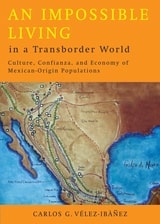
An Impossible Living in a Transborder World
Culture, Confianza, and Economy of Mexican-Origin PopulationsCarlos G. Vélez-Ibáñez
University of Arizona Press, 2010
They are known as cundinas or tandas in Mexico, and for many people these local savings-and-loan operations play an indispensable role in the struggle to succeed in today’s transborder economy. With this extensively researched book, Carlos Vélez-Ibáñez updates and expands upon his major 1983 study of rotating savings and credit associations (ROSCAs), incorporating new data that reflect the explosion of Mexican-origin populations in the United States. Much more than a study of one economic phenomenon though, the book examines the way in which these practices are part of greater transnational economies and how these populations engage in—and suffer through—the twenty-first century global economy.
Central to the ROSCA is the cultural concept of mutual trust, or confianza. This is the cultural glue that holds the reciprocal relationship together. As Vélez-Ibáñez explains, confianza “shapes the expectations for relationships within broad networks of interpersonal links, in which intimacies, favors, goods, services, emotion, power, or information are exchanged.” In a border region where migration, class movement, economic changes, and institutional inaccessibility produce a great deal of uncertainty, Mexican-origin populations rely on confianza and ROSCAs to maintain a sense of security in daily life. How do transborder people adapt these common practices to meet the demands of a global economy? That is precisely what Vélez-Ibáñez investigates.
Central to the ROSCA is the cultural concept of mutual trust, or confianza. This is the cultural glue that holds the reciprocal relationship together. As Vélez-Ibáñez explains, confianza “shapes the expectations for relationships within broad networks of interpersonal links, in which intimacies, favors, goods, services, emotion, power, or information are exchanged.” In a border region where migration, class movement, economic changes, and institutional inaccessibility produce a great deal of uncertainty, Mexican-origin populations rely on confianza and ROSCAs to maintain a sense of security in daily life. How do transborder people adapt these common practices to meet the demands of a global economy? That is precisely what Vélez-Ibáñez investigates.
[more]

Archiving Mexican Masculinities in Diaspora
Nicole M. Guidotti-Hernández
Duke University Press, 2021
In Archiving Mexican Masculinities in Diaspora, Nicole M. Guidotti-Hernández challenges machismo—a shorthand for racialized and heteronormative Latinx men's misogyny—with nuanced portraits of Mexican men and masculinities along and across the US-Mexico border. Guidotti-Hernández foregrounds Mexican men's emotional vulnerabilities and intimacies in their diasporic communities. Highlighting how Enrique Flores Magón, an anarchist political leader and journalist, upended gender norms through sentimentality and emotional vulnerability that he performed publicly and expressed privately, Guidotti-Hernández documents compelling continuities between his expressions and those of men enrolled in the Bracero program. Braceros—more than 4.5 million Mexican men who traveled to the United States to work in temporary agricultural jobs from 1942 to 1964—forged domesticity and intimacy, sharing affection but also physical violence. Through these case studies that reexamine the diasporic male private sphere, Guidotti-Hernández formulates a theory of transnational Mexican masculinities rooted in emotional and physical intimacy that emerged from the experiences of being racial, political, and social outsiders in the United States.
[more]