Results by title
2 books match the query 'Mezey, Naomi'
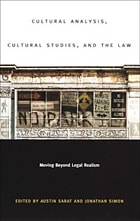
Cultural Analysis, Cultural Studies, and the Law
Moving Beyond Legal RealismAustin Sarat and Jonathan Simon, eds.
Duke University Press, 2003
Drawing on legal scholarship, literary criticism, psychoanalytic theory, and anthropology, the essays collected here exemplify the contributions cultural analysis and cultural studies make to interdisciplinary legal study. Some of these broad-ranging pieces describe particular approaches to the cultural study of the law, while others look at specific moments where the law and culture intersect. Contributors confront the deep connections between law, social science, and post-World War II American liberalism; examine the traffic between legal and late-nineteenth- and early-twentieth-century scientific discourses; and investigate, through a focus on recovered memory, the ways psychotherapy is absorbed into the law. The essayists also explore specific moments where the law is forced to comprehend the world beyond its boundaries, illuminating its dependence on a series of unacknowledged aesthetic, psychological, and cultural assumptions—as in Aldolph Eichmann’s 1957 trial, hiv-related cases, and the U.S. Supreme Court’s recent efforts to define the role of race in the construction of constitutionally adequate voting districts.
Contributors. Paul Berman, Peter Brooks, Wai Chee Dimock, Anthony Farley, Shoshanna Felman, Carol Greenhouse, Paul Kahn, Naomi Mezey, Tobey Miller, Austin Sarat, Jonathan Simon, Alison Young
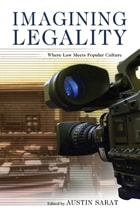
Imagining Legality
Where Law Meets Popular CultureAustin Sarat
University of Alabama Press, 2011
Imagining Legality argues that images of law suggested by television and film are as numerous as they are various, and that they give rise to a potent and pervasive imaginative life of the law. The media’s projections of the legal system remind us not only of the way law lives in our imagination but also of the contingencies of our own legal and social arrangements.
Contributors to Imagining Legality are less interested in the accuracy of the portrayals of law in film and television than in exploring the conditions of law’s representation, circulation, and consumption in those media. In the same way that legal scholars have taken on the disciplinary perspectives of history, economics, sociology, anthropology, and psychology in relation to the law, these writers bring historical, sociological, and cultural analysis, as well as legal theory, to aid in the understanding of law and popular culture.