Results by title
6 books match the query 'Michelangelo Buonarroti'
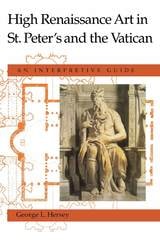
High Renaissance Art in St. Peter's and the Vatican
An Interpretive GuideGeorge L. Hersey
University of Chicago Press, 1993
Michelangelo, Raphael, Bramante—together these artists created some of the most glorious treasures of the Vatican, viewed daily by thousands of tourists. But how many visitors understand the way these artworks reflect the passions, dreams, and struggles of the popes who commissioned them? For anyone making an artistic pilgrimage to the High Renaissance splendors of the Vatican, George L. Hersey's book is the ideal guide.
Before starting the tour of individual works, Hersey describes how the treacherously shifting political and religious alliances of sixteenth-century Italy, France, and Spain played themselves out in the Eternal City. He offers vivid accounts of the lives and personalities of four popes, each a great patron of art and architecture: Julius II, Leo X, Clement VII, and Paul III. He also tells of the complicated rebuilding and expanding of St. Peter's, a project in which Bramante, Raphael, and Michelangelo all took part.
Having set the historical scene, Hersey then explores the Vatican's magnificent Renaissance art and architecture. In separate chapters, organized spatially, he leads the reader through the Cortile del Belvedere and Vatican Museums, with their impressive holdings of statuary and paintings; the richly decorated Stanze and Logge of Raphael; and Michelangelo's Last Judgment and newly cleaned Sistine Chapel ceiling. A fascinating final chapter entitled "The Tragedy of the Tomb" recounts the vicissitudes of Michelangelo's projected funeral monument to Julius II.
Hersey is never content to simply identify the subject of a painting or sculpture. He gives us the story behind the works, telling us what their particular themes signified at the time for the artist, the papacy, and the Church. He also indicates how the art was received by contemporaries and viewed by later generations.
Generously illustrated and complete with a useful chronology, High Renaissance Art in St. Peter's and the Vatican is a valuable reference for any traveler to Rome or lover of Italian art who has yearned for a single-volume work more informative and stimulating than ordinary guidebooks. At the same time, Hersey's many anecdotes and intriguing comparisons with works outside the Vatican will provide new insights even for specialists.
[more]
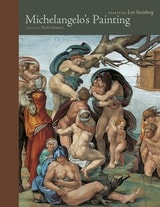
Michelangelo's Painting
Selected EssaysLeo Steinberg
University of Chicago Press, 2019
Leo Steinberg was one of the most original art historians of the twentieth century, known for taking interpretive risks that challenged the profession by overturning reigning orthodoxies. In essays and lectures ranging from old masters to contemporary art, he combined scholarly erudition with an eloquent prose that illuminated his subject and a credo that privileged the visual evidence of the image over the literature written about it. His writings, sometimes provocative and controversial, remain vital and influential reading.
For half a century, Steinberg delved into Michelangelo’s work, revealing the symbolic structures underlying the artist’s highly charged idiom. This volume of essays and unpublished lectures elucidates many of Michelangelo’s paintings, from frescoes in the Sistine Chapel to the Conversion of St. Paul and the Crucifixion of St. Peter, the artist’s lesser-known works in the Vatican’s Pauline Chapel; also included is a study of the relationship of the Doni Madonna to Leonardo.
Steinberg’s perceptions evolved from long, hard looking. Almost everything he wrote included passages of old-fashioned formal analysis, but always put into the service of interpretation. He understood that Michelangelo’s rendering of figures, as well as their gestures and interrelations, conveys an emblematic significance masquerading under the guise of naturalism. Michelangelo pushed Renaissance naturalism into the furthest reaches of metaphor, using the language of the body to express fundamental Christian tenets once expressible only by poets and preachers.
Leo Steinberg was one of the most original art historians of the twentieth century, known for taking interpretive risks that challenged the profession by overturning reigning orthodoxies. Michelangelo’s Painting is the second volume in a series that presents Steinberg’s writings, selected and edited by his longtime associate Sheila Schwartz.
[more]
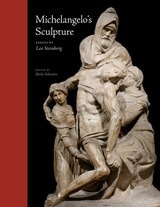
Michelangelo’s Sculpture
Selected EssaysLeo Steinberg
University of Chicago Press, 2018
Leo Steinberg was one of the most original and daring art historians of the twentieth century, known for taking interpretative risks that challenged the profession by overturning reigning orthodoxies. In essays and lectures that ranged from old masters to contemporary art, he combined scholarly erudition with an eloquent prose that illuminated his subject and a credo that privileged the visual evidence of the image over the literature written about it. His works, sometimes provocative and controversial, remain vital and influential reading.
For half a century, Steinberg delved into Michelangelo’s work, revealing the symbolic structures underlying the artist’s highly charged idiom. This volume of essays and unpublished lectures explicates many of Michelangelo’s most celebrated sculptures, applying principles gleaned from long, hard looking. Almost everything Steinberg wrote included passages of old-fashioned formal analysis, but here put to the service of interpretation. He understood that Michelangelo’s rendering of figures as well as their gestures and interrelations conveys an emblematic significance masquerading under the guise of naturalism. Michelangelo pushed Renaissance naturalism into the furthest reaches of metaphor, using the language of the body and its actions to express fundamental Christian tenets once expressible only by poets and preachers—or, as Steinberg put it, in Michelangelo’s art, “anatomy becomes theology.”
Michelangelo’s Sculpture is the first in a series of volumes of Steinberg’s selected writings and unpublished lectures, edited by his longtime associate Sheila Schwartz. The volume also includes a book review debunking psychoanalytic interpretation of the master’s work, a light-hearted look at Michelangelo and the medical profession and, finally, the shortest piece Steinberg ever published.
[more]
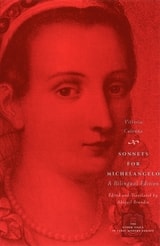
Sonnets for Michelangelo
A Bilingual EditionVittoria Colonna
University of Chicago Press, 2005
The most published and lauded woman writer of early sixteenth-century Italy, Vittoria Colonna (1490–1547) in effect defined what was the "acceptable" face of female authorship for her time. Hailed by the generation's leading male literati as an equal, she was praised both for her impeccable command of Petrarchan style and for the unimpeachable chastity and piety of the persona she promoted through her literary works.
This book presents for the very first time a body of Colonna's verse that reveals much about her poetic aims and outlook, while also casting new light on one of the most famous friendships of the age. Sonnets for Michelangelo, originally presented in manuscript form to her close friend Michelangelo Buonarroti as a personal gift, illustrates the striking beauty and originality of Colonna's mature lyric voice and distinguishes her as a poetic innovator who would be widely imitated by female writers in Italy and Europe in the sixteenth century. After three centuries of relative neglect, this new edition promises to restore Colonna to her rightful place at the forefront of female cultural production in the Renaissance.
This book presents for the very first time a body of Colonna's verse that reveals much about her poetic aims and outlook, while also casting new light on one of the most famous friendships of the age. Sonnets for Michelangelo, originally presented in manuscript form to her close friend Michelangelo Buonarroti as a personal gift, illustrates the striking beauty and originality of Colonna's mature lyric voice and distinguishes her as a poetic innovator who would be widely imitated by female writers in Italy and Europe in the sixteenth century. After three centuries of relative neglect, this new edition promises to restore Colonna to her rightful place at the forefront of female cultural production in the Renaissance.
[more]
The Architecture of Michelangelo
James S. Ackerman
University of Chicago Press, 1986
In this widely acclaimed work, James Ackerman considers in detail the buildings designed by Michelangelo in Florence and Rome—including the Medici Chapel, the Farnese Palace, the Basilica of St. Peter, and the Capitoline Hill. He then turns to an examination of the artist's architectural drawings, theory, and practice. As Ackerman points out, Michelangelo worked on many projects started or completed by other architects. Consequently this study provides insights into the achievements of the whole profession during the sixteenth century. The text is supplemented with 140 black-and-white illustrations and is followed by a scholarly catalog of Michelangelo's buildings that discusses chronology, authorship, and condition. For this second edition, Ackerman has made extensive revisions in the catalog to encompass new material that has been published on the subject since 1970.
[more]
The Vanishing
Shakespeare, the Subject, and Early Modern CultureChristopher Pye
Duke University Press, 2000
In The Vanishing Christopher Pye combines psychoanalytic and cultural theory to advance an innovative interpretation of Renaissance history and subjectivity. Locating the emergence of the modern subject in the era’s transition from feudalism to a modern societal state, Pye supports his argument with interpretations of diverse cultural and literary phenomena, including Shakespeare’s Hamlet and King Lear, witchcraft and demonism, anatomy theaters, and the paintings of Michelangelo.
Pye explores the emergence of the early modern subject in terms of a range of subjectivizing mechanisms tied to the birth of a modern conception of history, one that is structured around a spatial and temporal horizon—a vanishing point. He also discusses the distinctly economic character of early modern subjectivity and how this, too, is implicated in our own modern modes of historical understanding. After explaining how the aims of New Historicist and Foucauldian approaches to the Renaissance are inseparably linked to such a historical conception, Pye demonstrates how the early modern subject can be understood in terms of a Lacanian and Zizekian account of the emerging social sphere. By focusing on the Renaissance as a period of remarkable artistic and cultural production, he is able to illustrate his points with discussions of a number of uniquely fascinating topics—for instance, how demonism was intimately related to a significant shift in law and symbolic order and how there existed at the time a “demonic” preoccupation with certain erotic dimensions of the emergent social subject.
Highly sophisticated and elegantly crafted, The Vanishing will be of interest to students of Shakespeare and early modern culture, Renaissance visual art, and cultural and psychoanalytic theory.
[more]