Results by title
4 books match the query 'Michoacán'
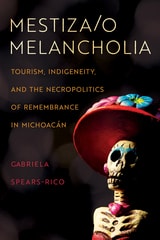
Mestiza/o Melancholia
Tourism, Indigeneity, and the Necropolitics of Remembrance in MichoacánGabriela Spears-Rico
University of Arizona Press, 2027
Through the concept of mestiza/o melancholia, scholar Gabriela Spears-Rico offers a new way to think about the relationship between mestizaje and indigeneity in Mexico. For Spears-Rico, the concept is a longing for the lost part of one’s identity, manifested in touristic visits and material appropriations of folklorized indigeneity, yet unconcerned with political reparations for Indigenous people.
Relying on a rich ethnography in mestiza/o and P’urhépecha pueblos in Michoacán, the book examines mestiza/o mourning and melancholia as it appears in Day of the Dead tourism and in Virgin of Guadalupe worship among Mexican mestizos. This book centers Indigenous resistance, articulating a P’urhépecha critique of regional necropolitics and obstinate appropriations, arguing for the need to decolonize mestizaje. A deep conversation with P’urhépecha dissent, this book elevates the need for solidarity with current Indigenous movements in a region fraught by extractive settler colonialism.
Mestiza/o Melancholia challenges readers to rethink identity, tourism, and belonging in Mexico.
Michoacán and Eden
Vasco de Quiroga and the Evangelization of Western MexicoBy Bernardino Verástique
University of Texas Press, 2000
Don Vasco de Quiroga (1470-1565) was the first bishop of Michoacán in Western Mexico. Driven by the desire to convert the native Purhépecha-Chichimec peoples to a purified form of Christianity, free of the corruptions of European Catholicism, he sought to establish New World Edens in Michoacán by congregating the people into pueblo-hospital communities, where mendicant friars could more easily teach them the fundamental beliefs of Christianity and the values of Spanish culture.
In this broadly synthetic study, Bernardino Verástique explores Vasco de Quiroga's evangelizing project in its full cultural and historical context. He begins by recreating the complex and not wholly incompatible worldviews of the Purhépecha and the Spaniards at the time of their first encounter in 1521. With Quiroga as a focal point, Verástique then traces the uneasy process of assimilation and resistance that occurred on both sides as the Spaniards established political and religious dominance in Michoacán. He describes the syncretisms, or fusions, between Christianity and indigenous beliefs and practices that arose among the Purhépecha and relates these to similar developments in other regions of Mexico.
Written especially for students and general readers, this book demonstrates how cultural and geographical environments influence religious experience, while it adds to our understanding of the process of indigenous appropriation of Christian theological concepts in the New World.
The Anatomy of Eleven Towns in Michoacán
By Dan Stanislawski
University of Texas Press, 1950
In this book, Dan Stanislawski studies the geography of various small towns in one Mexican state. He discusses the factors—landscape, buildings, culture groups, and so forth—that create a unique personality for each of these towns.
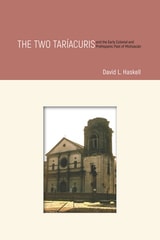
The Two Taríacuris and the Early Colonial and Prehispanic Past of Michoacán
David L. Haskell
University Press of Colorado, 2018
Informed by theoretical approaches to narrative, historicity, structure, and agency developed by cultural and historical anthropologists, Haskell demonstrates that the author of the Relación de Michoacán shaped, and was shaped by, a culturally distinct conceptualization and experience of the time in which the past and the present are mutually informing. The book asks, How reliable are past accounts of events when these accounts are removed from the events they describe? How do the personal agendas of past chroniclers and their informants shape our present understanding of their cultural history? How do we interpret chronicles such as the Relación de Michoacán on multiple levels? It also demonstrates that answers to these questions are possible when attention is paid to the context of narrative production and the narratives themselves are read closely.
The Two Taríacuris and the Early Colonial and Prehispanic Past of Michoacán makes a significant contribution to the scholarship on indigenous experience and its cultural manifestations in Early Colonial period Central Mexico and the anthropological literature on historicity and narrative. It will be of interest to Mesoamerican specialists of all disciplines, cultural and historical anthropologists, and theorists and critics of narrative.