Results by title
6 books match the query 'Middle Ages (449-1066)'
Arts of Dying
Literature and Finitude in Medieval EnglandD. Vance Smith
University of Chicago Press, 2020
People in the Middle Ages had chantry chapels, mortuary rolls, the daily observance of the Office of the Dead, and even purgatory—but they were still unable to talk about death. Their inability wasn’t due to religion, but philosophy: saying someone is dead is nonsense, as the person no longer is. The one thing that can talk about something that is not, as D. Vance Smith shows in this innovative, provocative book, is literature.
Covering the emergence of English literature from the Old English to the late medieval periods, Arts of Dying argues that the problem of how to designate death produced a long tradition of literature about dying, which continues in the work of Heidegger, Blanchot, and Gillian Rose. Philosophy’s attempt to designate death’s impossibility is part of a literature that imagines a relationship with death, a literature that intensively and self-reflexively supposes that its very terms might solve the problem of the termination of life. A lyrical and elegiac exploration that combines medieval work on the philosophy of language with contemporary theorizing on death and dying, Arts of Dying is an important contribution to medieval studies, literary criticism, phenomenology, and continental philosophy.
Covering the emergence of English literature from the Old English to the late medieval periods, Arts of Dying argues that the problem of how to designate death produced a long tradition of literature about dying, which continues in the work of Heidegger, Blanchot, and Gillian Rose. Philosophy’s attempt to designate death’s impossibility is part of a literature that imagines a relationship with death, a literature that intensively and self-reflexively supposes that its very terms might solve the problem of the termination of life. A lyrical and elegiac exploration that combines medieval work on the philosophy of language with contemporary theorizing on death and dying, Arts of Dying is an important contribution to medieval studies, literary criticism, phenomenology, and continental philosophy.
[more]
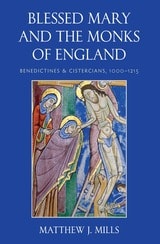
Blessed Mary and the Monks of England, 1000-1215
Matthew J. Mills
Catholic University of America Press, 2024
In the study of historical Mariology, the monastic communities of England before and after the Norman conquest receive too little attention. Classic surveys, such as Hilda Graef’s, Mary: A History of Doctrine and Devotion (2 vols, orig. 1963, 1965), highlight key figures and developments; and a fine book by Mary Clayton, The Cult of the Virgin Mary in Anglo-Saxon England (1990), takes scholarship as far as the early-eleventh century. The present volume, building upon such works, delves more deeply into the prayerful, intellectual and artistic contemplation of Mary during the age of monasticism, roughly the two hundred years prior to the advent of the mendicant orders in the thirteenth century. In the history of England, this was a time of high drama: conquest, power struggle, martyrdom; for English monasticism, it was marked by suppression, reform and renewal, patronage, and new currents of prayer and thought. Against this backdrop, Matthew Mills uncovers many vibrant contributions to Marian doctrine and devotion by theologians and communities living according to the sixth-century Rule of St Benedict: the Benedictines and their successors, the Cistercians, who arrived in England in 1128. In a thematic unfolding of Mary’s life and identity, from conception to assumption and intercession, a picture emerges of a Mariology shaped by the constant of monastic liturgy, anchored in deep biblical and patristic wisdom, cherished and transmitted by the Englishman, St Bede (d. 735), and animated by profound love. Towering figures, St Anselm (d. 1109) and St Ælred (d. 1167), are placed within a wider landscape, alongside lesser-known but still significant individuals, including the Cistercian abbot, John of Forde (d. 1214), royal confessor and pioneer of Marian exegesis of the Song of Songs. England’s monastic Mariology was colored by Greek as well as Latin influences and touched by key experiences of the contemporary church at large: apocalyptic disappointment, eleventh-century reform (sometimes called, ‘Gregorian’), sacramentalism, intense yearning for salvation. This book also sheds light upon the significance of Mary for medieval monks’ understanding of their own profession; their mother and their lady, she was, in addition, their icon and exemplar of life in St Benedict’s ‘school for the Lord’s service’ (Rule, Prol. 45).
[more]
Cardinal Newman in His Age
His Place in English Theology and LiteratureHarold L. Weatherby
Vanderbilt University Press, 1973
An examination of Cardinal Newman
[more]

Gender in medieval places, spaces and thresholds
Edited by Victoria Blud, Diane Heath, and Einat Klafter
University of London Press, 2019
This collection addresses the concept of gender in the middle ages through the study of place and space, exploring how gender and space may be mutually constructive and how individuals and communities make and are made by the places and spaces they inhabit. From womb to tomb, how are we defined and confined by gender and by space? Interrogating the thresholds between sacred and secular, public and private, enclosure and exposure, domestic and political, movement and stasis, the essays in this interdisciplinary collection draw on current research and contemporary theory to suggest new destinations for future study.
[more]
Joseph of Arimathea
Glyn S. Lewis
Westholme Publishing, 2017
Exploring the legend of the man who brought Christianity to the British Isles
“This author testifieth Joseph of Arimathea to be the first preacher of the word of God within our realms. Long after that, when Austin came from Rome, this our realm had bishops and priests there-in, as is well known to the learned of our realm.”—Elizabeth I, in a 1559 letter to Roman Catholic bishops on the precedence of the Church of England
The name Joseph of Arimathea is generally well known, either from the accounts in each of the New Testament Gospels that tell of his providing a tomb for the burial of Jesus; from his depictions in medieval and Renaissance art; from his associations with the Holy Grail that later found greater expression in medieval Arthurian stories; and even from the story that has endured in western Britain that as a trader in tin, copper, and lead, he had traveled often to the region—and with him came the Christian religion. These stories are strongly rooted, despite the lack of impeccable source material—so much so that Elizabeth I used Joseph of Arimathea as proof that the Church of England predated the Catholic church in her country. In Joseph of Arimathea Glyn S. Lewis brings these fragments together in order to provide as fully as is possible what we can infer about this first-century apostle.
The author first discusses Arimathea, a town that has yet to be positively identified. He then reviews the accounts of Joseph’s entombment of Jesus that appear in each of the four Gospels. From these earliest references, the author next consults the literary and oral tradition evidence of Joseph’s passage by ship to the south of France among a group of fugitives escaping persecution for being Christians, and his early visits to Britain as a trader in precious ores. These voyages are said to have brought him to the area around Glastonbury, which became a flourishing monastery in the Middle Ages. Whether or not Joseph of Arimathea visited Britain, his story remains an enthralling and fascinating mystery.
[more]
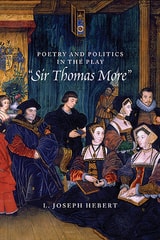
Poetry and Politics in the Play Sir Thomas More
L. Joseph Hebert
Catholic University of America Press, 2026
If ever a play had something to say about the art of statesmanship, that play is Sir Thomas More. Its origins and authorship shrouded in mystery, the manuscript was likely written and revised between 1593 and 1604. This carefully crafted and dramatically compelling work pays tribute to a man eminent in philosophy and literature as well as politics, whose brilliant career and violent death revolved around controversies relevant to the turbulent transformations of the Tudor age, and to the subsequent development of modern government and society.
Known then and now as "a man for all seasons," More was an accomplished poet, rhetorician, lawyer, diplomat, member of parliament and speaker of the House of Commons, a legal and political advisor to the city of London and King Henry VIII, and finally Chancellor of England. Having established a reputation for moral integrity, fervent piety, and vigorous opposition to both corruption and misguided attempts at reform, More saw his public career come to an abrupt end when he refused to recognize Henry as head of the English Church. In the generations that followed his trial and execution for "high treason," More was hailed by many as a man of wisdom, courage, and good faith-indeed, as "a blessed and happy martyr,"-even as the regime whose foundations he opposed continued to insist upon his error, guilt, and folly.
Under the watchful eye of an Elizabethan censor, Sir Thomas More explores questions of profound philosophic and historic significance-questions that remained politically explosive at the time, and that continue to divide authors and audiences today. This book is the first to offer a comprehensive reading of the political and philosophical currents informing the play, including scene by scene summaries of the drama and clarifying synopses of sources referenced in the commentary.
[more]