Results by title
2 books match the query 'Middle Border'
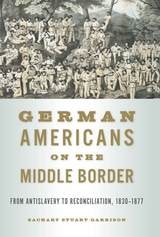
German Americans on the Middle Border
From Antislavery to Reconciliation, 1830–1877Zachary Stuart Garrison
Southern Illinois University Press, 2020
Before the Civil War, Northern, Southern, and Western political cultures crashed together on the middle border, where the Ohio, Mississippi, and Missouri Rivers meet. German Americans who settled in the region took an antislavery stance, asserting a liberal nationalist philosophy rooted in their revolutionary experience in Europe that emphasized individual rights and freedoms. By contextualizing German Americans in their European past and exploring their ideological formation in failed nationalist revolutions, Zachary Stuart Garrison adds nuance and complexity to their story.
Liberal German immigrants, having escaped the European aristocracy who undermined their revolution and the formation of a free nation, viewed slaveholders as a specter of European feudalism. During the antebellum years, many liberal German Americans feared slavery would inhibit westward progress, and so they embraced the Free Soil and Free Labor movements and the new Republican Party. Most joined the Union ranks during the Civil War.
After the war, in a region largely opposed to black citizenship and Radical Republican rule, German Americans were seen as dangerous outsiders. Facing a conservative resurgence, liberal German Republicans employed the same line of reasoning they had once used to justify emancipation: A united nation required the end of both federal occupation in the South and special protections for African Americans. Having played a role in securing the Union, Germans largely abandoned the freedmen and freedwomen. They adopted reconciliation in order to secure their place in the reunified nation. Garrison’s unique transnational perspective to the sectional crisis, the Civil War, and the postwar era complicates our understanding of German Americans on the middle border.
[more]
Reading on the Middle Border
The Culture of Print in Late-Nineteenth-Century Osage, IowaChristine Pawley
University of Massachusetts Press, 2009
Reading is an everyday activity so taken for granted that it seems virtually invisible. In spite of its ubiquity in modern life (or perhaps because of its familiarity), scholars have only recently begun paying attention to its development as a social practice. During the nineteenth century, an evolving print culture made reading an essential part of Americans' daily routines. To date, the history of American reading practices has tended to focus on middle-class white people living in northeastern cities before 1876. Reading on the Middle Border shifts the focus to the Midwest and broadens the base of economic classes studied.
Christine Pawley investigates the use of print by "ordinary" Americans in the small, rural community of Osage, Iowa—the town that shaped Hamlin Garland—analyzing primary source material on education, religious life, a reading club, and business affairs. A major section of her study focuses on the public library, an institution that provides a valuable window into the reading practices of men and women of various ages, classes, ethnicities, and religions. An extensive database of library circulation and accessions information, combined with federal and state census data, sheds light on the elusive issue of "Who read what?"
Pawley explores the ways print confirmed or challenged people's economic, social, and religious world, and asks what values print expressed or confronted. She also raises questions relating to modes and contexts of reading, distinguishing between groups and individuals. The picture of print in Osage is complex and defies reduction, but by placing print in a community context and viewing printed materials as an expression of activities, not mere artifacts, Pawley enhances our understanding of the role of reading in American culture.
[more]