Results by title
3 books match the query 'Middle Eastern influences'
Imports and Immigrants
Near Eastern Contacts with Iron Age CreteGail L. Hoffman
University of Michigan Press, 1998
Drawing together all the evidence and arguments for Near Eastern immigrants in Crete, Hoffman demonstrates there are basic problems with the accepted interpretations. Evidence of continued technical expertise casts doubt on the necessity of reintroduction, while careful scrutiny of the evidence supporting immigrant craftsmen reveals many inadequacies in the currently accepted analyses.
Imports and Immigrants identifies the need for reassessing all dimensions of the question of artistic relationships between ancient Greece and other regions of the Aegean basin and suggests new avenues of inquiry in this important debate. The volume also reassesses arguments made for the presence of Near Eastern immigrants in Crete. This book includes a catalogue indispensable for future work on these issues and illustrations of most of the known imports to Crete.
Gail L. Hoffman is Associate Professor of Greek Art and Archaeology, Department of Classics, Yale University.
Lucian’s Laughing Gods
Religion, Philosophy, and Popular Culture in the Roman EastInger N.I. Kuin
University of Michigan Press, 2023
In Lucian's Laughing Gods, author Inger N. I. Kuin argues that in ancient Greek thought, comedic depictions of divinities were not necessarily desacralizing. In religion, laughter was accommodated to such an extent as to actually be constituent of some ritual practices, and the gods were imagined either to reciprocate or push back against human laughter—they were never deflated by it. Lucian uses the gods as comic characters, but in doing so, he does not automatically negate their power. Instead, with his depiction of the gods and of how they relate to humans—frivolous, insecure, callous—Lucian challenges the dominant theologies of his day as he refuses to interpret the gods as ethical models. This book contextualizes Lucian’s comedic performances in the intellectual life of the second century CE Roman East broadly, including philosophy, early Christian thought, and popular culture (dance, fables, standard jokes, etc.). His texts are analyzed as providing a window onto non-elite attitudes and experiences, and methodologies from religious studies and the sociology of religion are used to conceptualize Lucian’s engagement with the religiosity of his contemporaries.
Romancing the Maya
Mexican Antiquity in the American Imagination, 1820-1915By R. Tripp Evans
University of Texas Press, 2004
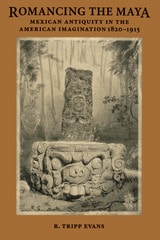
During Mexico's first century of independence, European and American explorers rediscovered its pre-Hispanic past. Finding the jungle-covered ruins of lost cities and artifacts inscribed with unintelligible hieroglyphs—and having no idea of the age, authorship, or purpose of these antiquities—amateur archaeologists, artists, photographers, and religious writers set about claiming Mexico's pre-Hispanic patrimony as a rightful part of the United States' cultural heritage.
In this insightful work, Tripp Evans explores why nineteenth-century Americans felt entitled to appropriate Mexico's cultural heritage as the United States' own. He focuses in particular on five well-known figures—American writer and amateur archaeologist John Lloyd Stephens, British architect Frederick Catherwood, Joseph Smith, founder of the Church of Jesus Christ of Latter-Day Saints, and the French émigré photographers Désiré Charnay and Augustus Le Plongeon. Setting these figures in historical and cultural context, Evans uncovers their varying motives, including the Manifest Destiny-inspired desire to create a national museum of American antiquities in New York City, the attempt to identify the ancient Maya as part of the Lost Tribes of Israel (and so substantiate the Book of Mormon), and the hope of proving that ancient Mesoamerica was the cradle of North American and even Northern European civilization. Fascinating stories in themselves, these accounts of the first explorers also add an important new chapter to the early history of Mesoamerican archaeology.