Results by title
6 books match the query 'Middle Eastern literature'
After Jews And Arabs
Remaking Levantine CultureAmmiel Alcalay
University of Minnesota Press, 1992
By exposing the rich and diverse textual and cultural legacy of this time and space, Alcalay reassesses the exclusion of Semitic culture in Europe from the perspective of contemporary Arabic culture and opposing images of the Israeli-Palestinian conflict. This book will compel a revision of Jewish studies by placing contemporary Israeli culture within its Middle Eastern context and the terms of colonial, postcolonial, and multicultural discourse.
Beyond Babel
A Handbook for Biblical Hebrew and Related LanguagesJohn Kaltner
SBL Press, 2002
Beyond Babel provides a general introduction to and overview of the languages that are significant for the study of the Hebrew Bible and ancient Israel. Included are essays on biblical and inscriptional Hebrew, Akkadian, Northwest Semitic dialects (Ammonite, Edomite, and Moabite), Arabic, Aramaic, Egyptian, Hittite, Phoenician, postbiblical Hebrew, and Ugaritic.
Each chapter in the volume shares a common format, including an overview of the language, a discussion of its significance for the Hebrew Bible, and a list of ancient sources and modern resources for further study of the language. A general introduction by John Huehnergard discusses the importance of the study of Near Eastern languages for biblical scholarship, helping to make the volume an ideal resource for persons beginning an in-depth study of the Hebrew Bible.
Prophets and Prophecy in the Ancient Near East
Martti Nissinen
SBL Press, 2019
A new, expanded edition of a classic reference tool
This volume of more than 170 documents of prophecy from the ancient Near East brings together a representative sample of written documents from Mesopotamia, the Levant, and Egypt dating to the second and first millennia BCE. Nissinen's collection provides nonspecialist readers clear translations, transliterations, and discussions of oracles reports and collections, quotations of prophetic messages in letters and literature, and texts that reference persons with prophetic titles. This second edition includes thirty-four new texts.
Features:
- Modern, idiomatic, and readable English translations
- Thirty-four new translations
- Contributions of West Semitic, Egyptian, and Luwian sources from C. L. Seow, Robert K. Ritner, and H. Craig Melchert
The Neighbors
By Ahmad Mahmoud
University of Texas Press, 2013
Ahmad Mahmoud sets The Neighbors against the backdrop of the oil nationalization crisis that gripped Iran in the early 1950s. His protagonist, Khaled, a young man from a rundown neighborhood in Ahvaz, a city in southern Iran, becomes involved in the struggle to wrest Iran’s oil industry from the British and, as the result of his political activities, comes to realize that there is more to life than the drudgery and poverty his parents and neighbors have experienced.
The Neighbors, published in 1974, cemented Mahmoud’s reputation as a novelist and captured the ethos of a generation—the generation that laid the groundwork for those who continue to struggle for democracy in Iran today. Though the novel received considerable praise and was read widely, its political nature earned the ire of Mohammad Reza Shah’s regime, and the Islamic Republic has objected to its sexually explicit content. This is the first time one of Ahmad Mahmoud’s novels has appeared in English translation.
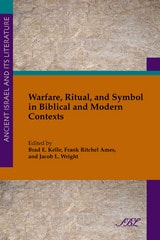
Warfare, Ritual, and Symbol in Biblical and Modern Contexts
Brad E. Kelle
SBL Press, 2014
New perspectives on Israelite warfare for biblical studies, military studies, and social theory
Contributors investigate what constituted a symbol in war, what rituals were performed and their purpose, how symbols and rituals functioned in and between wars and battles, what effects symbols and rituals had on insiders and outsiders, what ways symbols and rituals functioned as instruments of war, and what roles rituals and symbols played in the production and use of texts.
Features:
- Thirteen essays examine war in textual, historical, and social contexts
- Texts from the Hebrew Bible are read in light of ancient Near Eastern texts and archaeology
- Interdisciplinary studies make use of contemporary ritual and social theory
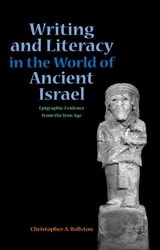
Writing and Literacy in the World of Ancient Israel
Epigraphic Evidence from the Iron AgeChristopher A. Rollston
SBL Press, 2010