Results by title
7 books match the query 'Middle class women'
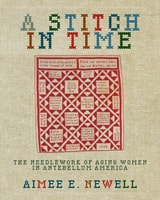
A Stitch in Time
The Needlework of Aging Women in Antebellum AmericaAimee E. Newell
Ohio University Press, 2014
Drawing from 167 examples of decorative needlework—primarily samplers and quilts from 114 collections across the United States—made by individual women aged forty years and over between 1820 and 1860, this exquisitely illustrated book explores how women experienced social and cultural change in antebellum America.
The book is filled with individual examples, stories, and over eighty fine color photographs that illuminate the role that samplers and needlework played in the culture of the time. For example, in October 1852, Amy Fiske (1785–1859) of Sturbridge, Massachusetts, stitched a sampler. But she was not a schoolgirl making a sampler to learn her letters. Instead, as she explained, “The above is what I have taken from my sampler that I wrought when I was nine years old. It was w[rough]t on fine cloth [and] it tattered to pieces. My age at this time is 66 years.”
Situated at the intersection of women’s history, material culture study, and the history of aging, this book brings together objects, diaries, letters, portraits, and prescriptive literature to consider how middle-class American women experienced the aging process. Chapters explore the physical and mental effects of “old age” on antebellum women and their needlework, technological developments related to needlework during the antebellum period and the tensions that arose from the increased mechanization of textile production, and how gift needlework functioned among friends and family members. Far from being solely decorative ornaments or functional household textiles, these samplers and quilts served their own ends. They offered aging women a means of coping, of sharing and of expressing themselves. These “threads of time” provide a valuable and revealing source for the lives of mature antebellum women.
Publication of this book was made possible in part through generous funding from the Coby Foundation, Ltd and from the Quilters Guild of Dallas, Helena Hibbs Endowment Fund.
Beyond the Black Lady
Sexuality and the New African American Middle ClassLisa B. Thompson
University of Illinois Press, 2012
Domestic Economies
Women, Work, and the American Dream in Los AngelesSusanna Rosenbaum
Duke University Press, 2017
EDUCATING THE PROPER WOMAN READER
VICTORIAN FAMILY LITERARY MAGAZINES & CULTURAL HEALTH OF THE NATIONJennifer Phegley
The Ohio State University Press, 2004
Jennifer Phegley presents an examination of four mid-Victorian magazines that middle-class women read widely. Educating the Proper Woman Reader reevaluates prevailing assumptions about the vexed relationship between nineteenth-century women readers and literary critics.
While many scholars have explored the ways nineteenth-century critics expressed their anxiety about the dangers of women’s unregulated and implicitly uncritical reading practices, which were believed to threaten the sanctity of the home and the cultural status of the nation, Phegley argues that family literary magazines revolutionized the position of women as consumers of print by characterizing them as educated readers and able critics. Her analysis of images of influential women readers (in Harper’s), intellectual women readers (in The Cornhill), independent women readers (in Belgravia), and proto-feminist women readers/critics (in Victoria) indicates that women played a significant role in determining the boundaries of literary culture within these magazines. She argues that these publications supported women’s reading choices, inviting them to define literary culture rather than to consume it passively.
Not only does this book revise our understanding of nineteenth-century attitudes toward women readers, but it also takes a fresh look at the transatlantic context of literary production. Further, Phegley demonstrates the role these publications played in improving cultural literacy among women of the middle classes as well as the interplay between fiction and essays of the time by writers such as Mary Braddon, Charles Dickens, George Eliot, Elizabeth Gaskell, G. H. Lewes, Harriet Martineau, Margaret Oliphant, George Sala, William Thackeray, and Anthony Trollope.
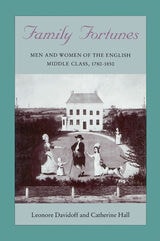
Family Fortunes
Men and Women of the English Middle Class, 1780-1850Leonore Davidoff and Catherine Hall
University of Chicago Press, 1987
"The book explores how the middle class constructed its own institutions, material culture and values during the industrial revolution, looking at two settings—urban manufacturing Birmingham and rural Essex—both centers of active capitalist development. The use of sources is dazzling: family business records, architectural designs, diaries, wills and trusts, newspapers, prescriptive literature, sermons, manuscript census tracts, the papers of philanthropic societies, popular fiction, and poetry.
"Family Fortunes occupies a place beside Mary Ryan's The Cradle of the Middle Class and Suzanne Lebsock's Free Women of Petersburg. It provides scholars with a definitive study of the middle class in England, and facilitates a comparative perspective on the history of middle-class women, property, and the family."—Judith Walkowitz, Johns Hopkins University
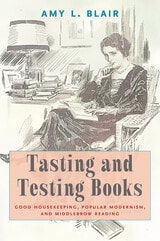
Tasting and Testing Books
Good Housekeeping, Popular Modernism, and Middlebrow ReadingAmy L. Blair
University of Massachusetts Press, 2024
A CHOICE 2025 Outstanding Academic Title
Honorable Mention, 2023-2024 Research Society of American Periodicals Book Prize
In its February 1926 issue, Good Housekeeping magazine introduced a column for its approximately one million subscribers called “Tasting and Testing Books.” The column’s author, Emily Newell Blair, would go on to produce ninety-one reading advice columns for the magazine between 1926 and 1934. During this period, Good Housekeeping became the most widely circulated periodical in the United States, doubling its circulation to over two million copies. Much of its popularity stemmed from its intensive promotion of its Seal of Approval for a variety of products, which brought consumers to it for utilitarian purposes. With her focus on regular books, Blair distinguished herself from highbrow literary critics, many of whom have been objects of study as High Modernists. She offered advice to help middle-class women readers make their own choices about the best books in which to invest time and money, rather than dictating what they should or should not read. She aligns herself with the average subscriber, outside the book publishing and reviewer industries, focusing on books that would now be termed middlebrow reading.
Blair’s time at Good Housekeeping covers the era from the heights of the “Roaring Twenties” to the depths of the Great Depression, and her recommendations offer a window into the uses of middlebrow reading during this period of dramatic economic and social shifts. Tasting and Testing Books argues that the consumer-first message of Good Housekeeping infused Blair’s advice column and validated a new attitude of proudly middlebrow pleasure reading in the mid-twentieth century. These columns shed new light on the reading lives of too-often overlooked women, often living outside of urban centers and away from elite literary circles, and present Emily Newell Blair, who strongly identified with her readers as a truly democratic tastemaker.
Women Between Two Worlds
Midlife Reflections on Work and FamilyMyra Dinnerstein
Temple University Press, 1992