Results by title
6 books match the query 'Miklitsch, Robert'
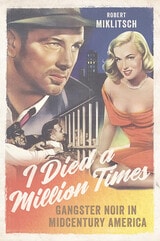
I Died a Million Times
Gangster Noir in Midcentury AmericaRobert Miklitsch
University of Illinois Press, 2020
With the Senate's organized crime hearings and the brighter-than-bright myth of the American Dream as a backdrop, Miklitsch examines the style and history, and the production and cultural politics, of classic pictures from The Big Heat and The Asphalt Jungle to lesser-known gems like 711 Ocean Drive and post-Fifties movies like Ocean’s Eleven. Miklitsch pays particular attention to trademark leitmotifs including the individual versus the collective, the family as a locus of dissension and rapport, the real-world roots of the heist picture, and the syndicate as an octopus with its tentacles deep into law enforcement, corporate America, and government. If the memes of gangster noir remain prototypically dark, the look of the films becomes lighter and flatter, reflecting the influence of television and the realization that, under the cover of respectability, crime had moved from the underworld into the mainstream of contemporary everyday life.
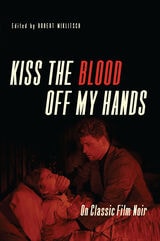
Kiss the Blood Off My Hands
On Classic Film NoirEdited by Robert Miklitsch
University of Illinois Press, 2014
But a new generation of writers is pushing aside the fog of cigarette smoke surrounding classic noir scholarship. In Kiss the Blood Off My Hands: On Classic Film Noir, Robert Miklitsch curates a bold collection of essays that reassesses the genre's iconic style, history, and themes. Contributors analyze the oft-overlooked female detective and little-examined aspects of filmmaking like love songs and radio aesthetics, discuss the significance of the producer and women's pulp fiction, and investigate topics as disparate as Disney noir and the Fifties heist film, B-movie back projection and blacklisted British directors. At the same time the writers' collective reconsideration shows the impact of race and gender, history and sexuality, technology and transnationality on the genre.
As bracing as a stiff drink, Kiss the Blood Off My Hands writes the future of noir scholarship in lipstick and chalk lines for film fans and scholars alike.
Contributors: Krin Gabbard, Philippa Gates, Julie Grossman, Robert Miklitsch, Robert Murphy, Mark Osteen, Vivian Sobchack, Andrew Spicer, J. P. Telotte, and Neil Verma.
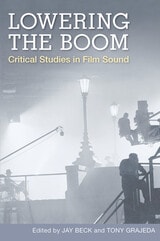
Lowering the Boom
Critical Studies in Film SoundEdited by Jay Beck and Tony Grajeda
University of Illinois Press, 2007
As the first collection of new work on sound and cinema in over a decade, Lowering the Boom addresses the expanding field of film sound theory and its significance in rethinking historical models of film analysis. The contributors consider the ways in which musical expression, scoring, voice-over narration, and ambient noise affect identity formation and subjectivity. Lowering the Boom also analyzes how shifting modulation of the spoken word in cinema results in variations in audience interpretation. Introducing new methods of thinking about the interaction of sound and music in films, this volume also details avant-garde film sound, which is characterized by a distinct break from the narratively based sound practices of mainstream cinema. This interdisciplinary, global approach to the theory and history of film sound opens the eyes and ears of film scholars, practitioners, and students to film's true audio-visual nature.
Contributors are Jay Beck, John Belton, Clark Farmer, Paul Grainge, Tony Grajeda, David T. Johnson, Anahid Kassabian, David Laderman, James Lastra, Arnt Maasø, Matthew Malsky, Barry Mauer, Robert Miklitsch, Nancy Newman, Melissa Ragona, Petr Szczepanik, Paul Théberge, and Debra White-Stanley.

Psycho-Marxism
Marxism and Psychoanalysis Late in the Twentieth Century, Volume 97Robert Miklitsch, spec issue ed
Duke University Press, 0
Contributors. Elizabeth Jane Bellamy, Teresa Brennan, Rosaria Champagne, Stathis Gourgouris, Catherine Liu, Kathleen McHugh, Robert Miklitsch, Abdul-Karim Mustapha, Laurence A. Rickels, Eugene Victor Wolfenstein, Slavoj Zizek
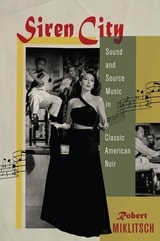
Siren City
Sound and Source Music in Classic American NoirMiklitsch, Robert
Rutgers University Press, 2011
Focusing on a wide range of celebrated and less well known films and offering an introductory discussion of film sound, Robert Miklitsch mobilizes the notion of audiovisuality to investigate period sound technologies such as the radio and jukebox, phonograph and Dictaphone, popular American music such as "hot" black jazz, and "big numbers" featuring iconic performers such as Lauren Bacall, Veronica Lake, and Rita Hayworth. Siren City resonates with the sounds and source music of classic American noir-gunshots and sirens, swing riffs and canaries. Along with the proverbial private eye and femme fatale, these audiovisuals are central to the noir aesthetic and one important reason the genre reverberates with audiences around the world.
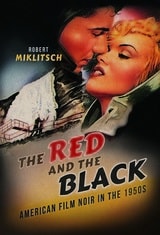
The Red and the Black
American Film Noir in the 1950sRobert Miklitsch
University of Illinois Press, 2017
Mixing scholarship with a fan's devotion to the crooked roads of critique, Miklitsch autopsies marquee films like D.O.A., Niagara, and Kiss Me Deadly plus a number of lesser-known classics. Throughout, he addresses the social and technological factors that dealt deuce after deuce to the genre--its celebrated style threatened by new media and technologies such as TV and 3-D, color and widescreen, its born losers replaced like zombies by All-American heroes, the nation rocked by the red menace and nightmares of nuclear annihilation. But against all odds, the author argues, inventive filmmakers continued to make formally daring and socially compelling pictures that remain surprisingly, startlingly alive.
Cutting-edge and entertaining, The Red and the Black reconsiders a lost period in the history of American movies.