Results by title
3 books match the query 'Milanovic, Branko'
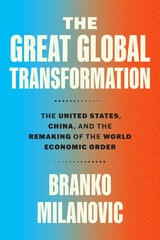
The Great Global Transformation
The United States, China, and the Remaking of the World Economic OrderBranko Milanovic
University of Chicago Press, 2026
From the essential chronicler of the world economy, a portrait of the Great Powers in transition.
The world’s two great economic powers are on opposite trajectories. In the United States, decades of neoliberal policies produced a small class of rich elites and gutted the middle class. In China, the same global forces have created a massive new upper class. The result is the greatest reshuffling of global incomes since the Industrial Revolution—a dramatic shakeup of each country’s political order. As the two powers retreat from one another, the implications for their futures, and for the world economy, are uncertain.
In The Great Global Transformation, acclaimed economist Branko Milanovic draws on original research to chart how these seismic shifts will shape the next century of the global economy. As both the US and China retreat into protectionism, Milanovic shows how a new and multipolar world order will follow—and how rising nationalism will have dramatically different effects on the two countries. And he shows us the fight ahead: as plutocracy returns, global war threatens, and a new system silently shapes our nations, driving populist discontent to the breaking point.
A worthy successor to Capitalism, Alone and his other landmark works, Milanovic’s new book announces the arrival of a new era he terms “national market liberalism,” in which liberalism survives in domestic economies, but not necessarily in the social arena. The Great Global Transformation is Milanovic’s indispensable account of the new twenty-first century now underway.
[more]
The Great Global Transformation
The United States, China, and the Remaking of the World Economic OrderBranko Milanovic
University of Chicago Press, 2026
From the essential chronicler of the world economy, a portrait of the Great Powers in transition.
The world’s two great economic powers are on opposite trajectories. In the United States, decades of neoliberal policies produced a small class of rich elites and gutted the middle class. In China, the same global forces have created a massive new upper class. The result is the greatest reshuffling of global incomes since the Industrial Revolution—a dramatic shakeup of each country’s political order. As the two powers retreat from one another, the implications for their futures, and for the world economy, are uncertain.
In The Great Global Transformation, acclaimed economist Branko Milanovic draws on original research to chart how these seismic shifts will shape the next century of the global economy. As both the US and China retreat into protectionism, Milanovic shows how a new and multipolar world order will follow—and how rising nationalism will have dramatically different effects on the two countries. And he shows us the fight ahead: as plutocracy returns, global war threatens, and a new system silently shapes our nations, driving populist discontent to the breaking point.
A worthy successor to Capitalism, Alone and his other landmark works, Milanovic’s new book announces the arrival of a new era he terms “national market liberalism,” in which liberalism survives in domestic economies, but not necessarily in the social arena. The Great Global Transformation is Milanovic’s indispensable account of the new twenty-first century now underway.
The world’s two great economic powers are on opposite trajectories. In the United States, decades of neoliberal policies produced a small class of rich elites and gutted the middle class. In China, the same global forces have created a massive new upper class. The result is the greatest reshuffling of global incomes since the Industrial Revolution—a dramatic shakeup of each country’s political order. As the two powers retreat from one another, the implications for their futures, and for the world economy, are uncertain.
In The Great Global Transformation, acclaimed economist Branko Milanovic draws on original research to chart how these seismic shifts will shape the next century of the global economy. As both the US and China retreat into protectionism, Milanovic shows how a new and multipolar world order will follow—and how rising nationalism will have dramatically different effects on the two countries. And he shows us the fight ahead: as plutocracy returns, global war threatens, and a new system silently shapes our nations, driving populist discontent to the breaking point.
A worthy successor to Capitalism, Alone and his other landmark works, Milanovic’s new book announces the arrival of a new era he terms “national market liberalism,” in which liberalism survives in domestic economies, but not necessarily in the social arena. The Great Global Transformation is Milanovic’s indispensable account of the new twenty-first century now underway.
[more]
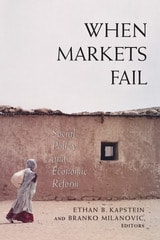
When Markets Fail
Social Policy and Economic ReformEthan B. Kapstein
Russell Sage Foundation, 2002
The sweeping political and economic changes of the past decade—including the spread of democracy, pro-market policies, and economic globalization—have dramatically increased the demand in developing countries for social programs such as unemployment compensation, pensions, and income supplements for the poor. When Markets Fail examines how emerging market economies in Eastern Europe, Latin America, North Africa, and the Middle East are shaping their social policies in response to these changes. The contributors—leading scholars of development and social policy—use detailed case studies to examine whether the emerging economies are likely to move toward European-style welfare systems, characterized by high unemployment benefits and large entitlements, or if they will opt for more austere, stripped-down welfare regimes. They find that much will depend on how well emerging economies perform economically, but that the political forces, ideological preferences, and historical backgrounds of each country will also play a decisive role. In his chapter on Central and Eastern Europe, Peter Lindert focuses on how aging populations and the fall of communism have fostered increased need for social assistance in the region. In contrast, Nancy Birdsall and Stephen Haggard highlight the positive role of democratization and Western-style social programs in promoting East Asian social policies. Zafiris Tzannatos and Iqbal Kaur argue that governments in North Africa and the Middle East must foster both human capital formation and competition in the market for social services if they are to meet the growing need for services. When Markets Fail presents some evidence that a global convergence in social policies may be taking place: as Europe slowly makes its welfare provisions less generous, the emerging market economies will be under increasing demographic and political pressure to make their social welfare systems more comprehensive. The book also examines the vital role that organizations such as the World Bank, the International Monetary Fund, and the Asian Development Bank can play in fostering effective social services in developing economies. Economic globalization and political liberalization have produced many economic winners around the world, but these forces have created losers as well. When Markets Fail addresses the problem of how governments in developing countries have responded to the plight of those losers through social policy. The success of these policies, however, remains sharply contested, as is their role in helping to achieve meaningful poverty reduction. When Markets Fail is essential reading for anyone interested in economic liberalization and its consequences for the developing world.
[more]