Results by title

4 books match the query 'Mileur, Jerome M.'
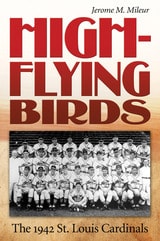
cover of High-Flying Birds: The 1942 St. Louis Cardinals

High-Flying Birds

The 1942 St. Louis Cardinals

Jerome M. Mileur

University of Missouri Press, 2009
1942: Americans suddenly found themselves at war but were not about to be distracted from the National Pastime. The Brooklyn Dodgers and New York Yankees were looking to continue their World Series rivalry from the 1941 season, and a youthful team from St. Louis was determined to stop them.
With only one player older than thirty, the St. Louis Cardinals were the youngest team to win the National League pennant and World Series. Built on good pitching and tremendous speed on the base paths and in the field, the team featured rookie Stan Musial, future Hall of Famer Enos Slaughter, and ace pitcher Mort Cooper, the National League’s Most Valuable Player of 1942. With their winningest season ever, posting 106 victories, the 1942 Redbirds have been called the greatest Cardinal team of all time.
Jerome Mileur was just a kid from downstate Illinois, but he well remembers his view of one game from the left-field grandstand—and the thrill of attending the second game of the World Series. In this book, he brings a sure and loving grasp of his subject to reconstructing one of the most remarkable pennant drives in modern baseball history, with the Cards winning forty-three of their last fifty-one games and clinching first place on the last day of the season.
Mileur provides a game-by-game account of the season with play-by-play action, not only capturing all the thrills on the Cards’ way to the top but also conveying the physical and mental demands that the players endured. Counted out by nearly everyone but themselves in August, the Redbirds caught fire in the season’s final weeks to pass the seemingly unbeatable Dodgers. And by winning four games out of five to defeat the New York Yankees for the championship, they handed Joe DiMaggio his only World Series defeat.
More than a recapitulation of a thrilling season, Mileur’s book is a reminder of how major-league baseball in 1942 differed in so many ways from today’s game—one startling example is Mileur’s account of how the absence of outfield warning tracks contributed to a devastating injury to Brooklyn’s star outfielder, Pete Reiser. The tenor of the times is reflected as well in the juxtaposition of the baseball season with the United States’ first year in the Second World War.
The 1942 Cardinals were not only a remarkable team unto themselves but also the beginning of a new baseball dynasty—1942’s pennant was the first of three in a row for the Cards, as well as the first of three World Series victories in a space of five seasons. This account of that tremendous season is a page-turner for anyone who loves the game and a must-read for Cardinals fans.
[more]
cover of The Great Society and the High Tide of Liberalism

The Great Society and the High Tide of Liberalism

Sidney M. Milkis

University of Massachusetts Press, 2005

The long era of liberal reform that began with the Progressive movement of the early twentieth century and continued with the New Deal, culminated in the 1960s with Lyndon Johnson's Great Society. Inspired by the example of his mentor, Franklin Roosevelt, Johnson sought to extend the agenda of the New Deal beyond the realm of economic security to civil rights, housing, education, and health care. In the end, however, his bold ambitions for a Great Society, initiated against the backdrop of an increasingly costly and divisive war, fueled a conservative backlash and undermined faith in liberalism itself.

In this volume of original essays, a distinguished group of scholars and activists reassess the mixed legacy of this third major reform period of the last century. They examine not only the policies and programs that were part of LBJ's Great Society, but also the underlying ideological and political shifts that changed the nature of liberalism. Some of the essays focus on Lyndon Johnson himself and the institution of the modern presidency, others on specific reform measures, and still others on the impact of these initiatives in the decades that followed. Perspectives, methodologies, and conclusions differ, yet all of the contributors agree that the Great Society represented an important chapter in the story of the American republic and its ongoing struggle to reconcile the power of the state with the rights of individuals—a struggle that has continued into the twenty-first century.

In addition to the editors, contributors include Henry J. Abraham, Brian Balogh, Rosalyn Baxandall, Edward Berkowitz, Eileen Boris, Richard A. Cloward, Hugh Davis Graham, Hugh Heclo, Frederick Hess, William E. Leuchtenburg, Nelson Lichtenstein, Patrick McGuinn, Wilson Carey McWilliams, R. Shep Melnick, Frances Fox Piven, and David M. Shribman.
[more]
cover of The New Deal and the Triumph of Liberalism

The New Deal and the Triumph of Liberalism

Sidney M. Milkis

University of Massachusetts Press, 2002

For scholars who have studied it, as for many Americans who experienced it firsthand, Franklin Roosevelt's New Deal has long represented a turning point in the modern history of the United States. More than simply a bold program of political change, it marked a critical departure in the governing principles, institutional arrangements, and policies that shape American life. 

In this collection of original essays, a distinguished group of political scientists and historians reevaluate the legacy of the New Deal, showing how Roosevelt and his allies forged an enduring public philosophy—modern liberalism—that redefined the relationship of government and governed. Adapting broad principles from the past to the unprecedented circumstances of a worldwide depression, the New Dealers shifted American politics away from its traditional emphasis on self-reliance, private property, and decentralized power. In its place they advocated a new “economic constitutional order”—in effect, a new social contract—in which the government guaranteed protection to individuals against the uncertainties of the marketplace. 

Although the contributors differ in their assessment of the successes and failures of New Deal liberalism, all agree that its implications for American political life were profound and far-reaching—in the realm of foreign as well as domestic affairs, for the theory as well as the practice of government. Taken together, the essays offer a fresh look at the many ways the New Deal, in Harry Hopkins's phrase, “made America over.”

In addition to the editors, contributors are William E. Leuchtenburg, Marc Landy, Nelson Lichtenstein, Donald R. Brand, Jyette Klausen, Suzanne Mettler, Ronald Story, Seyom Brown, and Morton Keller.
[more]
cover of The Stars Are Back: The St. Louis Cardinals, the Boston Red Sox, and Player Unrest in 1946

The Stars Are Back

The St. Louis Cardinals, the Boston Red Sox, and Player Unrest in 1946

Jerome M. Mileur

Southern Illinois University Press, 2013

In 1946, as the aftershocks of World War II still trembled across the globe, America returned to its favorite pastime: baseball. In The Stars Are Back, Jerome M. Mileur offers a fascinating account of this storied season and of the backstage battle that would forever transform the game of professional baseball. Mileur begins with one of the most famous clashes in major league history: the neck-and-neck race to the National League pennant between the St. Louis Cardinals and the Brooklyn Dodgers. As these two iconic teams engaged in a bitter struggle leading to the first-ever playoff to determine the winner of the National League pennant, the Boston Red Sox blazed a trail to the top of the American League to face the Cardinals in the World’s Series, as it was then called.

But while the nation was riveted by the return of its beloved baseball heroes, the game behind the scenes was just as dramatic. As the threat of unionization loomed and the Mexican League continued to lure players away from the United States with lucrative contracts, tensions between players and team owners mounted. The result was a standoff for control of the game that would culminate in the Magna Carta of baseball and the creation of standard contracts for players, ushering in the modern era of baseball.

Set against the backdrop of a country recovering from war, facing the new adversary of Communism, and absorbing the emotional impact of the atomic bomb, The Stars Are Back tells the story of a nation hungry for a return to normalcy and a game poised on the brink of new horizons.

[more]