Results by title
2 books match the query 'Militarism in literature'
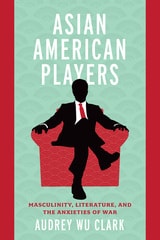
Asian American Players
Masculinity, Literature, and the Anxieties of WarAudrey Wu Clark
The Ohio State University Press, 2023
Honorable Mention, 2025 Association for Asian American Studies Book Awards, Literary Studies Category
The player is a womanizer, a trickster, a gambler—but can Asian American men fully participate in this kind of masculinity? In Asian American Players, Audrey Wu Clark showcases how the literary figure of the Asian American player unsettles the hegemony of white American masculinity through mimicry, even as that masculinity socially and politically alienates him. She examines gendered and racialized US militarism through works written during major postmodern American wars, investigating how books by John Okada, David Henry Hwang, Chang-rae Lee, Frances Khirallah Noble, and Viet Thanh Nguyen (re)fashion Asian American masculinity in ways that ultimately mimic masculinist American foreign policy and military strategies during corresponding wars. She unearths a dual picture of Asian American players: as traces of the anxiety of America’s quest for empowerment and continued military and industrial dominance in the international arena and as those tarred as inferior and disloyal outsiders within this mirrored global dominance. She thus finds new inroads into understanding US imperialism and militarism and identifies ways that key literary figures have written against insidious tropes.
The player is a womanizer, a trickster, a gambler—but can Asian American men fully participate in this kind of masculinity? In Asian American Players, Audrey Wu Clark showcases how the literary figure of the Asian American player unsettles the hegemony of white American masculinity through mimicry, even as that masculinity socially and politically alienates him. She examines gendered and racialized US militarism through works written during major postmodern American wars, investigating how books by John Okada, David Henry Hwang, Chang-rae Lee, Frances Khirallah Noble, and Viet Thanh Nguyen (re)fashion Asian American masculinity in ways that ultimately mimic masculinist American foreign policy and military strategies during corresponding wars. She unearths a dual picture of Asian American players: as traces of the anxiety of America’s quest for empowerment and continued military and industrial dominance in the international arena and as those tarred as inferior and disloyal outsiders within this mirrored global dominance. She thus finds new inroads into understanding US imperialism and militarism and identifies ways that key literary figures have written against insidious tropes.
[more]
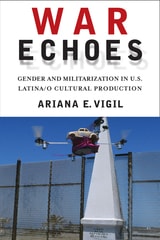
War Echoes
Gender and Militarization in U.S. Latina/o Cultural ProductionVigil, Ariana E
Rutgers University Press, 2014
War Echoes examines how Latina/o cultural production has engaged with U.S. militarism in the post–Viet Nam era. Analyzing literature alongside film, memoir, and activism, Ariana E. Vigil highlights the productive interplay among social, political, and cultural movements while exploring Latina/o responses to U.S. intervention in Central America and the Middle East. These responses evolved over the course of the late twentieth and early twenty-first centuries—from support for anti-imperial war, as seen in Alejandro Murguia's Southern Front, to the disavowal of all war articulated in works such as Demetria Martinez’s Mother Tongue and Camilo Mejia’s Road from Ar Ramadi. With a focus on how issues of race, class, gender, and sexuality intersect and are impacted by war and militarization, War Echoes illustrates how this country’s bellicose foreign policies have played an integral part in shaping U.S. Latina/o culture and identity and given rise to the creation of works that recognize how militarized violence and values, such as patriarchy, hierarchy, and obedience, are both enacted in domestic spheres and propagated abroad.
[more]