Results by title
6 books match the query 'Military occupation'

Beyond Occupation
Apartheid, Colonialism and International Law in the Occupied Palestinian TerritoriesEdited by Virginia Tilley
Pluto Press, 2012
Beyond Occupation looks at three contentious terms that regularly arise in contemporary arguments about Israel's practices towards Palestinians in the occupied territories – occupation, colonialism and apartheid – and considers whether their meanings in international law truly apply to Israel's policies. This analysis is timely and urgent – colonialism and apartheid are serious breaches of human rights law and apartheid is a crime against humanity under the Rome Statute of the International Criminal Court.
The contributors present conclusive evidence that Israel’s administration of the Palestinian territories is consistent with colonialism and apartheid, as these regimes are defined in human rights law. Their analysis further shows that these practices are deliberate Israeli state policies, imposed on the Palestinian civilian population under military occupation.
These findings raise serious implications for the legality and legitimacy of Israel's continuing occupation of the Palestinian territories and the responsibility of the entire international community to challenge practices considered contrary to fundamental values of the international legal order.
Corporate Complicity in Israel's Occupation
Evidence from the London Session of the Russell Tribunal on PalestineEdited by Asa Winstanley and Frank Barat
Pluto Press, 2011
The Russell Tribunal on Palestine is a people’s tribunal in the spirit of the Tribunal on Vietnam that was set up by Bertrand Russell in the 1960s. This book contains a selection of the most vital evidence and testimonies presented at the London session. It includes the papers submitted to the tribunal, written by expert witnesses, based on their detailed research into the companies that prop-up Israeli occupation.
Examining the involvement of corporations in the illegal occupation of Palestinian land by Israel, the tribunal of 2010 generated widespread media coverage. The book identifies companies and corporations participating in such illegality and possibilities for legal action against them are discussed.
Released to coincide with the South Africa session at the end of 2011, Corporate Complicity in Israel's Occupation is a vital resource to lawyers, journalists and activists hoping to take informed action against Israeli war crimes and occupation.

Military Occupation and Diplomacy
Soviet Troops in Romania, 1944–1958Sergiu Verona
Duke University Press, 1992
Drawing on declassified archival material in the United States and the United Kingdom, the author considers Khrushchev’s reversal of Stalinist expansionism by examining the motivation, function, and operation of the initial occupation of Romania; the complex involvement of Soviet diplomacy and its perception by the United States and other Western powers; the process by which Khrushchev decided to withdraw Soviet troops from that country; and the impact of this decision on Soviet policy. Verona extends his analysis, providing comparisons between Khrushchev’s and Gorbachev’s approaches to Eastern Europe, noting that similarities exist not only in domestic policies but in the realm of foreign policy as well.

The Occupied Clinic
Militarism and Care in KashmirSaiba Varma
Duke University Press, 2020

The Right to Maim
Debility, Capacity, DisabilityJasbir K. Puar
Duke University Press, 2017
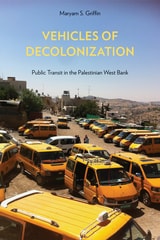
Vehicles of Decolonization
Public Transit in the Palestinian West BankMaryam S. Griffin
Temple University Press, 2022
Examining the border-enclosure strategy Israel uses to impose Palestinian im/mobilization, Maryam Griffin considers the ways public transportation in the Palestinian West Bank is a constant site of social struggle. Her illuminating book, Vehicles of Decolonization, studies collective movement, resistance, and everyday life in the West Bank to show how Palestinians assert a kind of Indigenous self-determination over mobility that Israeli settler colonialism seeks to undermine.
Having immersed herself in a year of fieldwork, Griffin maps multiple engagements with the flexible bus, shared van, and private taxi services to demonstrate that the politics of mobility are shaped by ongoing settler colonialism and Indigenous struggle. Griffin uses critical border studies to look at the contested nature of mobility at the sites of transit, where Palestinians practice self-determination through routine participation, spectacular political organizing and demonstration, and artistic renderings.
Featuring a variety of street images, Vehicles of Decolonization shows that multiple registers of people power work in concert not only to resist settler colonial logics but to reinhabit the land through the practice and preservation of alternative relations of mobility.