Results by title
5 books match the query 'Milk'
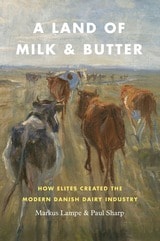
A Land of Milk and Butter
How Elites Created the Modern Danish Dairy IndustryMarkus Lampe and Paul Sharp
University of Chicago Press, 2018
This book presents a radical retelling of this story, placing (largely German-speaking) landed elites—rather than the Danish peasantry—at center stage. After acquiring estates in Denmark, these elites imported and adapted new practices from outside the kingdom, thus embarking on an ambitious program of agricultural reform and sparking a chain of events that eventually led to the emergence of Denmark’s famous peasant cooperatives in 1882. A Land of Milk and Butter presents a new interpretation of the origin of these cooperatives with striking implications for developing countries today.
Land of Milk and Money
A NovelAnthony Barcellos
Tagus Press, 2012

Milk and Filth
Carmen Giménez Smith
University of Arizona Press, 2013
Adding to the Latina tradition, Carmen Giménez Smith, politically aware and feminist-oriented, focuses on general cultural references rather than a sentimental personal narrative. She speaks of sexual politics and family in a fierce, determined tone voracious in its opinions about freedom and responsibility.
The author engages in mythology and art history, musically wooing the reader with texture and voice. As she references such disparate cultural figures as filmmaker Lars Von Trier, Annie from the film Annie Get Your Gun, Nabokov’s Lolita, Facebook entries and Greek gods, they appear as part of the poet’s cultural critique.
Phrases such as “the caustic domain of urchins” and “the gelatin shiver of tea’s surface” take the poems from lyrical images to comic humor to angry, intense commentary. On writing about “downgrading into human,” she says, “Then what? Amorality, osteoporosis and not even a marble estuary for the ages.”
Giménez Smith’s poetic arsenal includes rapier-sharp wordplay mixed with humor, at times self-deprecating, at others an ironic comment on the postmodern world, all interwoven with imaginative language of unexpected force and surreal beauty. Revealing a long view of gender issues and civil rights, the author presents a clever, comic perspective. Her poems take the reader to unusual places as she uses rhythm, images, and emotion to reveal the narrator’s personality. Deftly blending a variety of tones and styles, Giménez Smith’s poems offer a daring and evocative look at deep cultural issues.
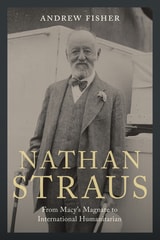
Nathan Straus
From Macy's Magnate to International HumanitarianAndrew Fisher
Rutgers University Press, 2026
Nathan Straus (1848–1931) encompassed worlds. He rose from his Jewish German immigrant family’s ruin in Civil War Georgia to become co-owner of Macy’s and Abraham & Straus department stores. He helped build American Zionism and cofounded the American Jewish Congress movement. His public service led to a nomination for New York City mayor.
This, the first comprehensive biography of Straus, details each of these lives but argues that his most historic achievements lay elsewhere—in philanthropy. Inspired by both his Jewish values and no-nonsense pragmatism, Straus designed, funded, and oversaw four Progressive philanthropic initiatives. The greatest—his demonstration and advocacy campaigns for milk pasteurization—saved the lives of countless thousands of infants in New York City and, ultimately, across much of America and western Europe. Straus also founded America’s first TB preventorium for at-risk children: a model for the forty-five more that followed. Partnering with Hadassah, he brought American public health innovations to Mandate Palestine. He provided vast relief for New York City’s jobless in the severe 1890s depression. In all, Straus’s humanitarianism won the acclaim of American presidents and world leaders and the gratitude of millions. We can learn from him today.
The Land of Milk and Uncle Honey
Memories from the Farm of My YouthAlan Guebert with Mary Grace Foxwell
University of Illinois Press, 2015
Here are Guebert's tireless parents, measuring the year not in months but in seasons for sewing, haying, and doing the books; Jackie the farmhand, needing ninety minutes to do sixty minutes' work and cussing the entire time; Hoard the dairyman, sore fingers wrapped in electrician's tape, sharing wine and the prettiest Christmas tree ever; and the unflappable Uncle Honey, spreading mayhem via mistreated machinery, flipped wagons, and the careless union of diesel fuel and fire.
Guebert's heartfelt and humorous reminiscences depict the hard labor and simple pleasures to be found in ennobling work, and show that in life, as in farming, Uncle Honey had it right with his succinct philosophy for overcoming adversity: "the secret's not to stop."
https://www.youtube.com/watch?v=DooGQqUlXI4&index=1&list=FLPxtuez-lmHxi5zpooYEnBg