Results by title

4 books match the query 'Miller, Greg'
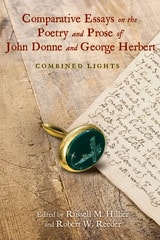
cover of Comparative Essays on the Poetry and Prose of John Donne and George Herbert: Combined Lights

Comparative Essays on the Poetry and Prose of John Donne and George Herbert

Combined Lights

Russell M. Hillier

University of Delaware Press, 2022
This book brings together ten essays on John Donne and George Herbert composed by an international group of scholars. The volume represents the first collection of its kind to draw close connections between these two distinguished early modern thinkers and poets who are justly coupled because of their personal and artistic association. The contributors' distinctive new approaches and insights illuminate a variety of topics and fields while suggesting new directions that future study of Donne and Herbert might take. Some chapters explore concrete instances of collaboration or communication between Donne and Herbert, and others find fresh ways to contextualize the Donnean and Herbertian lyric, carefully setting the poetry alongside discourses of apophatic theology or early modern political theory, while still others link Herbert's verse to Donne's devotional prose. Several chapters establish specific theological and aesthetic grounds for comparison, considering Donne and Herbert's respective positions on religious assurance, comic sensibility, and virtuosity with poetic endings. 
[more]
cover of Iron Wheel

Iron Wheel

Greg Miller

University of Chicago Press, 1998
The poems in Iron Wheel are hard won, the product of the clash of cultures: Southern, religious, gay. Miller achieves an intense, disturbing, and singular poetic voice, capable of tenderness, but undaunted when forced to confront the harsh, often violent realities of contemporary life in the South.
[more]
cover of Rib Cage

Rib Cage

Greg Miller

University of Chicago Press, 2001
Under the sway of the indelible storytelling culture of the South, Greg Miller has crafted poems from all that he hears and sees around him. Written in a language rarely heard in modern devotion, the poems in Rib Cage show old communities disintegrating, extended families dispersing, and people in economic or personal distress struggling for dignity and a clear sense of their predicaments. From plain speech to evocative lyricism, from free verse to hymnlike eloquence, Miller deftly gives a voice and a history to the places he creates, places that, in the end, expand to encompass all of humanity.

[more]
cover of Watch

Watch

Greg Miller

University of Chicago Press, 2009

                            Strasbourg

 The yellow and green rose, and the pink rock,

The chestnuts blooming, the cobblestone square,

Our Lady’s tower rising everywhere,

Dark timbered fronts; the mechanical clock

Whose rooster crows three times for Peter’s flock,

The Apostles, the old man’s and the child’s share

Of time—aspire I’d say to make me stare

And stop. I praise what I might otherwise mock,

The locked contingencies, the stock of losses,

Bright liquidity everywhere channeled,

A storied cityscape of destinies

Averted as when, turning, a young Turk tosses

His hands in the air and my chest’s pummeled,

“My brother, forgive me!” and my thoughts freeze.


In Watch, Greg Miller describes a fresh purposefulness in his life and achieves a new level of poetic thinking and composition in his writing. Artfully combining the religious and secular worldviews in his own sense of human culture, Miller complicates our understanding of all three. The poems in Watch sift layers of natural and human history across several continents, observing paintings, archeological digs, cityscapes, seascapes, landscapes—all in an attempt to envision a clear, grounded spiritual life. Employing an impressive array of traditional meters and various kinds of free verse, Miller’s poems celebrate communities both invented and real.

Praise for Iron Wheel

“Miller demonstrates that what Eliot said about reading a poem may be equally true of writing them: the best thing ‘is to be very, very intelligent’ and intelligence is not the same as erudition. Whether the world is made, found, or named, Miller offers an engaging portrait of things as they are.’’—David Orr, Poetry


[more]