Results by title
2 books match the query 'Miller, Hillary'
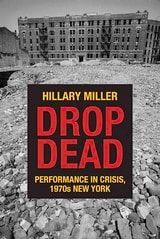
Drop Dead
Performance in Crisis, 1970s New YorkHillary Miller
Northwestern University Press, 2016
Winner, 2017 American Theater and Drama Society John W. Frick Book Award
Winner, 2017 ASTR Barnard Hewitt Award for Outstanding Research in Theater History
Hillary Miller’s Drop Dead: Performance in Crisis, 1970s New York offers a fascinating and comprehensive exploration of how the city’s financial crisis shaped theater and performance practices in this turbulent decade and beyond.
New York City’s performing arts community suffered greatly from a severe reduction in grants in the mid-1970s. A scholar and playwright, Miller skillfully synthesizes economics, urban planning, tourism, and immigration to create a map of the interconnected urban landscape and to contextualize the struggle for resources. She reviews how numerous theater professionals, including Ellen Stewart of La MaMa E.T.C. and Julie Bovasso, Vinnette Carroll, and Joseph Papp of The Public Theater, developed innovative responses to survive the crisis.
Combining theater history and close readings of productions, each of Miller’s chapters is a case study focusing on a company, a production, or an element of New York’s theater infrastructure. Her expansive survey visits Broadway, Off-, Off-Off-, Coney Island, the Brooklyn Academy of Music, community theater, and other locations to bring into focus the large-scale changes wrought by the financial realignments of the day.
Nuanced, multifaceted, and engaging, Miller’s lively account of the financial crisis and resulting transformation of the performing arts community offers an essential chronicle of the decade and demonstrates its importance in understanding our present moment.

Sanctuary Stage
The Greenwich Mews Theatre, 1951-1974Hillary Miller
University of Michigan Press, 2027
In 1951, white and Black artists from the progressive theaters of downtown and Harlem came together to create the Greenwich Mews Theatre. For over two decades the venue defied Jim Crow casting practices and Red Scare censorship; the theatre provided refuge to blacklisted artists and a stage for dramas of the civil rights movement. In Sanctuary Stage: The Greenwich Mews Theatre, 1951-1974, author Hillary Miller tells the history of this groundbreaking West Village institution through its productions and its network of leftist dramatists. Jointly sponsored and protected by a Presbyterian church and a synagogue, the Mews and its innovative producer Stella Holt earned accolades with staging works by Alice Childress, Langston Hughes, Loften Mitchell, Seán O’Casey, and George Tabori, and in its final chapter, the creation of the bilingual Greenwich Mews Spanish Theatre. Miller traces the rise and demise of this interracial and interfaith hub for cultural expression until its final fracture amid artistic and social turbulence in the 1970s.
Through its oppositional performance practices, the collective blurred the lines between the mainstream and the underground, bringing together multiethnic theater communities, anti-fascist activists, pro-labor audiences, and circles of interfaith justice movements.