Results by title
2 books match the query 'Millstein, Roberta L.'

Contingency Across the Life Sciences
How Accidents Can Be ConsequentialEdited by Alison K McConwell, Roberta L. Millstein, Michael R. Dietrich, and John Beatty
University of Chicago Press, 0
With perspectives from biology, history, and philosophy, an investigation of the meaning and importance of contingency in the life sciences.
Were the outcomes of evolution, humans included, inevitable? In his 1989 book Wonderful Life, Stephen Jay Gould invited his readers to replay “life’s tape”—“You press the rewind button and, making sure you thoroughly erase everything that actually happened, go back to any time and place in the past—say, to the seas of the Burgess Shale. Then let the tape run again.” If the outcomes of evolution truly depend on historical contingencies, you might not get anything at all like the same trajectory—maybe no humans or anything human-like. In the first book of its kind, Contingency Across the Life Sciences brings together scientists, philosophers, and historians to explore when historical contingency really matters for our understanding of the biological past and our place within it.
Using Darwin’s and Gould’s views on chance and contingency as a starting point, the chapters clarify the many different meanings of contingency and show how biologists have moved beyond the tape of life metaphor to find contingency in a range of ecological, evolutionary, and developmental processes, including experiments with contingency in actual populations. The collection ends with a set of reflections on how historical contingency can change the ways we see ourselves as biological and moral agents in a world that could have been otherwise.
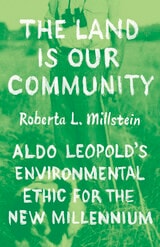
The Land Is Our Community
Aldo Leopold’s Environmental Ethic for the New MillenniumRoberta L. Millstein
University of Chicago Press, 2024
Informed by his experiences as a hunter, forester, wildlife manager, ecologist, conservationist, and professor, Aldo Leopold developed a view he called the land ethic. In a classic essay, published posthumously in A Sand County Almanac, Leopold advocated for an expansion of our ethical obligations beyond the purely human to include what he variously termed the “land community” or the “biotic community”—communities of interdependent humans, nonhuman animals, plants, soils, and waters, understood collectively. This philosophy has been extremely influential in environmental ethics as well as conservation biology and related fields.
Using an approach grounded in environmental ethics and the history and philosophy of science, Roberta L. Millstein reexamines Leopold’s land ethic in light of contemporary ecology. Despite the enormous influence of the land ethic, it has sometimes been dismissed as either empirically out of date or ethically flawed. Millstein argues that these dismissals are based on problematic readings of Leopold’s ideas. In this book, she provides new interpretations of the central concepts underlying the land ethic: interdependence, land community, and land health. She also offers a fresh take on of his argument for extending our ethics to include land communities as well as Leopold-inspired guidelines for how the land ethic can steer conservation and restoration policy.