Results by title
10 books match the query 'Mimbres culture'
Ancient Communities in the Mimbres Valley
Continuity and Change from AD 750 to 1350Roger Anyon and Steven A. LeBlanc
University of Arizona Press, 2024
In the Mimbres Valley of southwestern New Mexico, archaeologists have been working for decades to meticulously excavate archaeological sites.
Expanding beyond studies that focus on a single pueblo, this volume represents the final report on the excavations of the Mimbres Foundation. It brings together data from a range of pithouse and pueblo sites of different sizes and histories in diverse locations—to refine the current understandings of Mimbres region archaeology in the context of the Greater Southwest.
From the end of the Late Pithouse period through the Black Mountain phase, the book provides excellent documentation of the artifacts and data recovered from the sites, addresses models of Mimbres community, and tracks change and continuity in the valley over centuries. In addition, the authors consider the nature of the relationship between the Classic Mimbres period population of the valley and the people of the succeeding Black Mountain phase, as well as relationships among the Black Mountain phase people and those of neighboring parts of the region, including the Casas Grandes world and the Jornada Mogollon area.
In Ancient Communities in the Mimbres Valley two leading archaeologists bring together a trove of unpublished investigations, expanding understandings and setting a course for the future.
[more]
Engendering Households in the Prehistoric Southwest
Edited by Barbara J. Roth
University of Arizona Press, 2010
The French anthropologist Claude Lévi-Strauss once described a village as “deserted” when all the adult males had vanished. While his statement is from the first half of the twentieth century, it nonetheless illustrates an oversight that has persisted during most of the intervening decades.
Now Southwestern archaeologists have begun to delve into the task of “engendering” their sites. Using a “close to the ground” approach, the contributors to this book seek to engender the prehistoric Southwest by examining evidence at the household level.
Focusing on gendered activities in household contexts throughout the southwestern United States, this book represents groundbreaking work in this area. The contributors view households as a crucial link to past activities and behavior, and by engendering these households, we can gain a better understanding of their role in prehistoric society. Gender-structured household activities, in turn, can offer insight into broader-scale social and economic factors. The chapters offer a variety of theoretical and methodological approaches to engendering households and examine topics such as the division of labor, gender relations, household ritual, ceramic and ground stone production and exchange, and migration.
Engendering Households in the Prehistoric Southwest ultimately addresses broader issues of interest to many archaeologists today, including households and their various forms, identity and social boundary formation, technological style, and human agency. Focusing on gendered activities in household contexts throughout the southwestern United States, this book represents groundbreaking work in this area. The contributors view households as a crucial link to past activities and behavior, and by engendering these households, we can gain a better understanding of their role in prehistoric society. Gender-structured household activities, in turn, can offer insight into broader-scale social and economic factors.
[more]
Households on the Mimbres Horizon
Excavations at La Gila Encantada, Southwestern New MexicoBarbara J. Roth
University of Arizona Press, 2023
Pithouse sites represent the basic form of occupation in the Mimbres Mogollon region of southwestern New Mexico from AD 200 to the late 900s. This study presents the results of excavations of one such site, called La Gila Encantada.
Little is known about the variability present at pithouse sites away from the major Mimbres and Gila River Valleys. Nonriverine occupations have been understudied until now. This book describes subsistence and settlement practices and compares the results with recent research conducted at the larger villages in the Mimbres River Valley. Despite basic similarities in material culture, households at La Gila Encantada appear to have followed different trajectories than those along the rivers. Examining these differences, archaeologist Barbara J. Roth provides insights into some of the reasons why they existed and shows that the variability present in pithouse occupations over the years was tied to multiple factors, including environmental differences, economic practices, and the social composition of groups occupying the sites. With chapters assessing ceramic data, chipped and groundstone analysis, shell and mineral jewelry, and regional context, this look at the past offers relevant insights into current issues in Southwest archaeology, including identity, interaction, and household organization.
Little is known about the variability present at pithouse sites away from the major Mimbres and Gila River Valleys. Nonriverine occupations have been understudied until now. This book describes subsistence and settlement practices and compares the results with recent research conducted at the larger villages in the Mimbres River Valley. Despite basic similarities in material culture, households at La Gila Encantada appear to have followed different trajectories than those along the rivers. Examining these differences, archaeologist Barbara J. Roth provides insights into some of the reasons why they existed and shows that the variability present in pithouse occupations over the years was tied to multiple factors, including environmental differences, economic practices, and the social composition of groups occupying the sites. With chapters assessing ceramic data, chipped and groundstone analysis, shell and mineral jewelry, and regional context, this look at the past offers relevant insights into current issues in Southwest archaeology, including identity, interaction, and household organization.
[more]
Mimbres Archaeology of the Upper Gila, New Mexico
Stephen H. Lekson
University of Arizona Press, 1990
This reappraisal of archaeology conducted at the Saige-McFarland site presents for the first time a substantial body of comparative data from a Mimbres period site in the Gila drainage. Lekson offers a new and controversial interpretation of the Mimbres sequence, reintroducing the concept of the Mangas phase first proposed by the Gila Pueblo investigations of the 1930s and demonstrating a more gradual shift from pithouse to pueblo occupance than has been suggested previously.
[more]
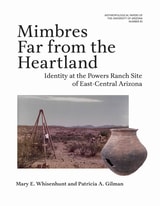
Mimbres Far from the Heartland
Identity at the Powers Ranch Site of East-Central ArizonaMary E. Whisenhunt and Patricia A. Gilman
University of Arizona Press, 2025
This new work offers a unique investigation into the complexities of Mimbres identity and social dynamics beyond the traditional Mimbres Valley heartland. Situated at the western edge of the Mimbres region, the Powers Ranch site represents a professionally excavated Classic period settlement in Arizona’s Gila River Valley. Through excavation and analysis of architecture and a rich array of artifacts, including ceramic sherds, projectile points, and shell artifacts, the authors provide a detailed look at the lives of Mimbres people on the periphery.
This work compares findings from Powers Ranch with those from neighboring sites in the Gila River Valley and further east in the Mimbres Valley, unraveling patterns of identity and affiliation that challenge previous understandings. The study is guided by three key research questions: the extent of affiliation between the community at the Powers Ranch site and Mimbres communities to the east, patterns that suggest Powers Ranch was a habitation and not a limited activity site, and whether the site was unique in comparison with Mimbres occupations situated to the south in the Gila River Valley. Contributions from scholars M. Steven Shackley, Martin H. Welker, and Arthur W. Vokes further enrich this volume, ensuring a comprehensive and authoritative exploration of the Powers Ranch site.
Mimbres Far from the Heartland is an invaluable addition to Southwest archaeology, shedding light on how people constructed unique identities in edge communities and how these identities were expressed through material culture and social networks. Whisenhunt and Gilman’s work significantly advances our understanding of Mimbres communities, offering new insights into the social resilience and cultural affiliations of people living far from their cultural heartland.
[more]
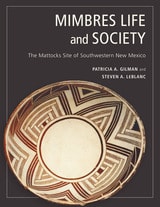
Mimbres Life and Society
The Mattocks Site of Southwestern New MexicoPatricia A. Gilman and Steven A. LeBlanc
University of Arizona Press, 2017
A thousand years ago, village farmers in the Mimbres Valley of what is now southwestern New Mexico created stunning black-on-white pottery. Mimbres pottery has added a fascinating dimension to southwestern archaeology, but it has also led to the partial or total destruction of most Mimbres sites. The Mimbres Foundation, in one of the few modern investigations of a Mimbres pueblo, excavated the Mattocks site, containing about 180 surface rooms in addition to pit structures. Mimbres Life and Society details the Mattocks site’s architecture and artifacts, and it includes 160 figures, showing more than 400 photographs of painted vessels from the site.
Mimbres pueblos, as early examples of people using surface room blocks, are ideal for investigating questions about how and why people moved from earlier subterranean pit structures to aboveground room blocks. The authors consider the number of households living at the site before and after the transition, as well as the lack of evidence for subsistence intensification and population growth as causes of this transition. These analyses suggest that each room block on the site housed a single family as opposed to multiple families, the more common interpretation. There were not necessarily more households on the site during the Classic period than earlier.
Patricia A. Gilman and Steven A. LeBlanc spent five seasons excavating at the Mattocks site and many more analyzing and writing about Mattocks site data. They note that subtle social differences among people were at play, and they emphasize that the Mattocks site may be unique among Mimbres pueblos in many aspects. Mimbres Life and Society reveals broad-ranging implications for southwestern archaeologists and anyone interested in understanding the ancient Southwest and early village societies.
[more]
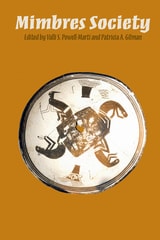
Mimbres Society
Edited by Valli S. Powell-Marti and Patricia A. Gilman
University of Arizona Press, 2006
The enchanting pottery created by the Mimbres people of southwestern New Mexico is considered by many scholars to be unique among all the ancient art traditions of North America. Distinguished by their elaborate hand-painted black-on-white designs, Mimbres vessels have inspired artists and collectors, and many insist that they are unrivaled in several millennia of pottery making.
While the attention to the extraordinary Mimbres painted pottery is well merited, the focus on its artistry alone has obscured other equally remarkable achievements and compelling questions about this unique and sophisticated society. Was the society as truly egalitarian as it has often been suggested? Was the pottery produced by specialists? How did Mimbres architecture—among the first to break living spaces into apartment-style room blocks—reflect the relationships among individuals, families, and communities? Did aggregate housing units translate into social equality, or did subtle hierarchies exist?
Tracing the way technology evolved in ceramic decoration, architecture, and mortuary practices, this collection of eight original contributions brings new insights into previously unexplored dimensions of Mimbres society. The contributors also provide vivid examples of how today’s archaeologists are linking field data to social theory.
[more]
Mimbres during the Twelfth Century
Abandonment, Continuity, and ReorganizationMargaret C. Nelson
University of Arizona Press, 1999
During the mid twelfth century, villages that had been occupied by the Mimbres people in what is now southwestern New Mexico were depopulated and new settlements were formed. While most scholars view abandonment in terms of failed settlements, Margaret Nelson shows that, for the Mimbres, abandonment of individual communities did not necessarily imply abandonment of regions. By examining the economic and social reasons for change among the Mimbres, Nelson reconstructs a process of shifting residence as people spent more time in field camps and gradually transformed them into small hamlets while continuing to farm their old fields. Challenging current interpretations of abandonment of the Mimbres area through archaeological excavation and survey, she suggests that agricultural practices evolved toward the farming of multiple fields among which families moved, with small social groups traveling frequently between small pueblos rather than being aggregated in large villages. Mimbres during the Twelfth Century is the first book-length contribution on this topic for the Classic Mimbres period and also addresses current debates on the role of Casas Grandes in these changes. By rethinking abandonment, Nelson shows how movement by prehistoric cultivators maintained continuity of occupation within a region and invites us to reconsider the dynamic relationship between people and their land.
[more]
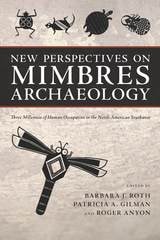
New Perspectives on Mimbres Archaeology
Three Millennia of Human Occupation in the North American SouthwestEdited by Barbara J. Roth, Patricia A. Gilman, and Roger Anyon
University of Arizona Press, 2018
In the early 1970s, understanding of the Mimbres region as a whole was in its infancy. In the following decades, thanks to dedicated work by enterprising archaeologists and nonprofit organizations, our understanding of the Mimbres region has become more complex, nuanced, and rich.
New Perspectives on Mimbres Archaeology brings together these experts in a single volume for the first time. The contributors discuss current knowledge of the people who lived in the Mimbres region of the southwestern United States and how our knowledge has changed since the Mimbres Foundation, directed by Steven A. LeBlanc, began the first modern archaeological investigations in the region. Many of these authors have spent decades conducting the fieldwork that has allowed for a broader understanding of Mimbres society.
Focusing on a variety of important research topics of interest to archaeologists—including the social contexts of people and communities, the role of ritual and ideology in Mimbres society, evidence of continuities and cultural change through time, and the varying impacts of external influences throughout the region—New Perspectives on Mimbres Archaeology presents recent data on and interpretations of the entire pre-Hispanic sequence of occupation. Additional contributions include a history of nonprofit archaeology by William H. Doelle and a concluding chapter by Steven A. LeBlanc reflecting on his decades-long work in Mimbres archaeology and outlining important areas for the next wave of research.
[more]
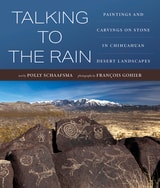
Talking to the Rain
Paintings and Carvings on Stone in Chihuahuan Desert LandscapesPolly Schaafsma, photographs by François Gohier
University of Utah Press, 2025
Explores ancient dialogue between desert farmers and the cosmos
In this visually stunning volume, Polly Schaafsma, leading authority on pre-Hispanic Indian rock imagery and kiva murals of the greater American Southwest, provides an insightful journey into the petroglyphs and rock paintings of the Jornada Mogollon farmers in southern New Mexico's lower Chihuahuan Desert.
Talking to the Rain defines the Rio Grande Tradition, emphasizing the foundational Jornada Style as exemplified by its Mimbres-like imagery as well as its diverse and complex rain-making symbolism. By examining visual metaphors of cosmology and place-making, the book reveals an ancient dialogue between farmers and the cosmos that places rain for crops as its central concern. Exceptional color photographs by François Gohier invite readers to experience the landscapes and locations selected for creating these images. Both scholarly and accessible, Talking to the Rain offers a fresh perspective on cultural landscapes and the profound connections between people, art, and environment, making it essential for understanding Southwest cultural history.
[more]