Results by title
4 books match the query 'Minstrel music'

Behind the Burnt Cork Mask
Early Blackface Minstrelsy and Antebellum American Popular CultureWilliam J. Mahar
University of Illinois Press, 1999
The songs, dances, jokes, parodies, spoofs, and skits of blackface groups such as the Virginia Minstrels and Buckley's Serenaders became wildly popular in antebellum America. Drawing on an unprecedented archival study of playbills, newspapers, sketches, monologues, and music, William J. Mahar explores the racist practices of minstrel entertainers and considers their performances as troubled representations of ethnicity, class, gender, and culture in the nineteenth century.
Mahar investigates the relationships between blackface comedy and other Western genres and traditions; between the music of minstrel shows and its European sources; and between "popular" and "elite" constructions of culture. Locating minstrel performances within their complex sites of production, Mahar reassesses the historiography of the field.
Blackface Nation
Race, Reform, and Identity in American Popular Music, 1812-1925Brian Roberts
University of Chicago Press, 2017
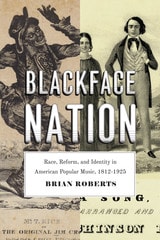
The Hutchinson Family Singers, the Northeast’s most popular middle-class singing group during the mid-nineteenth century, is perhaps the best example of the first strain of music. The group’s songs expressed an American identity rooted in communal values, with lyrics focusing on abolition, women’s rights, and socialism. Blackface minstrelsy, on the other hand, emerged out of an audience-based coalition of Northern business elites, Southern slaveholders, and young, white, working-class men, for whom blackface expressed an identity rooted in individual self-expression, anti-intellectualism, and white superiority. Its performers embodied the love-crime version of racism, in which vast swaths of the white public adored African Americans who fit blackface stereotypes even as they used those stereotypes to rationalize white supremacy. By the early twentieth century, the blackface version of the American identity had become a part of America’s consumer culture while the Hutchinsons’ songs were increasingly regarded as old-fashioned. Blackface Nation elucidates the central irony in America’s musical history: much of the music that has been interpreted as black, authentic, and expressive was invented, performed, and enjoyed by people who believed strongly in white superiority. At the same time, the music often depicted as white, repressed, and boringly bourgeois was often socially and racially inclusive, committed to reform, and devoted to challenging the immoralities at the heart of America’s capitalist order.
May Irwin
Singing, Shouting, and the Shadow of MinstrelsySharon Ammen
University of Illinois Press, 2017
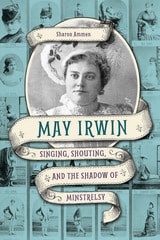
Sharon Ammen's in-depth study traces Irwin's hurly-burly life. Irwin gained fame when, layering aspects of minstrelsy over ragtime, she popularized a racist "Negro song" genre. Ammen examines this forgotten music, the society it both reflected and entertained, and the ways white and black audiences received Irwin's performances. She also delves into Irwin's hands-on management of her image and career, revealing how Irwin carefully built a public persona as a nurturing housewife whose maternal skills and performing acumen reinforced one another. Irwin's act, soaked in racist song and humor, built a fortune she never relinquished. Yet her career's legacy led to a posthumous obscurity as the nation that once adored her evolved and changed.
The Creolization of American Culture
William Sidney Mount and the Roots of Blackface MinstrelsyChristopher J. Smith
University of Illinois Press, 2014