Results by title
8 books match the query 'Miracle'
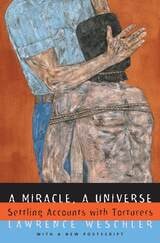
A Miracle, A Universe
Settling Accounts with TorturersLawrence Weschler
University of Chicago Press, 1998
"Disturbing and often enthralling."—New York Times Book Review
"Extraordinarily moving. . . . Weschler writes brilliantly."—Newsday
"Implausible, intricate and dazzling."—Times Literary Supplement
"As Weschler's interviewees told their tales, I paced agitatedly, choked back tears. . . . Weschler narrates these two episodes with skill and tact. . . . An inspiring book."—George Scialabba, Los Angeles Weekly

Anatomy of a Miracle
The End of Apartheid and the Birth of the New South AfricaPatti Waldmeir
Rutgers University Press, 1998
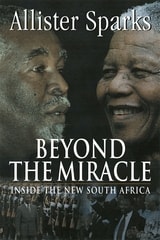
Beyond the Miracle
Inside the New South AfricaAllister Sparks
University of Chicago Press, 2003
Sparks sees South Africa as facing many of the same challenges as the rest of the world, especially a widening gap between rich and poor, exacerbated by the forces of globalization. While the transition government has done much to establish democracy and racial equality in a short time, as well as bring basic services such as clean water to millions who did not have them before, many blacks feel it has not done enough to redress the continuing imbalance of wealth in the country. Many whites, meanwhile, feel disempowered and confused about what role they have to play as a racial minority in a country they used to rule and regard as theirs by divine right. Sparks also covers other burning issues, such as the HIV/AIDS epidemic, high crime rates, the diamond wars, the Congo conflict, and the Zimbabwean land crisis.
Writing vividly and often quite movingly, Sparks draws on his decades of journalistic experience and his recent insider access to key figures in the liberation government to take stock of where South Africa has been, where it's going, and why the rest of the world should not turn away from this country where the First and Third Worlds meet. As Sparks persuasively argues, the success of Mandela's vision of a peaceful "rainbow nation" is crucial not just for the salvation of Africa, but also for the world.
“It is as good a guide to the new South Africa as any.”—Economist
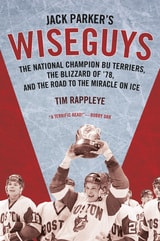
Jack Parker's Wiseguys
The National Champion BU Terriers, the Blizzard of ’78, and the Road to the Miracle on IceTim Rappleye
University Press of New England, 2017
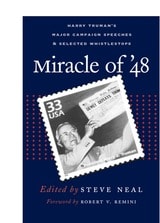
Miracle of '48
Edited by Steve Neal. Foreword by Robert V. Remini
Southern Illinois University Press, 2003
Miracle of ’48: Harry Truman’s Major Campaign Speeches and Selected Whistle-stopsis the first published collection of the public addresses Harry Truman made as he crisscrossed the United States from New York City to Los Angeles to Independence, Missouri in 1948. Edited by veteran political journalist Steve Neal, and complemented by a foreword from presidential historian Robert V. Remini, this volume captures the infectious spirit and determination of Truman’s message to the American people.
In an era when policy issues were paramount and televised debates were a thing of the future, Truman boldly stated his case directly to the American people, and they responded. “Senator Barkley and I will win this election and make these Republicans like it,” he declared in his acceptance speech at the Democratic National Convention in Philadelphia. “Don’t you forget that. We will do that because they are wrong and we are right.”
From the start of his “non-political” western tour in Crestline, Ohio, through his victory celebration in his hometown of Independence, the plainspoken Truman waged the good fight against all odds, never mixing his words or apologizing for his aggressively honest tactics. In blaming the GOP for a decline in farm prices, he alleged that the 80th Congress had “stuck a pitchfork in the farmer’s backs.” Truman is now regarded as among our greatest presidents and the populist message of his ’48 campaign is still as compelling and relevant today as it was over half a century ago.
“The political history of the United States reveals many unusual developments,” General Dwight D. Eisenhower wrote Truman after the 1948 election, “but certainly at no point does it record a greater accomplishment than yours, that can be traced so clearly to the stark courage and fighting heart of one man.”
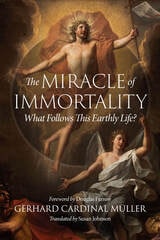
The Miracle of Immortality
What Follows This Earthly Life?Gerhard Cardinal Muller
Catholic University of America Press, 2026
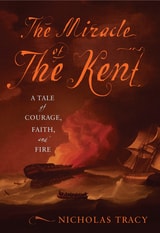
The Miracle of the Kent
A Tale of Courage, Faith, and FireNicholas Tracy
Westholme Publishing, 2008
“A naturally gripping adventure tale.”—Publishers Weekly
“Powerful and intensely focused.”—Booklist
“Tracy's satisfying narrative constitutes the first modern account. A finely detailed maritime history.”—Kirkus Reviews
In 1825, the Kent, an East Indiaman, set sail from England for India with a crew and nearly 600 men, women, and children on board. North of Spain, the ship was slammed by a ferocious gale, and while a sailor was inspecting the hold for damage, his lantern ignited a cask of spirits. A fire quickly erupted, and even with the desperate expedient of opening hatches and flooding the ship, the fire burned out of control. As night wore on, the ship became an inferno, with the flames moving toward stores of gunpowder. At this point, everyone on board knew that they would perish, and they began preparing for their ghastly deaths. Despite the raging tempest a sailor climbed one last time to the top of the Kent’s mainmast and—miraculously—a sail was sighted on the horizon. It was the Cambria, a small brig on its way to Mexico. The Cambriaspied the burning Kentand through determination and dogged seamanship in towering seas, the little brig closed the doomed vessel. Launching their boats, the Kent’s and Cambria’s crews were able to transfer nearly all of the children, women, and men to the brig and pull away before the Kent exploded. Dangerously overloaded, the Cambriamade the Cornish coast three days later.
In The Miracle of the Kent: A Tale of Courage, Faith, and Fire, award-winning historian Nicholas Tracy reconstructs this extraordinary tale through records left by the participants, revealing how those aboard the Kent faced their deaths, and their reactions to being offered a second chance. The story of the Kentis both a page-turning adventure and an inspirational homage to the capacity of the human spirit.
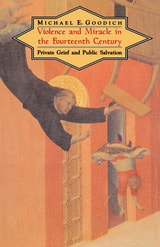
Violence and Miracle in the Fourteenth Century
Private Grief and Public SalvationMichael E. Goodich
University of Chicago Press, 1995
Rescue miracles offer a wide range of voices rarely heard in medieval history, from women and children to peasants and urban artisans. They tell of salvation not just from the ravages of nature and war, but from the vagaries of a violent society—crime, unfair judicial practices, domestic squabbles, and communal or factional conflict. The stories speak to a collapse of confidence in decaying institutions, from the law to the market to feudal authority. Particularly, the miraculous escapes documented during the Hundred Years' War, the Italian communal wars, and other conflicts are vivid testimony to the end of aristocratic warfare and the growing victimization of noncombatants.
Miracles, Goodich finds, represent the transcendent and unifying force of faith in a time of widespread distress and the hopeless conditions endured by the common people of the Middle Ages. Just as the lives of the saints, once dismissed as church propaganda, have become valuable to historians, so have rescue miracles, as evidence of an underlying medieval mentalite. This work expands our knowledge of that state of mind and the grim conditions that colored and shaped it.