Results by title
4 books match the query 'Mirandé, Alfredo'
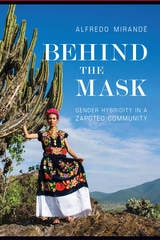
Behind the Mask
Gender Hybridity in a Zapotec CommunityAlfredo Mirandé
University of Arizona Press, 2017
The image of biologically male people dancing while dressed in the traditional, colorful attire of Zapotec, Juchiteca, females stands in sharp contrast to the prevailing view of Mexico as the land of charros, machismo, and unbridled ranchero masculinity. These indigenous people are called los muxes, and they are neither man nor woman, but rather a hybrid third gender.
After seeing a video of a muxe vela, or festival, sociologist Alfredo Mirandé was intrigued by the contradiction between Mexico’s patriarchal reputation and its warm acceptance of los muxes. Seeking to get past traditional Mexican masculinity, he presents us with Behind the Mask, which combines historical analysis, ethnographic field research, and interviews conducted with los muxes of Juchitán over a period of seven years. Mirandé observed community events, attended muxe velas, and interviewed both muxes and other Juchitán residents. Prefaced by an overview of the study methods and sample, the book challenges the ideology of a male-dominated Mexican society driven by the cult of machismo, featuring photos alongside four appendixes.
Delving into many aspects of their lives and culture, the author discusses how the muxes are perceived by others, how the muxes perceive themselves, and the acceptance of a third gender status among various North American indigenous groups. Mirandé compares traditional Mexicano/Latino conceptions of gender and sexuality to modern or Western object choice configurations. He concludes by proposing a new hybrid model for rethinking these seemingly contradictory and conflicting gender systems.
[more]
La Chicana
The Mexican-American WomanAlfredo Mirandé and Evangelina Enríquez
University of Chicago Press, 1981
La Chicana is the story of a marginal group in society, neither fully Mexican or fully American, who suffer under triple oppression: as women, as members of a colonized culture, and as victims of a cultural heritage dominated by the cult of machismo. Tracing the role of Chicanas from pre-Columbian society to the present, the authors reveal the antecedents and roots of contemporary cultural expectations in Aztec, colonial, and revolutionary Mexican historical periods. A discussion of the contribution of modern Chicanas to their community and to feminism and a look at literary stereotypes and the emergence of Chicana literature to counter them round out this perceptive and sympathetic analysis.
[more]
Ordinary Injustice
Rascuache Lawyering and the Anatomy of a Criminal CaseAlfredo Mirandé
University of Arizona Press, 2023
Ordinary Injustice is the unique and riveting story of a young Latino student, Juan Rulfo, with no previous criminal record involved in a domestic violence dispute that quickly morphs into a complex case with ten felonies, multiple enhancements, a “No Bail” order, and a potential life sentence without the possibility of parole.
Building from author Alfredo Mirandé’s earlier work Rascuache Lawyer, the account is told by “The Professor,” who led a pro bono rascuache legal defense team comprising the professor, a retired prosecutor, and student interns, working without a budget, office, paralegals, investigators, or support staff. The book is a must-read for anyone interested in race, gender, and criminal injustice and will appeal not only to law scholars and social scientists but to lay readers interested in ethnographic field research, Latinx communities, and racial disparities in the legal system.
The case is presented as a series of letters to the author’s fictional alter-ego, Fermina Gabriel, an accomplished lawyer and singer. This narrative device allows the author to present the case as it happens, relaying the challenges and complexities as they occur and drawing the reader in.
While Ordinary Injustice deals with important, complicated legal issues and questions that arise in criminal defense work and looks at the case from the time of Juan’s arrest to the preliminary hearing, indictment, pretrial motions, and attempts to obtain a negotiated plea, it is written in nontechnical and engaging language that makes law accessible to the lay reader.
[more]
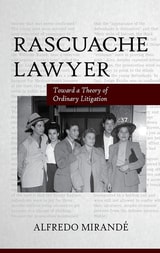
Rascuache Lawyer
Toward a Theory of Ordinary LitigationAlfredo Mirandé
University of Arizona Press, 2011
Alfredo Mirandé, a sociology professor, Stanford Law graduate, and part-time pro bono attorney, represents clients who are rascuache—a Spanish word for “poor” or even “wretched”—and on the margins of society. For Mirandé, however, rascuache means to be “down but not out,” an underdog who is still holding its ground. Rascuache Lawyer offers a unique perspective on providing legal services to poor, usually minority, folks who are often just one short step from jail. Not only a passionate argument for rascuache lawyering, it is also a thoughtful, practical attempt to apply and test critical race theory—particularly Latino critical race theory—in day-to-day legal practice.
Every chapter presents an actual case from Mirandé’s experience (only the names and places have been changed). His clients have been charged with everything from carrying a concealed weapon, indecent exposure, and trespassing to attempted murder, domestic violence, and child abuse. Among them are recent Mexican immigrants, drug addicts, gang members, and the homeless. All of them are destitute, and many are victims of racial profiling. Some “pay” Mirandé with bartered services such as painting, home repairs, or mechanical work on his car. And Mirandé doesn’t always win their cases. But, as he recounts, he certainly works tirelessly to pursue all legal remedies.
Each case is presented as a letter to a fascinating (fictional) “Super Chicana” named Fermina Gabriel, who we are told is an accomplished lawyer, author, and singer. This narrative device allows the author to present his cases as if he were recounting them to a friend, drawing in the reader as a friend as well.
Bookending the individual cases, Mirandé’s introductions and conclusions offer a compelling vision of progressive legal practice grounded in rascuache lawyering.
[more]