Results by title

14 books match the query 'Miscellaneous'
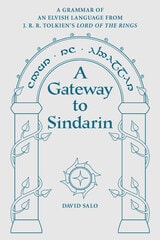
cover of A Gateway to Sindarin: A Grammar of an Elvish Language from JRR Tolkien's Lord of the Rings

A Gateway to Sindarin

A Grammar of an Elvish Language from JRR Tolkien's Lord of the Rings

David Salo

University of Utah Press, 2004

From the 1910s to the 1970s, author and linguist J. R. R. Tolkien worked at creating plausibly realistic languages to be used by the creatures and characters in his novels. Like his other languages, Sindarin was a new invention, not based on any existing or artificial language. By the time of his death, he had established fairly complete descriptions of two languages, the "elvish" tongues Quenya and Sindarin. He was able to compose poetic and prose texts in both, and he also constructed a lengthy sequence of changes for both from an ancestral "proto-language," comparable to the development of historical languages and capable of analysis with the techniques of historical linguistics.

In A Gateway to Sindarin, David Salo has created a volume that is a serious look at an entertaining topic. Salo covers the grammar, morphology, and history of the language. Supplemental material includes a vocabulary, Sindarin names, a glossary of terms, and an annotated list of works relevant to Sindarin. What emerges is an homage to Tolkien's scholarly philological efforts.

[more]
cover of A Grammar of Boumaa Fijian

A Grammar of Boumaa Fijian

R. M. W. Dixon

University of Chicago Press, 1988

The people who live in the Boumaa region of the Fijian island of Taveuni speak a dialect of Fijian that is mutually intelligible with Standard Fijian, the two differing as much perhaps as do the American and British varieties of English. During 1985, R. M. W. Dixon—one of the most insightful of linguists engaged in descriptive studies today—lived in the village of Waitabu and studied the language spoken there. He found in Boumaa Fijian a wealth of striking features unknown in commonly studied languages and on the basis of his fieldwork prepared this grammar.

Fijian is an agglutinating language, one in which words are formed by the profligate combining of morphemes. There are no case inflections, and tense and aspect as shown by independent clitics or words within a predicate complex. Most verbs come in both transitive and intransitive forms, and nouns can be build up regularly from verbal parts and verbs from nouns. The language is also marked by a highly developed pronoun system and by a vocabulary rich in areas of social significance.

In the opening chapters, Dixon describes the Islands' political, social, and linguistic organization, outlines the main points of Fijian phonology, and presents an overview of the grammar. In succeeding chapters, he examines a number of grammatical topics in greater detail, including clause and phrase structure, verbal syntax, deictics, and anaphora. The volume also includes a full vocabulary of all forms treated in discussion and three of the fifteen texts recorded from monolingual village elders on which the grammar is based.
[more]
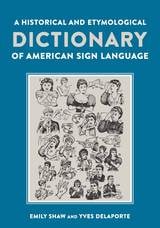
cover of A Historical and Etymological Dictionary of American Sign Language: The Origin and Evolution of More Than 500 Signs

A Historical and Etymological Dictionary of American Sign Language

The Origin and Evolution of More Than 500 Signs

Emily Shaw

Gallaudet University Press, 2014

The story of how American Sign Language (ASL) came to be is almost mythic. In the early 19th century, a hearing American reverend, Thomas Hopkins Gallaudet, met a Deaf French educator, Laurent Clerc, who agreed to come to the United States and help establish the first school in America to use sign language to teach deaf children. The trail of ASL’s development meanders at this point. No documentation of early ASL was published until the late 19th century, almost seven decades after the school’s founding. While there are many missing pieces in the history of America’s sign language, plenty of data exist regarding ASL etymology. This book is the first to collect all known texts featuring illustrations of early ASL and historical images of French Sign Language—langue des signes française (LSF)—and link them with contemporary signs.

     Through rigorous study of historical texts, field research in communities throughout France and the U.S., and an in-depth analysis of the cultural groups responsible for the lexicon, authors Emily Shaw and Yves Delaporte present a compelling and detailed account of the origins of over 500 ASL signs, including regional variations. Organized alphabetically by equivalent English glosses, each sign is accompanied by a succinct description of its origin and an LSF sign where appropriate. Featuring an introductory chapter on the history of the development of ASL and the etymological methodology used by the authors, this reference resource breaks new ground in the study of America’s sign language.
[more]
cover of Aurrera!: A Textbook for Studying Basque, Volume 1

Aurrera!

A Textbook for Studying Basque, Volume 1

Linda White

University of Nevada Press, 2008
The Basque language is one of Europe’s most ancient, its origins as mysterious as those of the Basque people themselves. It is also the official language of Euskadi, the bustling, modern Basque Autonomous Region of Spain, and the preferred tongue of tens of thousands of Basques and their descendants living in the European Basque Country and in diaspora around the world. Aurrera! is a comprehensive text for beginning-level students who are learning Basque (the Batua form approved by the Academy of the Basque Language) in a classroom setting or on their own. Each chapter introduces an element of grammar and offers students new vocabulary, written and spoken exercises, dialogues, and other activities that demonstrate the language in action, plus Basque reading texts that will entertain while they illustrate the material covered in the chapter. The complexities of Basque grammar are explained in clear, easy-to-understand terms, and the dialogues and exercises introduce students to common idioms and the basics of social conversation. Volume 1 covers material for the first two semesters of college-level language-classroom work. It is also designed to give independent learners a sound foundation in the language that will allow them to make their own way in a Basque-speaking environment and to read basic Basque texts.
[more]
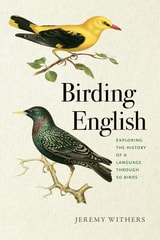
cover of Birding English: Exploring the History of a Language Through 50 Birds

Birding English

Exploring the History of a Language Through 50 Birds

Jeremy Withers

University of Iowa Press, 2026
What do words like unkindness, haggard, asparagus, jizz, and the singular they have to do with birds? Quite a lot, actually. From Old English roots and Shakespearean idioms to Victorian slang and modern online lingo, Birding English charts a dynamic course through English’s past, present, and future by admiring the plumage of falcons, the songs of sparrows, and the flight of ducks. With each of his fifty mini essays, Jeremy Withers uses birds as a point of entry into a key moment in the development of English: its origins in the Proto-Indo-European and Proto-Germanic languages, the influence of writers like Geoffrey Chaucer and William Shakespeare, the creation of English’s first dictionaries and grammar books, and the arrival of rhyming slang and portmanteaus. Ideal for word nerds and bird nerds alike, this book will enchant anyone who’s ever been captivated by the song of a bird or the song of a word.
[more]
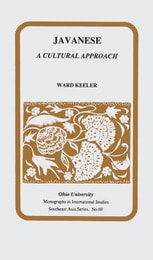
cover of Javanese: A Cultural Approach

Javanese

A Cultural Approach

Ward Keeler

Ohio University Press, 1984

Foreign language lessons often provide translations into a foreign language of phrases students would normally use in their native language and cultural setting. Particularly when studying a non-Western language, such direct translation is very misleading. Students must instead learn the conventions that guide human interactions, so they know both what to say and how to say it.

In this text, therefore, the sociological context of Javanese is explained as thoroughly as Javanese grammar. The book presents Javanese in its full complexity and range in order to illustrate a cultural appoach to a non-Western language; it will therefore be of interest not only to language learners, but to linguists, sociologists, anthropologists, and many others.
[more]
cover of Macedonian Audio Supplement: To accompany Macedonian: A Course for Beginning and Intermediate Students, Third Edition

Macedonian Audio Supplement

To accompany Macedonian: A Course for Beginning and Intermediate Students, Third Edition

Christina E. Kramer

University of Wisconsin Press, 2012

This set of audio CDs is designed to supplement the award-winning language textbook Macedonian: A Course for Beginning and Intermediate Students, Third Edition, by Christina E. Kramer and Liljana Mitkovska. The CDs contain almost two hours of audio tracks that were recorded in Macedonia by native speakers who bring to life the characters from the textbook’s story. The set additionally includes exercises for listening comprehension and the pronunciation of individual sounds.
[more]
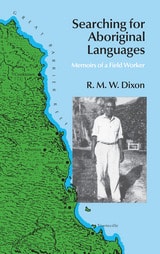
cover of Searching for Aboriginal Languages: Memoirs of a Field Worker

Searching for Aboriginal Languages

Memoirs of a Field Worker

R. M. W. Dixon

University of Chicago Press, 1989

In 1963 R. M. W. (Bob) Dixon set off for Australia, where he was to record, chart, and preserve several of the complex and nearly extinct Aboriginal languages. Beginning with his introduction to these languages while a graduate student at the University of Edinburgh and his difficulties in getting to the Australian bush, Dixon's fourteen-year tale is one of frustration and enlightenment, of setbacks and discoveries.

As he made his way through northern Australia, Dixon was dependent on rumors of Aboriginal speakers, the unreliable advice of white Australians, and the faulty memories of many of the remaining speakers of the languages. Suggestions of informants led him on a circuitous trail through the bush, to speakers such as the singer Willie Kelly in Ravenshoe, who wanted his recordings sent to the south, "where white people would pay big money to hear a genuine Aborigine sing" and Chloe Grant in Murray Upper, who told tales in four dialects of digging wild yams, of the blue-tongue lizard Banggara, and of the arrival of Captain Cook. Dixon tells of obtaining the trust of possible informants, of learning the customs and terrain of the country, and of growing understanding of the culture and tradition of his subjects. And he explains his surprise at his most unexpected discovery: that the rich oral tradition of the "primitive" Aborigines could yield a history of a people, as told by that people, that dates to almost ten millenia before.
[more]
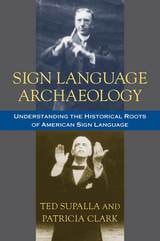
cover of Sign Language Archaeology: Understanding the Historical Roots of American Sign Language

Sign Language Archaeology

Understanding the Historical Roots of American Sign Language

Ted Supalla

Gallaudet University Press, 2014

This engrossing study investigates the infancy of American Sign Language (ASL). Authors Ted Supalla and Patricia Clark highlight the major events in ASL history, revealing much of what has not been clearly understood until now. According to tradition, ASL evolved from French Sign Language. The authors analyze the metalinguistic assumptions of these early accounts and also examine in depth a key set of films made by the National Association of the Deaf (NAD) between 1910 and 1920. Designed by the NAD to preserve classic ASL, the films feature 15 sign masters, the model signers of that time. In viewing these films, the authors discovered that the sign masters signed differently depending on their age. These variations provide evidence about the word formation process of early ASL, further supported by data collected from dictionaries of the 19th and early 20th centuries.

     By tracing the writings of selected individuals, this study reconstructs the historical context for early ASL grammar. It describes the language used in each century and how it changed, and focuses on the rediscovery of the literary legacy of the Deaf American voice. Sign Language Archaeology reveals the contrast between folk etymology and scientific etymology and allows readers to see ASL in terms of historical linguistics.
[more]
cover of Studies in Austronesian Linguistics: Mis Sea#76

Studies in Austronesian Linguistics

Mis Sea#76

Richard Mcginn

Ohio University Press, 1986
This volume consists of seventeen articles by scholars including Robert Blust, Paul Hopper, A. L. Becker, Sarah Bell, J. C. Catford, Talmy Givón, J. W. M. Verharr and John U. Wolff. Tagalog, Cebuano, Ilokano, Chamorro, Malay, Old Malay, Javanese, Old Javanese, Indonesian, Niases, Loniu, and Niuean are some of the languages discussed in the study. The essays explore the issues of ergativity in Western Austronesian languages, historical morphology, phonology, phonetics and morphophonemics.
[more]
cover of Teaching Foreign Language Skills: Second Edition

Teaching Foreign Language Skills

Second Edition

Wilga M. Rivers

University of Chicago Press, 1981
Since its original publication in 1968, Rivers's comprehensive and practical text has become a standard reference for both student teachers and veteran instructors. All who wish to draw from the most recent thinking in the field will welcome this new edition. Methodology is appraised, followed up by discussions on such matters as keeping students of differing abilities active, evaluating textbooks, using language labs creatively, and preparing effective exercises and drills. The author ends each chapter of this new edition with questions for research and discussion—a useful classroom tool—and provides an up-to-date bibliography that facilitates further understanding of such matters as the bilingual classroom.
[more]
cover of The Basque Language: A Practical Introduction

The Basque Language

A Practical Introduction

Alan R. King

University of Nevada Press, 2012
Since its first publication in 1994, Alan R. King’s introduction to the Basque language has become the standard textbook for classroom language students and individuals learning this unique language on their own. It offers clear explanations of grammatical structure, exercises that allow students to practice grammatical and communication skills, dialogues and narrative texts that provide a glimpse into Basque social and family life. It also provides exercises in pronunciation and tips for instructors and students to help them achieve fluency in modern Basque.
[more]
cover of Theoretical Perspectives on Word Order in South Asian Languages

Theoretical Perspectives on Word Order in South Asian Languages

Edited by Miriam Butt, Tracy Holloway King, and Gillian Ramchand

CSLI, 1994
Subject: Linguistics; South Asian Languages; Indo-Aryan Languages
[more]
cover of Vocabulary Building in Indonesian: An Advanced Reader

Vocabulary Building in Indonesian

An Advanced Reader

Soenjono Dardjowidjojo

Ohio University Press, 1984

An outstanding advanced text intended to complement and supplement Indonesian language materials now available. The author takes the student through a series of original essays and previously published material on a variety of subjects, not merely explaining grammatical and vocabulary matters, but offering detailed discussions of nuances, alternative meanings, synonyms and antonyms. This unique vocabulary exploration device forms about one–third of the book, and makes the lessons powerful aids to efficient and in–depth language learning.
[more]