Results by title
3 books match the query 'Missing in action'

Lost Eagles
One Man's Mission to Find Missing Airmen in Two World WarsBlaine Pardoe
University of Michigan Press, 2010
Praise for Lost Eagles
"The pilot and observer stories selected have not previously seen much exposure. Not only are they interesting, but I found myself relishing getting to the next chapter to find out what Frederick Zinn was doing during the next stage of his life."
---Alan Roesler, founding member, League of World War I Aviation Historians, and former Managing Editor, Over the Front
Praise for Blaine Pardoe's previous military histories (which average 4.5-star customer reviews on Amazon.com):
Terror of the Autumn Skies: The True Story of Frank Luke, America's Rogue Ace of World War I
"This painstaking biography of World War I ace Frank Luke will earn Pardoe kudos . . . Pardoe has flown a very straight course in researching and recounting Luke's myth-ridden life. . . . Thorough annotation makes the book that much more valuable to WWI aviation scholars as well as for more casual air-combat buffs."
---Booklist
The Cruise of the Sea Eagle: The Amazing True Story of Imperial Germany's Gentleman Pirate
"This is a gem of a story, well told, and nicely laid out with photos, maps, and charts that cleverly illuminate the lost era of ‘gentlemen pirates' at sea . . . [German commerce raider Felix von Luckner's] legend lives on in this lively and readable biography."
---Admiral James Stavridis, U.S. Navy, Naval History
Few people have ever heard of Frederick Zinn, yet even today airmen's families are touched by this man and the work he performed in both world wars. Zinn created the techniques still in use to determine the final fate of airmen missing in action. The last line of the Air Force Creed reads, "We will leave no airman behind." Zinn made that promise possible.
Blaine Pardoe weaves together the complex story of a man who brought peace and closure to countless families who lost airmen during both world wars. His lasting contribution to warfare was a combination of his methodology for locating the remains of missing pilots (known as the Zinn system) and his innovation of imprinting all aircraft parts with the same serial number so that if a wreck was located, the crewman could be identified. The tradition he established for seeking and recovering airmen is carried on to this day.
Blaine Pardoe is an accomplished author who has published dozens of military fiction novels and other books, including the widely acclaimed Cubicle Warfare: Self-Defense Tactics for Today's Hypercompetitive Workplace; Terror of the Autumn Skies: The True Story of Frank Luke, America's Rogue Ace of World War I; and The Cruise of the Sea Eagle: The Amazing True Story of Imperial Germany's Gentleman Pirate.
Jacket photo: Frederick Zinn's Sopwith aircraft, which crashed during World War I. National Museum of the United States Air Force Archives.
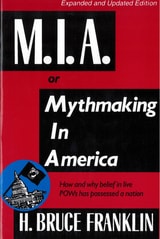
M.I.A. or Mythmaking in America
How and why belief in live POWs has possessed a nationFranklin, H. Bruce
Rutgers University Press, 1992
This paperback edition of M.I.A. or Mythmaking in America adds major new material about Ross Perot's role, the 1991-1992 Senate investigation, and illegal operations authorized by Ronald Reagan.
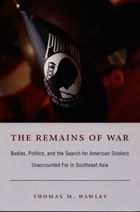
The Remains of War
Bodies, Politics, and the Search for American Soldiers Unaccounted For in Southeast AsiaThomas M. Hawley
Duke University Press, 2005
Hawley combines the theoretical insights of Judith Butler, Michel Foucault, and Emmanuel Levinas with detailed research into the history of the movement to recover the remains of soldiers missing in Vietnam. He examines the practices that constitute the Defense Department’s accounting protocol: the archival research, archaeological excavation, and forensic identification of recovered remains. He considers the role of the American public and the families of missing soldiers in demanding the release of pows and encouraging the recovery of the missing; the place of the body of the Vietnam veteran within the war’s legacy; and the ways that memorials link individual bodies to the body politic. Highlighting the contradictions inherent in the recovery effort, Hawley reflects on the ethical implications of the massive endeavor of the American government and many officials in Vietnam to account for the remains of American soldiers.