Results by title
7 books match the query 'Missions, American'
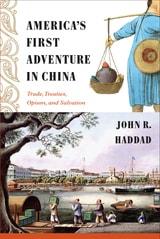
America's First Adventure in China
Trade, Treaties, Opium, and SalvationJohn R Haddad
Temple University Press, 2014
In America's First Adventure in China, John Haddad provides a colorful history of the evolving cultural exchange and interactions between these countries. He recounts how American expatriates adopted a pragmatic attitude-as well as an entrepreneurial spirit and improvisational approach-to their dealings with the Chinese. Haddad shows how opium played a potent role in the dreams of Americans who either smuggled it or opposed its importation, and he considers the missionary movement that compelled individuals to accept a hard life in an alien culture.
As a result of their efforts, Americans achieved a favorable outcome—they established a unique presence in China—and cultivated a relationship whose complexities continue to grow.
American Missionaries and the Middle East
Foundational EncountersMehmet Ali Dogan
University of Utah Press, 2010
During the nineteenth and early twentieth centuries, American missionary encounters in the Middle East set foundations for later U.S.-Middle Eastern relations. Missionaries presented examples of American culture to Middle Eastern peoples, just as they interpreted the Middle East for Americans back home. These engagements prompt larger questions about the consequences of American Christian cultural projection into the wider world.
This volume focuses on regions that were once part of the Ottoman Empire in western Asia, the Balkans, and North Africa. Contributors explain the distinctly American dimensions of these missionary encounters, the cultural influences they exerted on the region, and their consequences for local nationalism, print culture, education, and more. This is an excellent resource for specialists in history, Middle Eastern studies, American studies, religious studies, missiology, and anyone interested more broadly in American engagement in the Middle East.
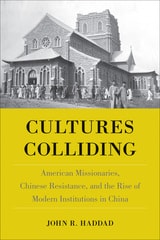
Cultures Colliding
American Missionaries, Chinese Resistance, and the Rise of Modern Institutions in ChinaJohn R. Haddad
Temple University Press, 2023
As incredible as it may seem, the American missionaries who journeyed to China in 1860 planning solely to spread the Gospel ultimately reinvented their entire enterprise. By 1900, they were modernizing China with schools, colleges, hospitals, museums, and even YMCA chapters. In Cultures Colliding, John R. Haddad nimbly recounts this transformative institution-building—how and why it happened—and its consequences.
When missionaries first traveled to rural towns atop mules, they confronted populations with entrenched systems of belief that embraced Confucius and rejected Christ. Conflict ensued as these Chinese viewed missionaries as unwanted disruptors. So how did this failing movement eventually change minds and win hearts? Many missionaries chose to innovate. They built hospitals and established educational institutions offering science and math. A second wave of missionaries opened YMCA chapters, coached sports, and taught college. Crucially, missionaries also started listening to Chinese citizens, who exerted surprising influence over the preaching, teaching, and caregiving, eventually running some organizations themselves. They embraced new American ideals while remaining thoroughly Chinese.
In Cultures Colliding, Haddad recounts the unexpected origins and rapid rise of American institutions in China by telling the stories of the Americans who established these institutions and the Chinese who changed them from within. Today, the impact of this untold history continues to resonate in China.
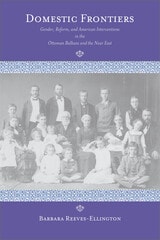
Domestic Frontiers
Gender, Reform, and American Interventions in the Ottoman Balkans and the Near EastBarbara Reeves-Ellington
University of Massachusetts Press, 2013
During the nineteenth and early twentieth centuries, American Protestant missionaries attempted to export their religious beliefs and cultural ideals to the Ottoman Empire. Seeking to attract Orthodox Christians and even Muslims to their faith, they promoted the paradigm of the “Christian home” as the foundation of national progress. Yet the missionaries' efforts not only failed to win many converts but also produced some unexpected results.
Drawing on a broad range of sources—Ottoman, Bulgarian, Russian, French, and English—Barbara Reeves-Ellington tracks the transnational history of this little-known episode of American cultural expansion. She shows how issues of gender and race influenced the missionaries' efforts as well as the complex responses of Ottoman subjects to American intrusions into their everyday lives. Women missionaries—married and single—employed the language of Christian domesticity and female moral authority to challenge the male-dominated hierarchy of missionary society and to forge bonds of feminist internationalism. At the same time, Orthodox Christians adapted the missionaries' ideology to their own purposes in developing a new strain of nationalism that undermined Ottoman efforts to stem growing sectarianism within their empire. By the beginning of the twentieth century, as some missionaries began to promote international understanding rather than Protestantism, they also paved the way for future expansion of American political and commercial interests.
Errand to the World
American Protestant Thought and Foreign MissionsWilliam R. Hutchison
University of Chicago Press, 1987

Korea Letters in the William Elliot Griffis Collection
An Annotated SelectionYoung-mee Yu Cho
Rutgers University Press, 2024
The Korean materials in the Griffis Collection at Rutgers University consist of journals, correspondence, articles, maps, prints, photos, postcards, manuscripts, scrapbooks, and ephemera. These papers reflect Griffis's interests and activities in relation to Korea as a historian, scholar, and theologian. They provide a rare window into the turbulent period of late nineteenth- and twentieth-century Korea, witnessed and evaluated by Griffis and early American missionaries in East Asia. The Korea Letters in the William Elliot Griffis Collection are divided into two parts: letters from missionaries and letters from Japanese and Korean political figures. Newly available and accessible through this collection, these letters develop a multifaceted history of early American missionaries in Korea, the Korean independence movement, and Griffis's views on Korean culture.
The Foreign Missionary Enterprise at Home
Explorations in North American Cultural HistoryEdited by Daniel H. Bays and Grant Wacker
University of Alabama Press, 2010
This volume is the first to examine at length and in detail the impact of the missionary experience on American cultural, political, and religious history.
This collection of 15 essays provides a fully developed account of the domestic significance of foreign missions from the 19th century through the Vietnam War. U.S. and Canadian missions to China, South America, Africa, and the Middle East have, it shows, transformed the identity and purposes of their mother countries in important ways. Missions provided many Americans with their first significant exposure to non-Western cultures and religions. They helped to establish a variety of new academic disciplines in home universities—linguistics, anthropology, and comparative religion among them. Missionary women helped redefine gender roles in North America, and missions have vitalized tiny local churches as well as entire denominations, causing them to rethink their roles and priorities, both here and abroad. In fact, missionaries have helped define our own national identity by influencing our foreign, trade, military, and immigration policies over the last two centuries.
Topics in the collection range from John Saillant's essay on the missions of free African Americans to Liberia in the 19th century to Grant Wacker's essay on the eventual disillusionment of noted writer Pearl S. Buck. Kathryn T. Long’s essay on the “Auca martyrs” offers a sobering case study of the missionary establishment's power to, in tandem with the evangelical and secular press, create and record the stories of our time. William L. Svelmoe documents the improbable friendship between fundamentalist Bible translator William Cameron Townsend and Mexico’s secular socialist president Lázaro Cárdenas. And Anne Blue Wills details the ways many American groups—black, Protestant, Catholic, and Mormon—sought to convert one another, stead-
fastly envisioning “others” as every bit as “heathen” as those in far-off lands.
The Foreign Missionary Enterprise at Home is an insightful, provocative collection that will stimulate much discussion and debate. It is valuable for academic libraries and seminaries, scholars of religious history and American studies, missionary groups, cultural historians and ethnographers, and political scientists.