Results by title
4 books match the query 'Mitchell, Rick'

Brecht in L.A.
Rick Mitchell
Intellect Books, 1995
Additionally, Brecht in L.A., winner of the 2002 SWTA National New Play Contest (US), is already a critically acclaimed play, which suggests that the work has the potential to be widely (and successfully) produced. And such productions will enhance the marketability of the book. A play influenced by Brecht is, in itself, not unique, since many leading, contemporary dramatists--such as Caryl Churchill, Edward Bond, Tony Kushner, Heiner Muller, and Howard Barker--have been affected by Brechtian dramaturgy. But a Brechtian-influenced play with Brecht as the lead character is unique. The play represents the only dramatic work in English which features Brecht himself as the title character.
Brecht in L.A., centering on Brecht while adapting/critiquing Brechtian dramatic form, also provides a unique opportunity for the instructor who is teaching Brechtian theatre since--with just one text (which will includes endnotes and appendices)--the instructor can cover epic theatre, the "Brecht debate," Brecht's biography, and contradictions between Brecht's theatrical practices and his everyday life.
The book's wide-ranging audience will include theatre artists; playgoers; students of drama, theatre, English, and performance studies; scholars; and readers interested in Brecht, Hollywood, and/or biography. Brecht in L.A. will also be an important addition to the considerable collections of books about Brecht which are carried by countless libraries.
Disaster Capitalism
Or Money Can't Buy You Love - Three PlaysRick Mitchell
Intellect Books, 2011
Disaster capitalism is an increasingly popular critical paradigm for contextualizing and understanding life in the twenty-first century. This book includes three full-length plays by award-winning dramatist Rick Mitchell: Shadow Anthropology, a dark comedy about the US occupation of Afghanistan; Through the Roof, a Faustian trip through the social history of natural disaster in New Orleans; and Celestial Flesh, a sacrilegious romp through the 1980s sanctuary movement. Placing the plays in historical and thematic context, the author introduces the collection with an essay examining catastrophe, capitalism, and what he calls “Apocalypse Theater for the Twenty-First Century.”
The Composition of Herman Melville
Rick Mitchell
Intellect Books, 2002
This play, which contains biographical information relating to Herman Melville, is fundamentally an exploration of the ways in which these two things take place.
The play admits the truth of Walter Benjamin's view of history as, "time filled by the presence of the now." Parallels between past and present (e.g., racism, domestic abuse, and the plight of the visionary American artist) are clearly implied, but the play also utilizes new technologies, in particular video, in order to represent the kind of dialectical history and representation promoted by Benjamin.
During Melville's lifetime, and in his own creative imagination, the archaic was undergoing its transformation into modernity. Thus Melville is an especially apt subject for an exploration of modernity and representation that utilizes both the modern &endash; i.e., video, montage &endash; and elements of the archaic &endash; i.e., the performing body, allusions to whaling, 'discovery' in the South Seas.
The Composition of Herman Melville utilizes performance strategies in an effort to embody the complex textuality of a writer who haunts the landscape of America, from the mid-nineteenth century to the present. This book is believed to represent the only work of historical fiction &endash; albeit in dramatic form &endash; that focuses primarily on Herman Melville, considered by many to be America's greatest writer.
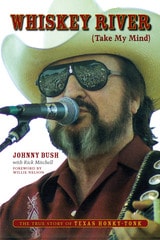
Whiskey River (Take My Mind)
The True Story of Texas Honky-TonkBy Johnny Bush with Rick Mitchell
University of Texas Press, 2007
When it comes to Texas honky-tonk, nobody knows the music or the scene better than Johnny Bush. Author of Willie Nelson's classic concert anthem "Whiskey River," and singer of hits such as "You Gave Me a Mountain," "Undo the Right," "Jim, Jack and Rose," and "I'll Be There," Johnny Bush is a legend in country music, a singer-songwriter who has lived the cheatin', hurtin', hard-drinkin' life and recorded some of the most heart-wrenching songs about it. He has one of the purest honky-tonk voices ever to come out of Texas. And Bush's career has been just as dramatic as his songs—on the verge of achieving superstardom in the early 1970s, he was sidelined by a rare vocal disorder that he combated for thirty years. But, survivor that he is, Bush is once again filling dance halls across Texas and inspiring a new generation of musicians who crave the authenticity—the "pure D" country—that Johnny Bush has always had and that Nashville country music has lost.
In Whiskey River (Take My Mind), Johnny Bush tells the twin stories of his life and of Texas honky-tonk music. He recalls growing up poor in Houston's Kashmere Gardens neighborhood and learning his chops in honky-tonks around Houston and San Antonio—places where chicken wire protected the bandstand and deadly fights broke out regularly. Bush vividly describes life on the road in the 1960s as a band member for Ray Price and Willie Nelson, including the booze, drugs, and one-night stands that fueled his songs but destroyed his first three marriages. He remembers the time in the early 1970s when he was hotter than Willie and on the fast track to superstardom—until spasmodic dysphonia forced his career into the slow lane. Bush describes his agonizing, but ultimately successful struggle to keep performing and rebuild his fan base, as well as the hard-won happiness he has found in his personal life.
Woven throughout Bush's autobiography is the never-before-told story of Texas honky-tonk music, from Bob Wills and Floyd Tillman to Junior Brown and Pat Green. Johnny Bush has known almost all the great musicians, past and present, and he has wonderful stories to tell. Likewise, he offers shrewd observations on how the music business has changed since he started performing in the 1950s—and pulls no punches in saying how Nashville music has lost its country soul. For everyone who loves genuine country music, Johnny Bush, Willie Nelson, and stories of triumph against all odds, Whiskey River (Take My Mind) is a must-read.