Results by title
3 books match the query 'Mitchell, Timothy'
911 A Public Emergency?, Volume 20
Ella Shohat, Brent Edwards, Stefano Harney, Randy Martin, Timothy Mitchell, and Fred Moten, eds.
Duke University Press, 0
Examining the strengths and shortcomings of area, race, and gender studies in the search for understanding, this issue considers cross-cultural feminism as a means of combating terrorism; racial profiling of Muslims in the context of other racist logics; and the homogenization of dissent. The issue includes poetry, photographic work, and an article by Judith Butler on the discursive space surrounding the attacks of September 11. This impressive range of contributions questions the meaning and implications of the events of September 11 and their aftermath.
Contributors. Muneer Ahmad, Meena Alexander, Lopamudra Basu, Judith Butler, Zillah Eisenstein, Stefano Harney, Randy Martin, Rosalind C. Morris, Fred Moten, Sandrine Nicoletta, Yigal Nizri, Jasbir K. Puar, Amit S. Rai, Ella Shohat, Ban Wang
Palestine in a Transnational Context, Volume 21
Timothy Mitchell , Gyan Prakash and Ella Shohat, eds.
Duke University Press, 0
This special issue places the Palestine question in a transnational and comparative frame that strives to better depict its historical complexity. The issue also gives special consideration to the different modes of Palestinian resistance both within and outside the state of Israel and the occupied territories.
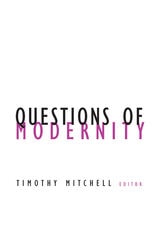
Questions Of Modernity
Timothy Mitchell
University of Minnesota Press, 2000
Well-known contributors offer an illuminating look at how modernity develops in non-Western contexts.
Modernity has always laid claim to universal certainty—which meant assigning a different and lesser significance to anything deemed purely local, non-Western, or lacking a universal expression. This book makes those very non-Western, non-universal elements the tools for fashioning a more complex, rigorous, and multifaceted understanding of how the modern comes about. Focusing on the making of modernity outside the West, eight leading anthropologists, historians, and political theorists explore the production of new forms of politics, sensibility, temporality, and selfhood in locations ranging from nineteenth-century Bengal to contemporary Morocco.
Topics include the therapeutics of colonial medical practice, the multiple registers of popular film, television serials and their audiences, psychiatrists and their patients, the iconic figure of the young widow, and the emergence of new political forms beyond the grasp of civil society. Contributors: Lila Abu-Lughod, Columbia U; Dipesh Chakrabarty, U of Chicago; Partha Chatterjee, Centre for Studies in Social Sciences, Calcutta; Veena Das, U of Delhi; Nicholas B. Dirks, Columbia U; Stefania Pandolfo, UC Berkeley; and Gyan Prakash, Princeton U.