Results by title
10 books match the query 'Mixed Media'
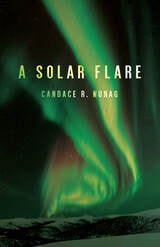
A Solar Flare
Candace R. Nunag
University of Alabama Press, 2025
A hybrid of short works exploring the 1859 Carrington solar flare
A flood of illumination, a cosmic cataclysm frozen in time—the Carrington Event of 1859 was the most disruptive solar flare in recorded history, an electromagnetic storm that wiped out telegraph systems across the world and which, if it were to occur today, might well destroy anything on the planet with an electrical circuit.
Candace Nunag’s A Solar Flare is a hybrid of short essays, research notes, poems, graphite rubbings, and instant photographs, as well as bits of flash fiction, all simultaneously contemplating technology and memory, while preoccupied with the 1859 solar flare. The ghost of the Carrington Event haunts A Solar Flare with the promise of definitive answers about the narrator’s many severed connections: her digital, supernatural, eastern, western, and analog past. It is an attempt to illuminate the path of thought, wending its way through the tangles of rumination and irreconcilable spaces of wonder.

Beyond the Visual
Multisensory Modes of Beholding ArtEdited by Ken Wilder and Aaron McPeake
University College London, 2025
In what ways can visual art be enjoyed beyond sight? Bringing together leading international scholars and artists in the emerging field of “blindness arts”—including blind and partially blind artists, curators, advocates for inclusive practices and models of audio description, cognitive psychologists, and theorists of installation, performance, and sound art—Beyond the Visual seeks to broaden the discussion of multisensory ways of beholding contemporary art, with a particular emphasis on modes that transcend a dependency upon sight. Through diverse examples of multisensory engagement, it contributes to ongoing conversations around accessibility and blindness in art while also challenging and expanding our understanding of how art is experienced.

Essay Film and Narrative Techniques
Screen-writing Non-fictionEdited by Romana Turina and Kiki Tianqi Yu
Intellect Books, 2025
Uniting filmmakers and practice-led researchers, Essay Film and Narrative Techniques: Screen-writing Non-fiction explores the evolving language of essay film through various methods of narration, including production diaries, self-critiques, interviews, and theoretical analyses. Including canonical works and unconventional approaches, this collection emphasizes how essay films blur the lines between personal expression and collective storytelling.
In this volume, renowned scholars and practitioners unpack the conceptual and contextual dimensions of screenwriting for essay film, considering its role as both a cinematic and research tool. Whether reflecting on the personal camera or hybrid creative methodologies, the essays provide invaluable insights into how essay films are written and realized.
With its interdisciplinary scope and innovative approach, this work is a beneficial resource for academics, filmmakers, and students of documentary and experimental cinema, offering a nuanced understanding of how screenwriting shapes nonfiction storytelling.
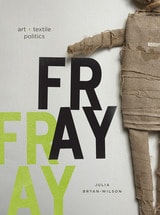
Fray
Art and Textile PoliticsJulia Bryan-Wilson
University of Chicago Press, 2017
Closely examining how amateurs and fine artists in the United States and Chile turned to sewing, braiding, knotting, and quilting amid the rise of global manufacturing, Julia Bryan-Wilson argues that textiles unravel the high/low divide and urges us to think flexibly about what the politics of textiles might be. Her case studies from the 1970s through the 1990s—including the improvised costumes of the theater troupe the Cockettes, the braided rag rugs of US artist Harmony Hammond, the thread-based sculptures of Chilean artist Cecilia Vicuña, the small hand-sewn tapestries depicting Pinochet’s torture, and the NAMES Project AIDS Memorial Quilt—are often taken as evidence of the inherently progressive nature of handcrafted textiles. Fray, however, shows that such methods are recruited to often ambivalent ends, leaving textiles very much “in the fray” of debates about feminized labor, protest cultures, and queer identities; the malleability of cloth and fiber means that textiles can be activated, or stretched, in many ideological directions.
The first contemporary art history book to discuss both fine art and amateur registers of handmaking at such an expansive scale, Fray unveils crucial insights into how textiles inhabit the broad space between artistic and political poles—high and low, untrained and highly skilled, conformist and disobedient, craft and art.
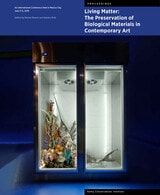
Living Matter
The Preservation of Biological Materials in Contemporary Art: An International Conference Held in Mexico City, June 3–5, 2019Rachel Rivenc
J. Paul Getty Trust, The, 2022
Eggshells, flowers, onion peels, sponge cake, dried bread, breast milk, bacteria, living organisms—these are just a few of the biological materials that contemporary artists are using to make art. But how can works made from such perishable ingredients be preserved? And what logistical, ethical, and conceptual dilemmas might be posed by doing so?
Because they are prone to rapid decay, even complete disappearance, biological materials used in art pose a range of unique conservation challenges. This groundbreaking book probes the issues associated with displaying, collecting, and preserving these unique works of art. The twenty-four papers from the conference present a range of case studies, prominently featuring artists’ perspectives, as well as conceptual discussions, thereby affording a comprehensive and richly detailed overview of current thinking and practices on this topic. Living Matter is the first publication to explore broadly the role of biological materials in the creative process and present a variety of possible approaches to their preservation.
The free online edition of this open-access publication is available at www.getty.edu/publications/living-matter/ and includes videos and zoomable illustrations. Also available are free PDF, EPUB, and Kindle/MOBI downloads of the book.
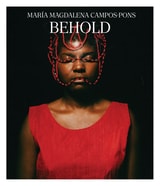
María Magdalena Campos-Pons
BeholdCarmen Hermo
J. Paul Getty Trust, The, 2023
María Magdalena Campos-Pons (b. 1959) makes powerful work that holds and beholds the stories of historically silenced peoples and urges societal change. Her journey as an artist, teacher, and activist has taken her from Cuba through the United States, and her autobiographical compositions honor her Nigerian and Chinese ancestors while also facing the future. With an artistic practice that crosses boundaries, intertwines media—from photography to sculpture, film to performance—and references traditions and beliefs ranging from feminism to Santería, Campos-Pons’s work is deeply layered and complex.
This volume, the first critical look at the artist’s oeuvre in nearly two decades, surveys the concerns, materials, and places invoked throughout her forty-year career. Thoughtful essays explore her vibrant, arresting artwork, which confronts issues of agency and the construction of race and belonging and challenges us to reckon with these issues in our own lives.
This volume, copublished with the Brooklyn Museum, accompanies an exhibition on view at the Brooklyn Museum from September 15, 2023, to January 14, 2024, the Nasher Museum of Art at Duke University from February 15 to June 9, 2024, the Frist Art Museum from September 27, 2024, to January 5, 2025, and the J. Paul Getty Museum at the Getty Center from February 11 to May 4, 2025.

Mixed Media
Feminist Presses and Publishing PoliticsSimone Murray
Pluto Press, 2004
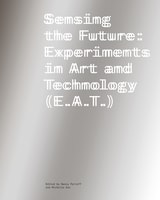
Sensing the Future
Experiments in Art and Technology (E.A.T.)Nancy Perloff
J. Paul Getty Trust, The, 2024
In 1966, Billy Klüver and Fred Waldhauer, engineers at Bell Labs in Murray Hill, New Jersey, teamed up with artists Robert Rauschenberg and Robert Whitman to form a nonprofit organization, Experiments in Art and Technology (E.A.T.). E.A.T.’s debut event, 9 Evenings: Theatre & Engineering, integrated art, theater, and groundbreaking technology in a series of performances at the 69th Regiment Armory in Manhattan. Its second major event, the Pepsi Pavilion at Expo ’70 in Osaka, Japan, presented a multisensory environment for the first world exposition held in Asia. At these events, and in the hundreds of collaborations E.A.T. facilitated in between, the participants—including John Cage, Lucinda Childs, Deborah Hay, Steve Paxton, Yvonne Rainer, and David Tudor—imagined innovative ways for art and science to intersect and enrich society.
Sensing the Future tells the story of these collaborations between artists and engineers and how they led to new installations and technology-based artworks. Through the examination of films, photographs, diagrams, and artists’ records from the E.A.T. archive at the Getty Research Institute, this volume provides a new perspective on multimedia art in the 1960s and ’70s and highlights the ways E.A.T. pushed the role of the artist beyond the traditional art world.
This volume is published to accompany an exhibition on view at the Getty Research Institute at the Getty Center from September 10, 2024, to February 23, 2025.
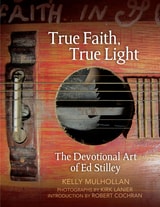
True Faith, True Light
The Devotional Art of Ed StilleyKelly Mulhollan
University of Arkansas Press, 2015
But one day Ed’s life was permanently altered. While plowing his field, he became convinced he was having a heart attack. Ed stopped his work and lay down on the ground. Staring at the sky, he saw himself as a large tortoise struggling to swim across a river. On his back were five small tortoises—his children—clinging to him for survival. And then, as he lay there in the freshly plowed dirt, Ed received a vision from God, telling him that he would be restored to health if he would agree to do one thing: make musical instruments and give them to children.
And so he did. Beginning with a few simple hand tools, Ed worked tirelessly for twenty-five years to create over two hundred instruments, each a crazy quilt of heavy, rough-sawn wood scraps joined with found objects. A rusty door hinge, a steak bone, a stack of dimes, springs, saw blades, pot lids, metal pipes, glass bottles, aerosol cans—Ed used anything he could to build a working guitar, fiddle, or dulcimer. On each instrument Ed inscribed “True Faith, True Light, Have Faith in God.”
True Faith, True Light: The Devotional Art of Ed Stilley documents Ed Stilley’s life and work, giving us a glimpse into a singular life of austere devotion.
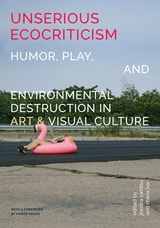
Unserious Ecocriticism
Humor, Play & Environmental Destruction in Art & Visual CultureEdited by Jessica Landau and Maria Lux
Amherst College Press, 2026
Climate change, biodiversity loss, and environmental injustice are complex, messy, and gravely important issues. In addressing these concerns, traditional ecocriticism understandably has taken itself very seriously. Unserious Ecocriticism, by contrast, highlights alternative responses to the challenges of environmental collapse and catastrophe. By theorizing an unserious ecocriticism, contributors to this volume validate and empower alternatives to mainstream environmentalism, scholarship, and artmaking. The essays, artworks, and non-traditional scholarly formats of this edited collection demonstrate that the creative tools available to artists and those who study them are particularly well positioned to inventively disrupt normative modes of ecocritical presentation and environmentalist thought.
Rather than approach environmental crises through tragic and dire warnings, contributors take seriously the unexpected or easily dismissed, play with format and form, embrace the bodily and abject, take pleasure in their subjects of study, have fun, and crack jokes. In Unserious Ecocriticism, humor, playfulness, parody, and irreverence become tools to challenge expectations, cope with complicated problems, and imagine new futures.
Edited by Jessica Landau and Maria Lux, with a foreword by Aaron Sachs and contributions from Allie ES Wist, Deke Weaver, Kathleen McDermott, Annie Ronan, Kimiko Matsumura, Ina Linge, Paula Kupfer, Craig Carey, Anna Ialeggio, Topher Lineberry, Stentor Danielson, Patrick Gonder, Matthew Teti, Nicole Seymour, with Emily Eliza Scott, Rob Gioielli, and Jenny Price, Phaan Howng, and Jennifer Schell.