Results by title
7 books match the query 'Mochica Indians'
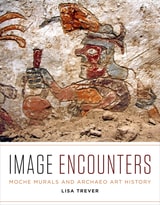
Image Encounters
Moche Murals and Archaeo Art HistoryLisa Trever
University of Texas Press, 2022
2022 Mr. and Mrs. Raymond J. Horowitz Book Prize, Bard Graduate Center
A landmark study of ancient Peruvian Moche mural art.
Moche murals of northern Peru represent one of the great, yet still largely unknown, artistic traditions of the ancient Americas. Created in an era without written scripts, these murals are key to understandings of Moche history, society, and culture. In this first comprehensive study on the subject, Lisa Trever develops an interdisciplinary methodology of “archaeo art history” to examine how ancient histories of art can be written without texts, boldly inverting the typical relationship of art to archaeology.
Trever argues that early coastal artistic traditions cannot be reduced uncritically to interpretations based in much later Inca histories of the Andean highlands. Instead, the author seeks the origins of Moche mural art, and its emphasis on figuration, in the deep past of the Pacific coast of South America. Image Encounters shows how formal transformations in Moche mural art, before and after the seventh century, were part of broader changes to the work that images were made to perform at Huacas de Moche, El Brujo, Pañamarca, and elsewhere in an increasingly complex social and political world. In doing so, this book reveals alternative evidentiary foundations for histories of art and visual experience.
Pampa Grande and the Mochica Culture
By Izumi Shimada
University of Texas Press, 1994
Pampa Grande, the largest and most powerful city of the Mochica (Moche) culture on the north coast of Peru, was built, inhabited, and abandoned during the period A.D. 550-700. It is extremely important archaeologically as one of the few pre-Hispanic cities in South America for which there are enough reliable data to reconstruct a model of pre-Hispanic urbanism.
This book presents a "biography" of Pampa Grande that offers a reconstruction not only of the site itself but also of the sociocultural and economic environment in which it was built and abandoned. Izumi Shimada argues that Pampa Grande was established rapidly and without outside influence at a strategic position at the neck of the Lambayeque Valley that gave it control over intervalley canals and their agricultural potential and allowed it to gain political dominance over local populations. Study of the site itself leads him to posit a large resident population made up of transplanted Mochica and local non-Mochica groups with a social hierarchy of at least three tiers.
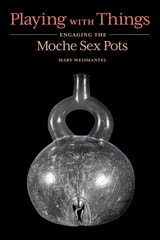
Playing with Things
Engaging the Moche Sex PotsBy Mary Weismantel
University of Texas Press, 2021
Winner, Association for Latin American Art-Arvey Foundation Book Award, 2022
More than a thousand years ago on the north coast of Peru, Indigenous Moche artists created a large and significant corpus of sexually explicit ceramic works of art. They depicted a diversity of sex organs and sex acts, and an array of solitary and interconnected human and nonhuman bodies. To the modern eye, these Moche “sex pots,” as Mary Weismantel calls them, are lively and provocative but also enigmatic creations whose import to their original owners seems impossible to grasp.
In Playing with Things, Weismantel shows that there is much to be learned from these ancient artifacts, not merely as inert objects from a long-dead past but as vibrant Indigenous things, alive in their own inhuman temporality. From a new materialist perspective, she fills the gaps left by other analyses of the sex pots in pre-Columbian studies, where sexuality remains marginalized, and in sexuality studies, where non-Western art is largely absent. Taking a decolonial approach toward an archaeology of sexuality and breaking with long-dominant iconographic traditions, this book explores how the pots "play jokes," "make babies," "give power," and "hold water,” considering the sex pots as actual ceramic bodies that interact with fleshly bodies, now and in the ancient past. A beautifully written study that will be welcomed by students as well as specialists, Playing with Things is a model for archaeological and art historical engagement with the liberating power of queer theory and Indigenous studies.
Sacrifice, Violence, and Ideology Among the Moche
The Rise of Social Complexity in Ancient PeruBy Steve Bourget
University of Texas Press, 2016
In a special precinct dedicated to ritual sacrifice at Huaca de la Luna on the north coast of Peru, about seventy-five men were killed and dismembered, their remains and body parts then carefully rearranged and left on the ground with numerous offerings. The discovery of this large sacrificial site—one of the most important sites of this type in the Americas—raises fundamental questions. Why was human sacrifice so central to Moche ideology and religion? And why is sacrifice so intimately related to the notions of warfare and capture?
In this pioneering book, Steve Bourget marshals all the currently available information from the archaeology and visual culture of Huaca de la Luna as he seeks to understand the centrality of human sacrifice in Moche ideology and, more broadly, the role(s) of violence in the development of social complexity. He begins by providing a fully documented account of the archaeological contexts, demonstrating how closely interrelated these contexts are to the rest of Moche material culture, including its iconography, the regalia of its elite, and its monumental architecture. Bourget then probes the possible meanings of ritual violence and human sacrifice and their intimate connections with concepts of divinity, ancestry, and foreignness. He builds a convincing case that the iconography of ritual violence and the practice of human sacrifice at all the principal Moche ceremonial centers were the main devices used in the establishment and development of the Moche state.
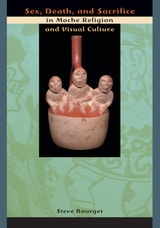
Sex, Death, and Sacrifice in Moche Religion and Visual Culture
By Steve Bourget
University of Texas Press, 2006
The Moche people who inhabited the north coast of Peru between approximately 100 and 800 AD were perhaps the first ancient Andean society to attain state-level social complexity. Although they had no written language, the Moche created the most elaborate system of iconographic representation of any ancient Peruvian culture. Amazingly realistic figures of humans, animals, and beings with supernatural attributes adorn Moche pottery, metal and wooden objects, textiles, and murals. These actors, which may have represented both living individuals and mythological beings, appear in scenes depicting ritual warfare, human sacrifice, the partaking of human blood, funerary rites, and explicit sexual activities.
In this pathfinding book, Steve Bourget raises the analysis of Moche iconography to a new level through an in-depth study of visual representations of rituals involving sex, death, and sacrifice. He begins by drawing connections between the scenes and individuals depicted on Moche pottery and other objects and the archaeological remains of human sacrifice and burial rituals. He then builds a convincing case for Moche iconography recording both actual ritual activities and Moche religious beliefs regarding the worlds of the living, the dead, and the afterlife. Offering a pioneering interpretation of the Moche worldview, Bourget argues that the use of symbolic dualities linking life and death, humans and beings with supernatural attributes, and fertility and social reproduction allowed the Moche to create a complex system of reciprocity between the world of the living and the afterworld. He concludes with an innovative model of how Moche cosmological beliefs played out in the realms of rulership and political authority.
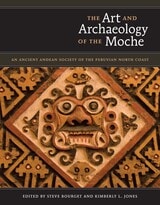
The Art and Archaeology of the Moche
An Ancient Andean Society of the Peruvian North CoastEdited by Steve Bourget and Kimberly L. Jones
University of Texas Press, 2008
Renowned for their monumental architecture and rich visual culture, the Moche inhabited the north coast of Peru during the Early Intermediate Period (AD 100-800). Archaeological discoveries over the past century and the dissemination of Moche artifacts to museums around the world have given rise to a widespread and continually increasing fascination with this complex culture, which expressed its beliefs about the human and supernatural worlds through finely crafted ceramic and metal objects of striking realism and visual sophistication.
In this standard-setting work, an international, multidisciplinary team of scholars who are at the forefront of Moche research present a state-of-the-art overview of Moche culture. The contributors address various issues of Moche society, religion, and material culture based on multiple lines of evidence and methodologies, including iconographic studies, archaeological investigations, and forensic analyses. Some of the articles present the results of long-term studies of major issues in Moche iconography, while others focus on more specifically defined topics such as site studies, the influence of El Niño/Southern Oscillation on Moche society, the nature of Moche warfare and sacrifice, and the role of Moche visual culture in decoding social and political frameworks.
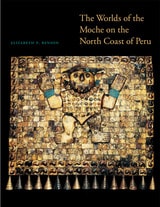
The Worlds of the Moche on the North Coast of Peru
By Elizabeth P. Benson
University of Texas Press, 2012
The Moche, or Mochica, created an extraordinary civilization on the north coast of Peru for most of the first millennium AD. Although they had no written language with which to record their history and beliefs, the Moche built enormous ceremonial edifices and embellished them with mural paintings depicting supernatural figures and rituals. Highly skilled Moche artisans crafted remarkable ceramic vessels, which they painted with figures and scenes or modeled like sculpture, and mastered metallurgy in gold, silver, and copper to make impressive symbolic ornaments. They also wove textiles that were complex in execution and design.
A senior scholar renowned for her discoveries about the Moche, Elizabeth P. Benson published the first English-language monograph on the subject in 1972. Now in this volume, she draws on decades of knowledge, as well as the findings of other researchers, to offer a grand overview of all that is currently known about the Moche. Touching on all significant aspects of Moche culture, she covers such topics as their worldview and ritual life, ceremonial architecture and murals, art and craft, supernatural beings, government and warfare, and burial and the afterlife. She demonstrates that the Moche expressed, with symbolic language in metal and clay, what cultures in other parts of the world presented in writing. Indeed, Benson asserts that the accomplishments of the Moche are comparable to those of their Mesoamerica contemporaries, the Maya, which makes them one of the most advanced civilizations of pre-Columbian America.