Results by title
4 books match the query 'Modality'
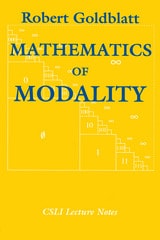
Mathematics of Modality
Robert Goldblatt
CSLI, 1993
Modal logic is the study of modalities—expressions that qualify assertions about the truth of statements—like some ordinary language phrases and mathematically motivated expressions. The study of modalities dates from antiquity, but has been most actively pursued in the last three decades. This volume collects together a number of Golblatt's papers on modal logic, beginning with his work on the duality between algebraic and set-theoretic models, and including two new articles, one on infinitary rules of inference, and the other about recent results on the relationship between modal logic and first-order logic.
[more]
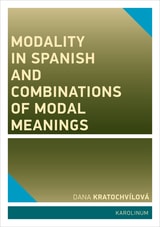
Modality in Spanish and Combinations of Modal Meanings
Dana Kratochvílová
Karolinum Press, 2019
With a focus on Spanish modality, this book presents Bohumil Zavadil’s theoretical approach—the first such presentation in English—to this category and, consequently, analyzes its possible application to Spanish. Concentrating on specific areas of the Spanish modal system where two modal meanings combine, Dana Kratochvílová integrates theoretical analyses with corpus-based studies from the InterCorp corpus on the choice of mood and the contextual interpretation of selected constructions. Her approachs verifies that areas where two modal meanings meet are a natural part of the Spanish modal system and that the combination of modal meanings has consequences on mood selection, thus shedding new light on the use of the subjunctive in Spanish.
[more]
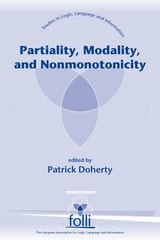
Partiality, Modality and Nonmonotonicity
Patrick Doherty
CSLI, 1996
This edited volume of articles provides a state-of-the-art description of research in logic-based approaches to knowledge representation which combines approaches to reasoning with incomplete information that include partial, modal, and nonmonotonic logics. The collection contains two parts: foundations and case studies. The foundations section provides a general overview of partiality, multi-valued logics, use of modal logic to model partiality and resource-limited inference, and an integration of partial and modal logics. The case studies section provides specific studies of issues raised in the foundations section. Several of the case studies integrate modal and partial modal logics with nonmonotonic logics. Both theoretical and practical aspects of such integration are considered. Knowledge representation issues such as default reasoning, theories of action and change, reason maintenance, awareness, and automation of nonmonotonic reasoning are covered.
[more]

The Evolution of Grammar
Tense, Aspect, and Modality in the Languages of the WorldJoan Bybee, Revere Perkins, and William Pagliuca
University of Chicago Press, 1994
Joan Bybee and her colleagues present a new theory of the evolution of grammar that links structure and meaning in a way that directly challenges most contemporary versions of generative grammar. This study focuses on the use and meaning of grammatical markers of tense, aspect, and modality and identifies a universal set of grammatical categories. The authors demonstrate that the semantic content of these categories evolves gradually and that this process of evolution is strikingly similar across unrelated languages.
Through a survey of seventy-six languages in twenty-five different phyla, the authors show that the same paths of change occur universally and that movement along these paths is in one direction only. This analysis reveals that lexical substance evolves into grammatical substance through various mechanisms of change, such as metaphorical extension and the conventionalization of implicature. Grammaticization is always accompanied by an increase in frequency of the grammatical marker, providing clear evidence that language use is a major factor in the evolution of synchronic language states.
The Evolution of Grammar has important implications for the development of language and for the study of cognitive processes in general.
[more]