Results by title
2 books match the query 'Modern American Literature'

Imagining Health
Medicine, Social Protest, and Modern American LiteratureIra Halpern
University of Massachusetts Press, 2026
A surprising look at how American writers envision a more equitable healthcare system
In the United States, a deep suspicion of professional medical expertise is becoming increasingly prominent. Meanwhile, many arguments for health justice take a highly critical view of medical authority, even rejecting it entirely. In the early to mid-twentieth century, alternatively, as medicine rapidly professionalized, Americans came to hold the medical establishment in a particularly high regard, while many saw how it could play a crucial role in progressive politics. In this period, technologies developed, specializations grew, and medical education became standardized. With this process came inequities, as marginalized populations struggled to access the highest levels of care. Literary writers confronting social ills through their work included critiques of this new system in their writing, Ira Halpern argues. Without abandoning professional medicine, they called for alternative systems of care that could better serve diverse populations.
Halpern examines the work of several writers—including Robert Herrick, Wallace Thurman, Frank Slaughter, Charles Chesnutt, Walter White, Ralph Ellison, Charlotte Perkins Gilman, Upton Sinclair, Stephen Crane, and Edith Wharton—to demonstrate how American writing from this period embedded a critical look at healthcare within other elements of progressive politics, from racial protest and women’s rights to disability justice and counter-capitalist viewpoints. Placing this writing into historical context, in terms of medical and scientific developments as well as traditions of social protest, Halpern reveals the efforts of these writers to envision better alternative trajectories for a quickly evolving medical establishment that left too many Americans without reliable care.
[more]
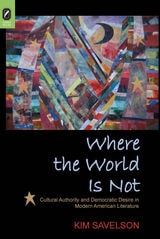
Where the World Is Not
Cultural Authority and Democratic Desire in Modern American LiteratureKim Savelson
The Ohio State University Press, 2009
How do novels that literally discuss invention and inventors engage through such discussions an array of critically important conversations and issues beyond invention? And to where and how can we trace and follow such discourses? In Where the World Is Not: Cultural Authority and Democratic Desire in Modern American Literature, Kim Savelson examines the ways in which resoundingly popular U.S. novels by Frank Norris, Willa Cather, F. Scott Fitzgerald, and Ralph Ellison host the tug-of-war between thought and action, between the democratic agenda of the pragmatist movement and the aristocratic idea of aesthetics. Savelson argues for and reads these novels as a way of thinking through the implications for the meaning and making of “culture” brought about by the ongoing social revolution of democratic modernity. She thus expands the scope of the current work being done on pragmatism, as well as the work being done on literature and democracy, carving out an intersection of these two fields.
Savelson demonstrates that the questions under her consideration appeared at different key moments over the course of the first half of the twentieth century, embodying and deepening the struggle between the abstract and the practical, the cultural and the commercial—a struggle that turned into a dilemma and a period of growth for modern democratic desire. In so doing, she offers a historical recontextualization of selected literary texts, analyzing them as a way of thinking about intellectual history with subtlety and particularity.
[more]