Results by title
26 books match the query 'Modern China'

Breaking the Chains
Gender, Context, and the Politics of Writing in Modern ChinaDong Limin
Seagull Books, 2025
How has literature shaped gender politics in modern China? How has the concept of “woman” evolved within the shifting sociopolitical landscape? Old Chains and New delves into these questions by examining the dynamic interplay between literature, gender, and historical change. Drawing from literary studies, history, and sociology, this book reveals how women’s writing has not only reflected but also actively shaped cultural and national transformations.
From the late Qing era, when the “woman question” emerged as part of China’s response to imperialist pressures, to the ongoing evolution of feminist literary scholarship, this study argues that gender and literature are deeply interwoven. Women’s liberation in modern China was never solely about gender equality—it became a driving force for broader social change and national identity formation. Engaging with the complexities of women’s literature through a cultural-political lens, this book challenges static definitions and calls for a reevaluation of women’s literature not just as a literary category but as a key component in shaping China’s modern intellectual and cultural history.
By adopting the framework of “China as method,” Old Chains and New reimagines the role of literature in ideological and cultural shifts. It highlights women’s writing as a unique form of aesthetic politics—one with the power to intervene in and transform reality.
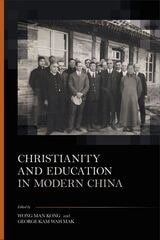
Christianity and Education in Modern China
Edited by Man Kong Wong and George Kam Wah Mak
Hong Kong University Press, 2025
In Christianity and Education in Modern China, the contributors demonstrate how Christianity served as a driving force in the development of modern education in China. Each essay offers new insights into Christian influence on education in modern China while examining how Christian missionaries and Chinese Christian educators interacted with China's social, cultural, and political contexts. They also explore how the legacies of Christian higher education affected higher education in mainland China, Taiwan, and Asia at large. On the whole, this volume compares the Western missionary and Chinese Christian perspectives with rich historiographical acumen by offering original case studies to examine Christianity’s impact on education in modern China.
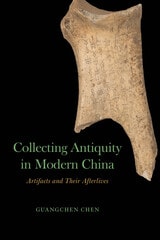
Collecting Antiquity in Modern China
Artifacts and Their AfterlivesGuangchen Chen
University of Chicago Press, 2026
In this book, Guangchen Chen argues that discerning collectors used antiquities to upend dominant discourses on history and cultural memory in twentieth-century China. Examining four categories of ancient artifacts—“carving” (oracle bones), “rubbing” (imprints of inscriptions and books), “brushing” (calligraphy), and “weaving” (textiles and costumes)—Chen explains how their modern (re)emergences changed our understanding of the relationship between tradition and modernity, textuality and materiality, and the very meaning of “Chineseness.”
Chen considers intellectuals such as Wang Yirong, Liu E, Luo Zhenyu, Wang Guowei, and Chen Mengjia, who played a pivotal role in the oracle bones’ modern reception. He also looks to major literary figures including Lu Xun, whose engagements with textual remnants of the past inspired his critique of Chinese culture; Guo Moruo, whose work on the calligraphic masterpiece Lantingxu contributed to the cultural-political climate that sparked the Cultural Revolution; Shi Zhecun, whose interest in inscriptions on ancient stelae helped him to hold fast to intellectual integrity in the face of political pressure; and Shen Congwen, whose obsession with ancient textiles saved him from committing suicide after his writing fell out of favor. These antiquarians used their collections as a strategy to synchronize historical time and to challenge two dominant yet contrasting ideologies in modern China: a regressive idealization of antiquity and an unquestioning trust in linear progress. During this turbulent period, long-lost artifacts came to function as omens, warnings, and revelations from another time, generating new meanings that were uniquely relevant to the present.
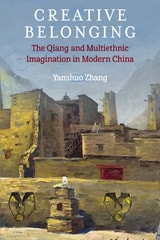
Creative Belonging
The Qiang and Multiethnic Imagination in Modern ChinaYanshuo Zhang
University of Michigan Press, 2026
China is a multicultural country home to fifty-five ethnic minority groups, yet due to linguistic and cultural barriers many of these groups remain understudied or unknown in the West. The Qiang, one of modern China’s officially recognized ethnic minorities, is also China’s longest-standing ethnoracial identity marker that has existed since the earliest recorded history of China. Creative Belonging investigates the formation and evolution of the Qiang as a people, a concept, and a cultural history in China. It further examines how the contemporary Qiang ethnic group interacts strategically with mainstream Chinese society, challenging the historically entrenched hierarchies between the sociocultural “centers” of China and its ethnic “peripheries.”
This book is based on years of ethnographic and textual-archival research in the Himalayan regions of southwest China, where the contemporary Qiang group resides. Drawing on a diverse range of official and local political discourses and previously unstudied literary, historiographical, and cinematic works, Yanshuo Zhang illuminates how the Qiang have carved out spaces of “creative belonging” within the parameters of multiculturalism in contemporary China. Rooted in ethnographic and textual-archival research, the book presents original materials produced by Qiang indigenous writers, scholars, artists, grassroots village cultural activists, and entrepreneurs at both the local and the global levels. Creative Belonging invites readers to rethink ethnicity and national belonging in China by centering minority groups’ efforts to expand the meanings and implications of “Chinese culture.”
Diaspora's Homeland
Modern China in the Age of Global MigrationShelly Chan
Duke University Press, 2018
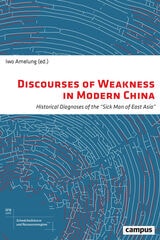
Discourses of Weakness in Modern China
Historical Diagnoses of the "Sick Man of East Asia"Edited by Iwo Amelung
Campus Verlag, 2018
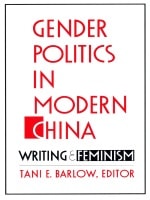
Gender Politics in Modern China
Writing and FeminismTani E. Barlow, ed.
Duke University Press, 1993
Ranging from interviews with contemporary writers, to historical accounts of gendered writing in Taiwan and semi-colonial China, to close feminist readings of individual authors, these essays confront the degree to which textual stategies construct notions of gender. Among the specific themes discussed are: how femininity is produced in texts by allocating women to domestic space; the extent to which textual production lies at the base of a changing, historically specific code of the feminine; the extent to which women in modern Chinese societies are products of literary canons; the ways in which the historical processes of gendering have operated in Chinese modernity vis à vis modernity in the West; the representation of feminists as avengers and as westernized women; and the meager recognition of feminism as a serious intellectual current and a large body of theory.
Originally published as a special issue of Modern Chinese Literature (Spring & Fall 1988), this expanded book represents some of the most compelling new work in post-Mao feminist scholarship and will appeal to all those concerned with understanding a revitalized feminism in the Chinese context.
Contributors. Carolyn Brown, Ching-kiu Stephen Chan, Sung-sheng Yvonne Chang, Yu-shih Chen, Rey Chow, Randy Kaplan, Richard King, Wolfgang Kubin, Wendy Larson, Lydia Liu, Seung-Yeun Daisy Ng, Jon Solomon, Meng Yue, Wang Zheng
Hu Shih and Intellectual Choice in Modern China
Min-Chih Chou
University of Michigan Press, 1984
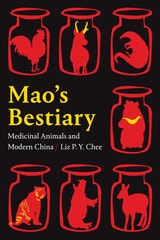
Mao's Bestiary
Medicinal Animals and Modern ChinaLiz P. Y. Chee
Duke University Press, 2021
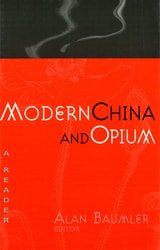
Modern China and Opium
A ReaderAlan Baumler, Editor
University of Michigan Press, 2001
Modern China, 1840–1972
An Introduction to Sources and Research AidsAndrew J. Nathan
University of Michigan Press, 1973
National Past-Times
Narrative, Representation, and Power in Modern ChinaAnn Anagnost
Duke University Press, 1997
Using interviews and participant observation as well as close readings of official documents, propaganda materials, and popular media, Anagnost notes the discontinuities in the nation’s narrative—moments where this narrative has been radically reorganized at critical junctures in China’s modern history. Covering a broad range of issues relating to representation and power—issues that have presented themselves with particular clarity in the years since the violent crackdown on the student movement of 1989—National Past-Times critiques the ambiguous possibilities produced by the market, as well as new opportunities for "unfreedom" in the discipline of labor and the commodification of women. Anagnost begins with a retrospective reflection on the practice of "speaking bitterness" in socialist revolutionary practice. Subsequent essays discuss the culture debates of the 1980s, the discourse of social disorder, the issue of population control, the film The Story of Qiu Ju, and anomalies at the theme park "Splendid China."
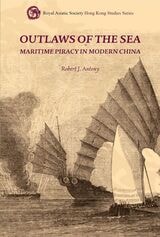
Outlaws of the Sea
Maritime Piracy in Modern ChinaRobert J. Antony
Hong Kong University Press, 2024
In Outlaws of the Sea, Robert J. Antony provides a comprehensive account of the history of maritime piracy in coastal south China from the 1630s to the 1940s. He neither romanticizes nor maligns pirates, but rather analyzes them in the context of their times and the broader world in which they lived. The author demonstrates that Chinese piracy was a pervasive force shaping maritime society as it ebbed and flowed between sporadic, small-scale ventures and professional, large-scale enterprises in the modern era. This book offers important new insights into the underside of modern China’s history and the interactions between pirates, foreign traders, local communities, and the state.
Politics, Ideology, and Literary Discourse in Modern China
Theoretical Interventions and Cultural CritiqueKang Liu and Xiaobing Tang, eds.
Duke University Press, 1993
With chapters by writers, scholars, and critics from mainland China, Hong Kong, and the United States, this volume explores the complexity of representing modernity within the Chinese context. Addressing the problem of finding a proper language for articulating fundamental issues in the historical experience of twentieth-century China, the authors critically re-examine notions of realism, the self/subject, and modernity and draw on perspectives from feminist criticism, ideological analysis, and postmodern theory. Among the many topics explored are subjectivity in Chinese cultural theory, Chinese gender relations, the viability of a Lacanian approach to Chinese identity, the politics of subversion in Chinese reportage, and the ambivalent status of the icon of paternity since Mao.
At the same time this book offers a probing look into the transformation that Chinese culture as well as the study of that culture is currently undergoing, it also reconfirms private discourse as an ideal site for an investigation into a real and imaginary, private and collective encounter with history.
Contributors. Liu Kang, Xiaobing Tang, Liu Zaifu, Stephen Chan, Lydia H. Liu, Wendy Larson, Theodore Huters, David Wang, Tonglin Lu, Yingjin Zhang, Yuejin Wang, Li Tuo, Leo Ou-fan Lee
Rescuing History from the Nation
Questioning Narratives of Modern ChinaPrasenjit Duara
University of Chicago Press, 1995
The backlash against such histories has resulted in a tendency to view the past as largely constructed, imagined, or invented. In this book, Duara offers a way out of the impasse between constructionism and the evolving nation; he redefines history as a series of multiple, often conflicting narratives produced simultaneously at national, local, and transnational levels. In a series of closely linked case studies, he considers such examples as the very different histories produced by Chinese nationalist reformers and partisans of popular religions, the conflicting narratives of statist nationalists and of advocates of federalism in early twentieth-century China. He demonstrates the necessity of incorporating contestation, appropriation, repression, and the return of the repressed subject into any account of the past that will be meaningful to the present. Duara demonstrates how to write histories that resist being pressed into the service of the national subject in its progress—or stalled progress—toward modernity.
Revisiting Women's Cinema
Feminism, Socialism, and Mainstream Culture in Modern ChinaLingzhen Wang
Duke University Press, 2021
Revolutionary Stagecraft
Theater, Technology, and Politics in Modern ChinaTarryn Li-Min Chun
University of Michigan Press, 2024
Co-Winner: 2024 Theatre Library Association George Freedley Memorial Award
Finalist: American Society for Theatre Research Barnard Hewitt Award for Outstanding Research in Theatre History
Winner: 2025 Association for Theatre in Higher Education Outstanding Book Award in Innovative Achievement
Revolutionary Stagecraft draws on a rich corpus of literary, historical, and technical materials to reveal a deep entanglement among technological modernization, political agendas, and the performing arts in modern China. This unique approach to Chinese theater history combines a close look at plays themselves, performance practices, technical theater details, and behind-the-scenes debates over “how to” make theater amid the political upheavals of China’s 20th century. The book begins at a pivotal moment in the 1920s—when Chinese theater artists began to import, use, and write about modern stage equipment—and ends in the 1980s when China's scientific and technological boom began. By examining iconic plays and performances from the perspective of the stage technologies involved, Tarryn Li-Min Chun provides a fresh perspective on their composition and staging. The chapters include stories on the challenges of creating imitation neon, rigging up a makeshift revolving stage, and representing a nuclear bomb detonating onstage.
In thinking about theater through technicity, the author mines well-studied materials such as dramatic texts and performance reviews for hidden technical details and brings to light a number of previously untapped sources such as technical journals and manuals; set design renderings, lighting plots, and prop schematics; and stage technology how-to guides for amateur thespians. This approach focuses on material stage technologies, situating these objects equally in relation to their technical potential, their human use, and the social, political, economic, and cultural forces that influence them. In each of its case studies, Revolutionary Stagecraft reveals the complex and at times surprising ways in which Chinese theater artists and technicians of the 20th century envisioned and enacted their own revolutions through the materiality of the theater apparatus.
The Avant-Garde and the Popular in Modern China
Tian Han and the Intersection of Performance and PoliticsLiang Luo
University of Michigan Press, 2014
The Emerging Lesbian
Female Same-Sex Desire in Modern ChinaTze-Lan D. Sang
University of Chicago Press, 2003
In this first ever book-length study of Chinese lesbians, Tze-lan D. Sang convincingly ties the debate over female same-sex love in China to the emergence of Chinese modernity. As women's participation in social, economic, and political affairs grew, Sang argues, so too did the societal significance of their romantic and sexual relations. Focusing especially on literature by or about women-preferring women, Sang traces the history of female same-sex relations in China from the late imperial period (1600-1911) through the Republican era (1912-1949). She ends by examining the reemergence of public debate on lesbians in China after Mao and in Taiwan after martial law, including the important roles played by globalization and identity politics.
The Invention of Madness
State, Society, and the Insane in Modern ChinaEmily Baum
University of Chicago Press, 2018
Focusing on typically marginalized historical actors, including municipal functionaries and the urban poor, The Invention of Madness shifts our attention from the elite desire for modern medical care to the ways in which psychiatric discourses were implemented and redeployed in the midst of everyday life. New meanings and practices of madness, Baum argues, were not just imposed on the Beijing public but continuously invented by a range of people in ways that reflected their own needs and interests. Exhaustively researched and theoretically informed, The Invention of Madness is an innovative contribution to medical history, urban studies, and the social history of twentieth-century China.
The Mouth That Begs
Hunger, Cannibalism, and the Politics of Eating in Modern ChinaGang Yue
Duke University Press, 1999
Yue’s discussion begins with a brief look at ancient Chinese alimentary writing and then moves on to its main concern: the exploration and textual analysis of themes of eating in modern Chinese literature from the May Fourth period through the post-Tiananmen era. The broad historical scope of this volume illustrates how widely applicable eating-related metaphors can be. For instance, Yue shows how cannibalism symbolizes old China under European colonization in the writing of Lu Xun. In Mo Yan’s 1992 novel Liquorland, however, cannibalism becomes the symbol of overindulgent consumerism. Yue considers other writers as well, such as Shen Congwen, Wang Ruowang, Lu Wenfu, Zhang Zianliang, Ah Cheng, Zheng Yi, and Liu Zhenyun. A special section devoted to women writers includes a chapter on Xiao Hong, Wang Anyi, and Li Ang, and another on the Chinese-American women writers Jade Snow Wong, Maxine Hong Kingston, and Amy Tan. Throughout, the author compares and contrasts the work of these writers with similarly themed Western literature, weaving a personal and political semiotics of eating.
The Mouth That Begs will interest sinologists, literary critics, anthropologists, cultural studies scholars, and everyone curious about the semiotics of food.
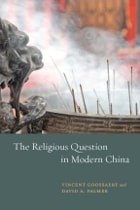
The Religious Question in Modern China
Vincent Goossaert and David A. Palmer
University of Chicago Press, 2011
Recent events—from strife in Tibet and the rapid growth of Christianity in China to the spectacular expansion of Chinese Buddhist organizations around the globe—vividly demonstrate that one cannot understand the modern Chinese world without attending closely to the question of religion. The Religious Question in Modern China highlights parallels and contrasts between historical events, political regimes, and cultural movements to explore how religion has challenged and responded to secular Chinese modernity, from 1898 to the present.
Vincent Goossaert and David A. Palmer piece together the puzzle of religion in China not by looking separately at different religions in different contexts, but by writing a unified story of how religion has shaped, and in turn been shaped by, modern Chinese society. From Chinese medicine and the martial arts to communal temple cults and revivalist redemptive societies, the authors demonstrate that from the nineteenth century onward, as the Chinese state shifted, the religious landscape consistently resurfaced in a bewildering variety of old and new forms. The Religious Question in Modern China integrates historical, anthropological, and sociological perspectives in a comprehensive overview of China’s religious history that is certain to become an indispensible reference for specialists and students alike.
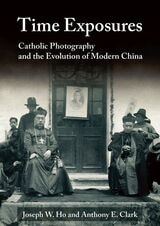
Time Exposures
Catholic Photography and the Evolution of Modern ChinaJoseph W. Ho and Anthony E. Clark
Hong Kong University Press, 2026
A history of China’s transition from empire to modern nation, told through photographs by and of Chinese Catholic communities.
Time Exposures explores how historical photographs created by and of Chinese Catholic communities illuminate the vicissitudes of China’s transition from empire to modern nation. Relying on an expansive worldwide network of Catholic photographic archives, this book examines largely unseen and unpublished images related to Catholicism in China. These images, made from the 1870s through the 1990s, were central to visual practices and afterlives that represent, recover, and reenvision diverse Chinese experiences. This volume provides insight into the lives of women and men behind and in front of the camera who were important documentarians of China’s local and national changes over time, shaping ways of seeing and belonging to the country’s many cultural evolutions.

Weapons of the People
The Culture and Politics of Guns in Modern ChinaLei Duan
University of Michigan Press, 2027
Why did a country that once mobilized millions of armed civilians become one of the most tightly regulated gun societies in the world? Weapons of the People traces the history of private gun ownership in modern China, from the late Qing dynasty to the early People’s Republic of China. Far from being rare, firearms were once embedded in everyday life, used for self-defense, social status, and political struggle. At the same time, government policies toward civilian arms were often inconsistent. These inconsistencies extended beyond uneven enforcement to include shifting official attitudes toward unsanctioned armed groups. The Chinese Communist Party’s treatment of armed individuals and groups repeatedly adapted to changing political conditions and strategic needs.
Drawing on extensive archival research, as well as published documents, legal cases, and personal accounts, Lei Duan reconstructs the social life of firearms and their shifting political meanings across different regimes. By uncovering these patterns of diversity in firearm ownership and inconsistency in government policy, this book highlights the complex interplay between firearms, society, and the state in modern Chinese history. This study invites readers to reconsider the role of firearms in shaping China’s modern trajectory and to challenge conventional understandings of the nation’s sociopolitical landscape. Duan offers a new prism through which to examine state-society relations in modern China.
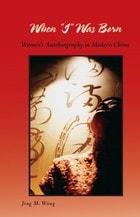
When “I” Was Born
Women’s Autobiography in Modern ChinaJing M. Wang
University of Wisconsin Press, 2008
When “I” Was Born: Women’s Autobiography in Modern China reclaims the voices of these particular writers, voices that have been misinterpreted and overlooked for decades. Tracing women writers as they move from autobiographical fiction, often self-revelatory and personal, to explicit autobiographies that focused on women’s roles in public life, Jing M. Wang reveals the factors that propelled this literary movement, the roles that liberal translators and their renditions of Western life stories played, and the way in which these women writers redefined writing and gender in the stories they told. But Wang reveals another story as well: the evolving history and identity of women in modern Chinese society. When “I” Was Born adds to a growing body of important work in Chinese history and culture, women’s studies, and autobiography in a global context.
Writers discussed include Xie Bingying, Zhang Ailing, Yu Yinzi, Fei Pu, Lu Meiyen, Feng Heyi, Ye Qian, Bai Wei, Shi Wen, Fan Xiulin, Su Xuelin, and Lu Yin.
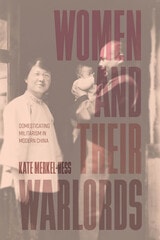
Women and Their Warlords
Domesticating Militarism in Modern ChinaKate Merkel-Hess
University of Chicago Press, 2024
In Women and Their Warlords, historian Kate Merkel-Hess examines the lives and personalities of the female relatives of the military rulers who governed regions of China from 1916 to 1949. Posing for candid photographs and sitting for interviews, these women did not merely advance male rulers’ agendas. They advocated for social and political changes, gave voice to feminist ideas, and shaped how the public perceived them. As the first publicly political partners in modern China, the wives and concubines of Republican-era warlords changed how people viewed elite women’s engagement in politics. Drawing on popular media sources, including magazine profiles and gossip column items, Merkel-Hess draws unexpected connections between militarism, domestic life, and state power in this insightful new account of gender and authority in twentieth-century China.