Results by title
5 books match the query 'Modern Europe'
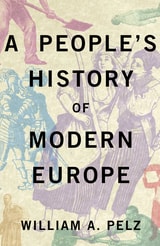
A People's History of Modern Europe
William A. Pelz
Pluto Press, 2016
The origin of capitalism and modern industrialism—and, not unrelated, the birthplace of Marxism—modern Europe provided the perfect conditions for a great number of political revolutions. From the monarchical terror of the Middle Ages to the mangled Europe of the twenty-first century, A People’s History of Modern Europe tracks the history of the continent through the deeds of those whom mainstream history tries to forget.
Along the way, William A. Pelz examines the German peasant wars of Thomas Müntzer, the bourgeoisie revolutions of the eighteenth century, the rise of the industrial worker in England, the turbulent journey of the Russian Soviets, the role of the European working class throughout the Cold War, and the revolutionary students in 1968. He then brings his story to the present day, where we continue to fight to forge an alternative to a heartless and often barbaric economic system.
As Germany and Greece argue over who owes what, with the very idea of Europe crumbling around them, Pelz’s accessible, provocative history could not be timelier. Sure to resonate with fans of books like Howard Zinn’s A People’s History of the United States, this people’s history sweeps away the tired platitudes of the privileged and provides an opportunity to understand the story of Europe from the ground up.
[more]
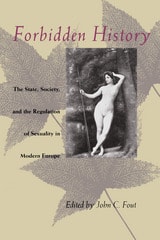
Forbidden History
The State, Society, and the Regulation of Sexuality in Modern EuropeEdited by John C. Fout
University of Chicago Press, 1992
How have society's values and attitudes toward sexuality and morality changed over the centuries? Why and how has the state sought to criminalize certain forms of sexual behavior and to control reproduction? How have churches tried to influence the state in its regulation of sexuality?
This anthology encompasses a broad range of essays on sexuality spanning European history from the fifteenth century to the present. The topics in this collection of fifteen essays have both historic importance and current relevance. All crucial issues in the regulation of sexuality are addressed, from incest to infanticide, from breast-feeding and women's sexuality to female prostitution, from pornography to reproductive politics, and from the first homosexual rights movement to AIDS.
Contributions from a diverse group of prominent scholars representing a variety of disciplines are included in this anthology. Essays by Randolph Trumbach on "Sex, Gender, and Identity in Modern Culture: Male Sodomy and Female Prostitution in Enlightenment London"; Ruth Perry on "Colonizing the Breast: Sexuality and Maternity in Eighteenth Century England"; Theo van der Meer on "Female Same-Sex Offenders in Late Eighteenth Century Amsterdam"; Robin Ann Sheets on "Pornography, Fairy Tales, and Feminism: Angela Carter's 'The Bloody Chamber'"; and James W. Jones on "Discourses on and of AIDS in West Germany, 1986-1990."
Offering the most up-to-date scholarship from a significant and growing field, this collection is essential for both students and faculty in social history, family history, women's and gender studies, gay studies, sociology and literature.
[more]
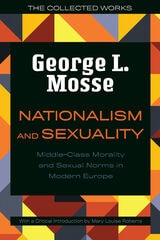
Nationalism and Sexuality
Middle-Class Morality and Sexual Norms in Modern EuropeGeorge L. Mosse, With a critical introduction by Mary Louise Roberts
University of Wisconsin Press, 2020
This landmark work by George L. Mosse, first published in 1985, examines the history of sexuality through the lens of bourgeois respectability and nationalism. Using a daring breadth of German and English sources, Nationalism and Sexuality pioneered the use of gender stereotypes as a methodology for studying the history of sexuality in mainstream European history. Mosse’s innovative inquiries on gender remain central to discussions about modern constructions of national belonging and the workings of the state. This edition of Mosse’s classic volume includes a new critical introduction by Mary Louise Roberts, whose books include What Soldiers Do: Sex and the American GI in World War II France.
[more]
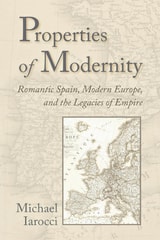
Properties of Modernity
Romantic Spain, Modern Europe, and the Legacies of EmpireMichael Iarocci
Vanderbilt University Press, 2006
Michael Iarocci traces the ways in which Spain went from being central to European history and identity during the early modern period to being marginalized and displaced by England, France, and Germany during the Romantic period. He points out that it has long been an unspoken assumption tainting much of literary criticism that Spain did not have a strong Romantic movement even though Spain itself had come to be viewed by the "new" Europe as the location of all that was romantic.
Through a close study of Cadalso, Saavedra, and Larra, Iarocci argues that Spanish writers were intensely concerned with the same issues taken up by more famous Romantics and that the ways in which they address these issues provides us with a richer notion, not only of Spain, but of all of Europe.
Through a close study of Cadalso, Saavedra, and Larra, Iarocci argues that Spanish writers were intensely concerned with the same issues taken up by more famous Romantics and that the ways in which they address these issues provides us with a richer notion, not only of Spain, but of all of Europe.
[more]
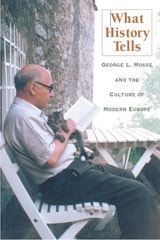
What History Tells
George L. Mosse and the Culture of Modern EuropeEdited by Stanley G. Payne, David J. Sorkin, and John S. Tortorice
University of Wisconsin Press, 2004
What History Tells presents an impressive collection of critical papers from the September 2001 conference "An Historian’s Legacy: George L. Mosse and Recent Research on Fascism, Society, and Culture." This book examines his historiographical legacy first within the context of his own life and the internal development of his work, and secondly by tracing the many ways in which Mosse influenced the subsequent study of contemporary history, European cultural history and modern Jewish history.
The contributors include Walter Laqueur, David Sabean, Johann Sommerville, Emilio Gentile, Roger Griffin, Saul Friedländer, Jay Winter, Rudy Koshar, Robert Nye, Janna Bourke, Shulamit Volkov, and Steven E. Aschheim.
The contributors include Walter Laqueur, David Sabean, Johann Sommerville, Emilio Gentile, Roger Griffin, Saul Friedländer, Jay Winter, Rudy Koshar, Robert Nye, Janna Bourke, Shulamit Volkov, and Steven E. Aschheim.
[more]