Results by title
4 books match the query 'Modern Japan'
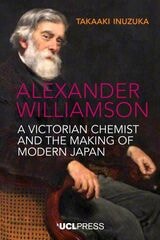
Alexander Williamson
A Victorian Chemist and the Making of Modern JapanTakaaki Inuzuka
University College London, 2021
A short, accessible biography exploring Alexander Williamson’s contribution to nineteenth-century science and Japanese society.
Alexander Williamson was a leading scientist and professor of chemistry at University College London in the late nineteenth century. He taught and cared for visiting Japanese students, assisting them with their goal of modernizing Japan. This short, accessible biography explores his contribution to nineteenth-century science, as well as his lasting impact on Japanese society. In 1863 five students from the Chōshū clan, with a desperate desire to learn from the West, made their way to England. They were put in the care of Williamson and his wife. Their mission was to learn about cutting-edge Western technology, science, economics, and politics. When they returned home, they rapidly became leading figures in Japanese life. The remarkable story of the part Williamson and University College London played in the modernization of Japan is little known today. This biography will promote a deeper understanding of Williamson’s scientific innovations and his legacy for Anglo-Japanese relations.
Alexander Williamson was a leading scientist and professor of chemistry at University College London in the late nineteenth century. He taught and cared for visiting Japanese students, assisting them with their goal of modernizing Japan. This short, accessible biography explores his contribution to nineteenth-century science, as well as his lasting impact on Japanese society. In 1863 five students from the Chōshū clan, with a desperate desire to learn from the West, made their way to England. They were put in the care of Williamson and his wife. Their mission was to learn about cutting-edge Western technology, science, economics, and politics. When they returned home, they rapidly became leading figures in Japanese life. The remarkable story of the part Williamson and University College London played in the modernization of Japan is little known today. This biography will promote a deeper understanding of Williamson’s scientific innovations and his legacy for Anglo-Japanese relations.
[more]
Discrimination in Modern Japan
Case Studies in Identity PoliticsJ. Mark Ramseyer
University of Chicago Press, 2023
An informative rethinking of how Japanese society discriminates against its Korean, Okinawan, and Burakumin populations.
In this book, J. Mark Ramseyer, a noted authority on Japan looks at discrimination against groups in Japanese society, focusing on the Korean, Okinawan, and Burakumin groups. Ramseyer asks why they experience discrimination in Japan, an unusually homogeneous society. Is it because of some prejudice on the part of the majority that prevents their integration into mainstream Japanese society? Or is it because some of the dynamics within the group create incentives for the group to stay together and to be on the fringes of society?
Ramseyer argues that the real explanation is the latter, and each of these three groups has been victimized by its own leadership. Precisely because the groups are dysfunctional, members of the group cannot control members who would appoint themselves group leaders. The result has been the capture of leadership positions by people who manipulate the group to their own private advantage and to the detriment of the group as a whole.
[more]
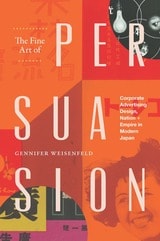
The Fine Art of Persuasion
Corporate Advertising Design, Nation, and Empire in Modern JapanGennifer Weisenfeld
Duke University Press, 2025
Commercial art is more than just mass-produced publicity; it constructs social and political ideologies that impact the public’s everyday life. In The Fine Art of Persuasion, Gennifer Weisenfeld examines the evolution of Japanese advertising graphic design from the early 1900s through the 1964 Tokyo Olympics, a pivotal design event that rebranded Japan on the world stage. Through richly illustrated case studies, Weisenfeld tells the story of how modern corporations and consumer capitalism transformed Japan’s visual culture and artistic production across the pre- and postwar periods, revealing how commercial art helped constitute the ideological formations of nation- and empire-building. Weisenfeld also demonstrates, how under the militarist regime of imperial Japan, national politics were effectively commodified and marketed through the same mechanisms of mass culture that were used to promote consumer goods. Using a multilayered analysis of the rhetorical intentions of design projects and the context of their production, implementation, and consumption, Weisenfeld offers an interdisciplinary framework that illuminates the importance of Japanese advertising design within twentieth-century global visual culture.
[more]
The Sublime Perversion of Capital
Marxist Theory and the Politics of History in Modern JapanGavin Walker
Duke University Press, 2016
In The Sublime Perversion of Capital Gavin Walker examines the Japanese debate about capitalism between the 1920s and 1950s, using it as a "prehistory" to consider current discussions of uneven development and contemporary topics in Marxist theory and historiography. Walker locates the debate's culmination in the work of Uno Kōzō, whose investigations into the development of capitalism and the commodification of labor power are essential for rethinking the national question in Marxist theory. Walker's analysis of Uno and the Japanese debate strips Marxist historiography of its Eurocentric focus, showing how Marxist thought was globalized from the start. In analyzing the little-heralded tradition of Japanese Marxist theory alongside Marx himself, Walker not only offers new insights into the transition to capitalism, the rise of globalization, and the relation between capital and the formation of the nation-state; he provides new ways to break Marxist theory's impasse with postcolonial studies and critical theory.
[more]