Results by title
2 books match the query 'Modern Korea'
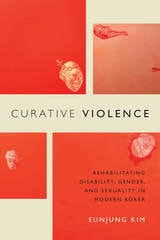
Curative Violence
Rehabilitating Disability, Gender, and Sexuality in Modern KoreaEunjung Kim
Duke University Press, 2017
In Curative Violence Eunjung Kim examines what the social and material investment in curing illnesses and disabilities tells us about the relationship between disability and Korean nationalism. Kim uses the concept of curative violence to question the representation of cure as a universal good and to understand how nonmedical and medical cures come with violent effects that are not only symbolic but also physical. Writing disability theory in a transnational context, Kim tracks the shifts from the 1930s to the present in the ways that disabled bodies and narratives of cure have been represented in Korean folktales, novels, visual culture, media accounts, policies, and activism. Whether analyzing eugenics, the management of Hansen's disease, discourses on disabled people's sexuality, violence against disabled women, or rethinking the use of disabled people as a metaphor for life under Japanese colonial rule or under the U.S. military occupation, Kim shows how the possibility of life with disability that is free from violence depends on the creation of a space and time where cure is seen as a negotiation rather than a necessity.
[more]
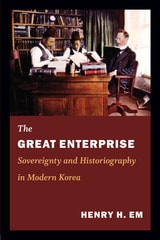
The Great Enterprise
Sovereignty and Historiography in Modern KoreaHenry H. Em
Duke University Press, 2013
In The Great Enterprise, Henry H. Em examines how the project of national sovereignty shaped the work of Korean historians and their representations of Korea's past. The goal of Korea attaining validity and equal standing among sovereign nations, Em shows, was foundational to modern Korean politics in that it served a pedagogical function for Japanese and Western imperialisms, as well as for Korean nationalism. Sovereignty thus functioned as police power and political power in shaping Korea's modernity, including anticolonial and postcolonial movements toward a radically democratic politics.
Surveying historical works written over the course of the twentieth century, Em elucidates the influence of Christian missionaries, as well as the role that Japan's colonial policy played in determining the narrative framework for defining Korea's national past. Em goes on to analyze postcolonial works in which South Korean historians promoted national narratives appropriate for South Korea's place in the U.S.-led Cold War system. Throughout, Em highlights equal sovereignty's creative and productive potential to generate oppositional subjectivities and vital political alternatives.
[more]