Results by title
6 books match the query 'Modern Middle East'
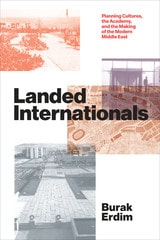
Landed Internationals
Planning Cultures, the Academy, and the Making of the Modern Middle EastBy Burak Erdim
University of Texas Press, 2020
2022 On the Brinck Book Award, University of New Mexico School of Architecture + Planning
Special Mention, First Book Prize, International Planning History Society
Landed Internationals examines the international culture of postwar urban planning through the case of the Middle East Technical University (METU) in Ankara, Turkey. Today the center of Turkey's tech, energy, and defense elites, METU was founded in the 1950s through an effort jointly sponsored by the UN, the University of Pennsylvania, and various governmental agencies of the United States and Turkey. Drawing on the language of the UN and its Technical Assistance Board, Erdim uses the phrase "technical assistance machinery" to encompass the sprawling set of relationships activated by this endeavor.
Erdim studies a series of legitimacy battles among bureaucrats, academics, and other professionals in multiple theaters across the political geography of the Cold War. These different factions shared a common goal: the production of nationhood—albeit nationhood understood and defined in multiple, competing ways. He also examines the role of the American architecture firm Skidmore, Owings, and Merrill; the New York housing policy guru Charles Abrams; the UN and the University of Pennsylvania; and the Turkish architects Altuğ and Behruz Çinici. In the end, METU itself looked like a model postwar nation within the world order, and Erdim concludes by discussing how it became an important force in transnational housing, planning, and preservation in its own right.
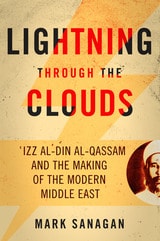
Lightning through the Clouds
?Izz al-Din al-Qassam and the Making of the Modern Middle EastBy Mark Sanagan
University of Texas Press, 2020
Lightning through the Clouds is the first English-language life-and-times biography of ‘Izz al-Din al-Qassam, a preeminent figure who helped to reshape the political and religious landscape of the region. A Syrian-born, Egyptian-educated cleric, he went from the battlefields of World War I to join the anticolonialist fight against the French in Syria. Sentenced to be executed by the French military, he managed to escape to Palestine, where he became an increasingly popular presence, moved by the plight of the poor and disenfranchised. Outraged by British rule and the encroachment of Zionism, he formed a secret society to resist the colonization of Palestine first by the British and then by Jewish immigrants from Europe, once again taking up arms and advocating for a moral, political, and military jihad as the only solution. His death at the hands of Palestine Police in 1935 drew thousands to his funeral and sparked the 1936–1939 Arab Revolt.
His influence continues to be felt in the region; for example, the military wing of the Palestinian Hamas organization is named the ‘Izz al-Din al-Qassam Brigades. Al-Qassam is either revered or reviled, depending on the observers’ perspective, but he is without doubt a fascinating and historically significant individual whose influence on the past, and our present, makes this examination of his life both important and timely.
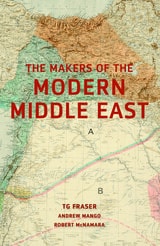
Making the Modern Middle East
Second EditionT.G. Fraser, Andrew Mango, and Robert McNamara
Gingko, 2015
This fully revised and updated second edition of The Makers of the Modern Middle East traces those changes and the ensuing history of the region through the rest of the twentieth century and on to the present. Focusing in particular on three leaders—Emir Feisal, Mustafa Kemal, and Chaim Weizmann—the book offers a clear, authoritative account of the region seen from a transnational perspective, one that enables readers to understand its complex history and the way it affects present-day events.
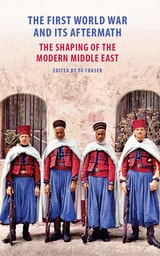
The First World War and Its Aftermath
The Shaping of the Modern Middle EastEdited by T.G. Fraser
Gingko, 2024
In addition to recounting the crucial international politics that drew fierce lines in the sands of the Middle East—a story of intrigue between the British, Russians, Ottomans, North Africans, Americans, and others—the contributors engage topics ranging from the war’s effects on women, the experience of the Kurds, sectarianism, the evolution of Islamism, and the importance of prominent intellectuals like Ziya Gökalp and Michel ‘Aflaq. They examine the dissolution of the Ottoman Empire, the exploitation of notions of Islamic unity and pan-Arabism, the influences of Woodrow Wilson and American ideals on Middle East leaders, and likewise the influence of Vladimir Lenin’s vision of a communist utopia. Altogether, they tell a story of promises made and promises broken, of the struggle between self-determination and international recognition, of centuries-old empires laying in ruin, and of the political poker of the twentieth century that carved up the region, separating communities into the artificial states we know today.
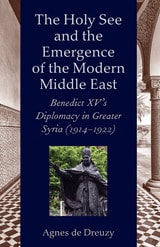
The Vatican and the Emergence of the Modern Middle East
Agnes de Dreuzy
Catholic University of America Press, 2016
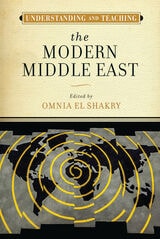
Understanding and Teaching the Modern Middle East
Edited by Omnia El Shakry
University of Wisconsin Press, 2020