Results by title
4 books match the query 'Modern Spain'

Confessions of the Letter Closet
Epistolary Fiction and Queer Desire in Modern SpainPatrick Paul Garlinger
University of Minnesota Press, 2005

The Culture of Cursilería
Bad Taste, Kitsch, and Class in Modern SpainNoel Valis
Duke University Press, 2002
Valis finds evidence in literature, cultural objects, and popular customs to
argue that cursilería has its roots in a sense of cultural inadequacy felt by the lower middle classes in nineteenth- and early-twentieth-century Spain. The Spain of this era, popularly viewed as the European power most resistant to economic and social modernization, is characterized by Valis as suffering from nostalgia for a bygone, romanticized society that structured itself on strict class delineations. With the development of an economic middle class during the latter half of the nineteenth century, these designations began to break down, and individuals across all levels of the middle class exaggerated their own social status in an attempt to protect their cultural capital. While the resulting manifestations of cursilería were often provincial, indeed backward, the concept was—and still is—closely associated with a sense of home. Ultimately, Valis shows how cursilería embodied the disparity between old ways and new, and how in its awkward manners, airs of pretension, and graceless anxieties it represents Spain's uneasy surrender to the forces of modernity.
The Culture of Cursilería will interest students and scholars of Latin America, cultural studies, Spanish literature, and modernity.

The Ethics of Autobiography
Replacing the Subject in Modern SpainAngel G. Loureiro
Vanderbilt University Press, 2000
To address this oversight, Loureiro draws from his own experiences as well as from a wide range of previous theoretical works on autobiography, especially from the writings of Emmanuel Levinas, who believed that the self does not begin as a self-positing consciousness but as a response to an address from the other. On this basis, Loureiro then brilliantly traces the complex interplays between the political, discursive, rhetorical, and ethical dimensions of autobiography.
After laying out these theoretical foundations, Loureiro puts them to work in analyzing four of the most fascinating autobiographies written by Spanish exiles: The Life of Joseph Blanco White, who lived from 1775 to 1841, Memoria de la Melancolia by Maria Teresa Leon (1904-1988), Coto vedado and En los reinos de taifa by Juan Goytisolo (born 1931), and Literature or Life by Jorge Semprun (born 1923). The lives of these authors, all of whom were exiled for political reasons, were disrupted by some of the most crucial events in Spain's tortuous road to modernity and democracy.
The book closes with a discussion of why there have been so few critical examinations of autobiographies written in modern Spain. Loureiro proposes that, even in today's Spain, stifling social and political forces smother ethical responsibility, which is an essential ingredient in creating autobiographies that dare to be more than a humdrum inventory of personal recollections. Only in exile have Spanish authors seemed able to find the conditions to write their lives in a truly responsible manner. This answer to a call that grounds the subject in an other is ultimately the only form of truth available in autobiography.
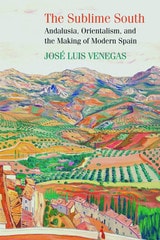
The Sublime South
Andalusia, Orientalism, and the Making of Modern SpainJose Luis Venegas
Northwestern University Press, 2018
The Sublime South: Andalusia, Orientalism, and the Making of Modern Spain is the first systematic study on cultural images of Andalusia as Spain’s “Orient” and the impact they have had on nation-building and modernization since the late nineteenth century. While a wealth of studies have examined how northern Europeans from the Romantic period viewed Spain and Andalusia as Europe’s Orient, little attention has been paid to how contemporary Spanish artists and intellectuals assimilated Romantic legacies to engage in an internal form of orientalism.
José Luis Venegas deftly explores Spain’s shifting engagements with oriental identity and otherness by looking, not just beyond national, ethnic, and racial borders, but at a territory that is institutionally embedded in the nation-state while symbolically placed between inclusion and abjection. The Sublime South shifts the focus and scale of Edward Said’s notion of orientalism by examining how it evolves and manifests transnationally, as the result of European colonialism in Africa and Asia, and intra-nationally, in a European yet orientalized country. Finally, Venegas challenges ethnocentric notions of Iberian cultures and fosters an understanding of the encounters between Western and Muslim cultures beyond opposing, and often mutually negating, essentialisms.