Results by title
56 books match the query 'Modernism (Art)' and 7 start with a

Aesthetics of Disturbance
Anti-Art in Avant-Garde DramaDavid Graver
University of Michigan Press, 1995

American Women Modernists
The Legacy of Robert Henri, 1910-1945Edited by Marian Wardle
Rutgers University Press, 2005
Seldom recognized, yet contributing significantly to the structure of early American modernism is a group of women who were once the art students of the popular and perhaps most influential American art teacher of the twentieth century, Robert Henri (1865-1929). Henri encouraged an art that was expressive of personal emotions and experience and that was grounded in life. He preached equality among different media and approaches to art. Giving heed to his teachings, his women students engaged in a wide variety of artistic production. Collectively, the stunning variety and power of their work in painting, sculpture, printmaking, textiles, decorative arts, and furniture broadens our understanding of American modernism and illuminates the role of women artists in shaping it. Yet, these women have remained largely unstudied, and virtually unknown, even among art historians.
The seven new essays included in this volume move beyond the famed Ashcan School-the small group of Henri's male students who worked in a narrow range of urban realist subjects-to recover the lesser known work of his women students. The contributors, who include well-known scholars of art history, American studies, and cultural studies demonstrate how these women participated in the "modernizing" of women's roles during this era; how gender controlled their art, productivity, sales, and reception; how their many styles, media, and subjects enrich our understanding of modern American art; and how the work of modern women artists relates to women's involvement in other areas of modern American society and culture, including labor and social reform, patronage, literature, dance, and music.
Lavishly illustrated and complemented by short biographies of more than 400 of Henri's students, this delightful collection adds a long-ignored but deserving dimension to an expanded story of American modernism and to women's contributions to the arts.
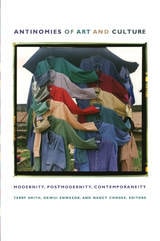
Antinomies of Art and Culture
Modernity, Postmodernity, ContemporaneityTerry Smith, Okwui Enwezor, and Nancy Condee, eds.
Duke University Press, 2008
In the volume’s introduction the theorist Terry Smith argues that predictions that postmodernity would emerge as a global successor to modernity have not materialized as anticipated. Smith suggests that the various situations of decolonized Africa, post-Soviet Europe, contemporary China, the conflicted Middle East, and an uncertain United States might be better characterized in terms of their “contemporaneity,” a concept which captures the frictions of the present while denying the inevitability of all currently competing universalisms. Essays range from Antonio Negri’s analysis of contemporaneity in light of the concept of multitude to Okwui Enwezor’s argument that the entire world is now in a postcolonial constellation, and from Rosalind Krauss’s defense of artistic modernism to Jonathan Hay’s characterization of contemporary developments in terms of doubled and even para-modernities. The volume’s centerpiece is a sequence of photographs from Zoe Leonard’s Analogue project. Depicting used clothing, both as it is bundled for shipment in Brooklyn and as it is displayed for sale on the streets of Uganda, the sequence is part of a striking visual record of new cultural forms and economies emerging as others are left behind.
Contributors: Monica Amor, Nancy Condee, Okwui Enwezor, Boris Groys, Jonathan Hay, Wu Hung, Geeta Kapur, Rosalind Krauss, Bruno Latour, Zoe Leonard, Lev Manovich, James Meyer, Gao Minglu, Helen Molesworth, Antonio Negri, Sylvester Okwunodu Ogbechie, Nikos Papastergiadis, Colin Richards, Suely Rolnik, Terry Smith, McKenzie Wark
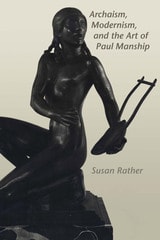
Archaism, Modernism, and the Art of Paul Manship
By Susan Rather
University of Texas Press, 1993
Archaism, an international artistic phenomenon from early in the twentieth century through the 1930s, receives its first sustained analysis in this book. The distinctive formal and technical conventions of archaic art, especially Greek art, particularly affected sculptors—some frankly modernist, others staunchly conservative, and a few who, like American Paul Manship, negotiated the distance between tradition and modernity. Susan Rather considers the theory, practice, and criticism of early twentieth-century sculpture in order to reveal the changing meaning and significance of the archaic in the modern world. To this end—and against the background of Manship’s career—she explores such topics as the archaeological resources for archaism, the classification of the non-Western art of India as archaic, the interest of sculptors in modem dance (Isadora Duncan and Ruth St. Denis), and the changing critical perception of archaism.
Rather rejects the prevailing conception of archaism as a sterile and superficial academic style to argue its initial importance as a modernist mode of expression. The early practitioners of archaism—including Aristide Maillol, André Derain, and Constantin Brancusi—renounced the rhetorical excess, overrefined naturalism, and indirect techniques of late nineteenth-century sculpture in favor of nonnarrative, stylized and directly carved works, for which archaic Greek art offered an important example. Their position found implicit support in the contemporaneous theoretical writings of Emmanuel Löwy, Wilhelm Worringer, and Adolf von Hildebrand.
The perceived relationship between archaic art and tradition ultimately compromised the modernist authority of archaism and made possible its absorption by academic and reactionary forces during the 1910s. By the 1920s, Paul Manship was identified with archaism, which had become an important element in the aesthetic of public sculpture of both democratic and totalitarian societies. Sculptors often employed archaizing stylizations as ends in themselves and with the intent of evoking the foundations of a classical art diminished in potency by its ubiquity and obsolescence. Such stylistic archaism was not an empty formal exercise but an urgent affirmation of traditional values under siege. Concurrently, archaism entered the mainstream of fashionable modernity as an ingredient in the popular and commercial style known as Art Deco. Both developments fueled the condemnation of archaism—and of Manship, its most visible exemplar—by the avant-garde. Rather’s exploration of the critical debate over archaism, finally, illuminates the uncertain relationship to modernism on the part of many critics and highlights the problematic positions of sculpture in the modernist discourse.
Art for a Modern India, 1947-1980
Rebecca M. Brown
Duke University Press, 2009
Through close analyses of specific objects of art and design, Brown describes how Indian artists engaged with questions of authenticity, iconicity, narrative, urbanization, and science and technology. She explains how the filmmaker Satyajit Ray presented the rural Indian village as a socially complex space rather than as the idealized site of “authentic India” in his acclaimed Apu Trilogy, how the painter Bhupen Khakhar reworked Indian folk idioms and borrowed iconic images from calendar prints in his paintings of urban dwellers, and how Indian architects developed a revivalist style of bold architectural gestures anchored in India’s past as they planned the Ashok Hotel and the Vigyan Bhavan Conference Center, both in New Delhi. Discussing these and other works of art and design, Brown chronicles the mid-twentieth-century trajectory of India’s modern visual culture.
Artificial Generation
Photogenic French Literature and the Prehistory of Cinematic ModernityChristina Parker-Flynn
Rutgers University Press, 2022
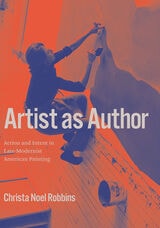
Artist as Author
Action and Intent in Late-Modernist American PaintingChrista Noel Robbins
University of Chicago Press, 2021