Results by title
12 books match the query 'Modernism (Christian theology)'
After the Death of God
Secularization as a Philosophical Challenge from Kant to NietzscheEspen Hammer
University of Chicago Press, 2025
A fresh history of nineteenth-century philosophy’s many ideas about secularization.
The secularization thesis, which held that religious belief would gradually yield to rationality, has been thoroughly debunked. What, then, can we learn from philosophers for whom the death of God seemed so imminent? In this book, Espen Hammer offers a sweeping analysis of secularization in nineteenth-century German philosophy, arguing that the persistence of religion (rather than its absence) animated this tradition. Hammer shows that Kant, Hegel, Feuerbach, Marx, and Nietzsche, each in their own way, sought to preserve and transform religion’s ethical and communal aspirations for modern life. A renewed appreciation for this tradition’s generous thought, Hammer argues, can help us chart a path through needlessly destructive conflicts between secularists and fundamentalists today.
The secularization thesis, which held that religious belief would gradually yield to rationality, has been thoroughly debunked. What, then, can we learn from philosophers for whom the death of God seemed so imminent? In this book, Espen Hammer offers a sweeping analysis of secularization in nineteenth-century German philosophy, arguing that the persistence of religion (rather than its absence) animated this tradition. Hammer shows that Kant, Hegel, Feuerbach, Marx, and Nietzsche, each in their own way, sought to preserve and transform religion’s ethical and communal aspirations for modern life. A renewed appreciation for this tradition’s generous thought, Hammer argues, can help us chart a path through needlessly destructive conflicts between secularists and fundamentalists today.
[more]
Alfred Loisy and Modern Biblical Studies
Jeffrey L. Morrow
Catholic University of America Press, 2019
The French Catholic priest and biblical scholar Alfred Loisy (1857-1940) was at the heart of the Roman Catholic Modernist crisis in the early part of the twentieth century. He saw much of his work as an attempt to bring John Henry Newman’s notion of development of doctrine into the realm of Catholic biblical studies, and thereby transform Catholic theology. This volume situates Loisy’s better known works on the New Testament and theology in the context of his lesser known work in Assyriology and Old Testament studies. His early training in Assyriology taught Loisy a comparative historical approach to studying ancient texts, in addition to providing him the requisite training in ancient Near Eastern languages and literature. Loisy built upon this Assyriological foundation with his historical critical work in biblical studies, first in the Old Testament. In his biblical scholarship, Loisy combined the then current trends of historical biblical criticism with his more comparative approach. Prior to his excommunication in 1908, Loisy attempted in his more popular writings to defend the inclusion of historical biblical criticism in the repertoire of Catholic biblical interpretation. He saw this as an important step in reforming Catholic theology. The Modernist crisis set the stage for the major debates that would occur in the Catholic theological world for more than a century. The controversy over Modernism became one important conflict that helped pave the way for the Second Vatican Council. The issues raised during Loisy’s time, remain contested today. Examining how Loisy approached biblical studies helps readers better understand his overall work, and the place it played in the pivotal intellectual turmoil of his day.
[more]
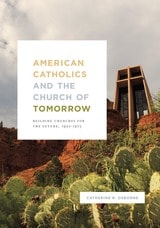
American Catholics and the Church of Tomorrow
Building Churches for the Future, 1925–1975Catherine R. Osborne
University of Chicago Press, 2018
In the mid-twentieth century, American Catholic churches began to shed the ubiquitous spires, stained glass, and gargoyles of their European forebears, turning instead toward startling and more angular structures of steel, plate glass, and concrete. But how did an institution like the Catholic Church, so often seen as steeped in inflexible traditions, come to welcome this modernist trend?
Catherine R. Osborne’s innovative new book finds the answer: the alignment between postwar advancements in technology and design and evolutionary thought within the burgeoning American Catholic community. A new, visibly contemporary approach to design, church leaders thought, could lead to the rebirth of the church community of the future. As Osborne explains, the engineering breakthroughs that made modernist churches feasible themselves raised questions that were, for many Catholics, fundamentally theological. Couldn’t technological improvements engender worship spaces that better reflected God's presence in the contemporary world? Detailing the social, architectural, and theological movements that made modern churches possible, American Catholics and the Churches of Tomorrow breaks important new ground in the history of American Catholicism, and also presents new lines of thought for scholars attracted to modern architectural and urban history.
Catherine R. Osborne’s innovative new book finds the answer: the alignment between postwar advancements in technology and design and evolutionary thought within the burgeoning American Catholic community. A new, visibly contemporary approach to design, church leaders thought, could lead to the rebirth of the church community of the future. As Osborne explains, the engineering breakthroughs that made modernist churches feasible themselves raised questions that were, for many Catholics, fundamentally theological. Couldn’t technological improvements engender worship spaces that better reflected God's presence in the contemporary world? Detailing the social, architectural, and theological movements that made modern churches possible, American Catholics and the Churches of Tomorrow breaks important new ground in the history of American Catholicism, and also presents new lines of thought for scholars attracted to modern architectural and urban history.
[more]
By Those Who Knew Them
French Modernists Left, Right, and CenterHarvey Hill
Catholic University of America Press, 2008
By Those Who Knew Them illuminates the lives of several key figures involved in the modernist movement--the movement for intellectual and structural renewal in turn-of-the-century Catholicism
[more]
Defending the Faith
William H. Marshner
Catholic University of America Press, 2016
At the dawn of the 20th Century, several writers who were to become famous under the title of "Modernists" were advancing a deep agenda for reform in the faith and praxis of the Roman Catholic Church. But their agenda met with serious and scholarly opposition from another group of writers, whose essays are here made available in English. They include the historian and university rector Pierre Battifol, the biblical exegete M.J. Lagrange, OP, the Jesuit historical theologians Eugène Portalié and Léonce de Grandmaison, and the philosophers Eugène Franon and Joannès Wehrlé. All welcomed the historico-critical methods of research, and far from thinking them fatal to orthodoxy (as the Modernists did), they thought the Church's faith would survive and be strengthened by rigorous scholarship. These thinkers, then, are the true predecessors of Pius XII (Divino afflante Spiritu) and Vatican II (Dei Verbum). At the same time, these men thought outside the boxes drawn by 19th Century Positivism (Loisy), anti-intellectualist pragmatism (LeRoy), and romantic mysticism (Tyrrell). Their concerns hold new significance in the light of John Paul II's 1990 encyclical Fides et Ratio. Reading these too-long forgotten writers, then, deepens in a new way one's understanding of the Catholic Church's decision to decline and even condemn the Modernists' agenda, whether one ultimately applauds that decision or deplores it.
[more]
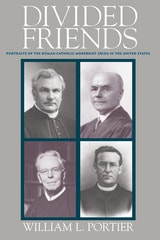
Divided Friends
William L. Portier
Catholic University of America Press, 2013
In two sets of intertwined biographical portraits, spanning two generations, Divided Friends dramatizes the theological issues of the modernist crisis, highlighting their personal dimensions and extensively reinterpreting their long-range effects. The four protagonists are Bishop Denis J. O?Connell, Josephite founder John R. Slattery, together with the Paulists William L. Sullivan and Joseph McSorley. Their lives span the decades from the Americanist crisis of the 1890s right up to the eve of Vatican II. In each set, one leaves the church and one stays. The two who leave come to see their former companions as fundamentally dishonest. Divided Friends entails a reinterpretation of the intellectual fallout from the modernist crisis and a reframing of the 20th century debate about Catholic intellectual life.
[more]
Maurice Blondel, Social Catholicism, and Action Française
The Clash over the Church's Role in Society during the Modernist EraPeter J. Bernardi
Catholic University of America Press, 2009
This work casts light on contemporary arguments over social Catholicism and the believer's role in society by illuminating a similar dispute among French Catholics during the Modernist Crisis (1909-1914)
[more]
Modernists and Mystics
C. J. T Talar
Catholic University of America Press, 2009
In the six original essays included in this volume, the authors discuss how von Hügel, Blondel, Bremond, and Loisy all found inspiration in the great mystics of the past.
[more]
Powers of Distinction
On Religion and ModernityNancy Levene
University of Chicago Press, 2017
In this major new work, philosopher of religion Nancy Levene examines the elemental character of religion and modernity. Deep in their operating systems, she argues, are dualisms of opposition and identity that cannot be reconciled with the forms of life they ostensibly support. These dualisms are dead ends, but they conceal a richer position—another kind of dualism constitutive of mutual relation. This dualism is difficult to distinguish and its concept of relation difficult to commit to. It risks contention and even violence. But it is also the indispensable support for modernity’s most innovative ideals: democracy, criticism, and interpretation.
In readings from Abraham to the present, Levene recovers this richer dualism in its difference from the alternatives—other dualisms, nondualism, multiplication. From Abraham we get the biblical call to give up tribal belonging for a promised land of covenantal relation. Yet modernity, inclusive of this call, is also the principle that critiques the promise when it divides self from other, us from them.
Drawing on a long tradition of thinkers and scholars even as she breaks new ground, Levene offers here nothing less than a new way of understanding modernity as an ethical claim about our world, a philosophy of the powers of distinction to include rather than to divide.
[more]
The Church Confronts Modernity
Leslie Woodcock Tentler
Catholic University of America Press, 2007
The Church Confronts Modernity assesses the history of Roman Catholicism since 1950 in the United States, the Republic of Ireland, and the Canadian province of Quebec
[more]
The Modernist Impulse in American Protestantism
William R. Hutchison
Duke University Press, 1992
This landmark study of American religion, recipient of the National Religious Book Award in 1976, is being brought back into print with an updated bibliography. The Modernist Impulse in American Protestantism traces the history of American Protestant thought from the early part of the nineteenth century to the present. William R. Hutchison deals especially with the "modernist" movement that flourished in the years around 1900, and with the colorful personalities and disputes associated with that movement.
[more]
The Reception of Pragmatism in France and the Rise of Roman Catholic Modernism, 1890-1914
David G. Schultenover
Catholic University of America Press, 2009
This collection of essays provides a small revolution in the study of Roman Catholic Modernism, a movement that until now has been largely seen as an episode that underscored institutional Catholicism's isolation from the mainstream intellectual currents of the time.
[more]