Results by title
9 books match the query 'Molecular biology'
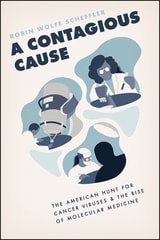
A Contagious Cause
The American Hunt for Cancer Viruses and the Rise of Molecular MedicineRobin Wolfe Scheffler
University of Chicago Press, 2019
A Contagious Cause is the first book to trace the century-long hunt for a human cancer virus in America, an effort whose scale exceeded that of the Human Genome Project. The government’s campaign merged the worlds of molecular biology, public health, and military planning in the name of translating laboratory discoveries into useful medical therapies. However, its expansion into biomedical research sparked fierce conflict. Many biologists dismissed the suggestion that research should be planned and the idea of curing cancer by a vaccine or any other means as unrealistic, if not dangerous. Although the American hunt was ultimately fruitless, this effort nonetheless profoundly shaped our understanding of life at its most fundamental levels. A Contagious Cause links laboratory and legislature as has rarely been done before, creating a new chapter in the histories of science and American politics.
Biomedia
Eugene Thacker
University of Minnesota Press, 2004
The merging of computer science and molecular biology, genetic codes and computer codes
As biotechnology defines the new millennium, genetic codes and computer codes increasingly merge—life understood as data, flesh rendered programmable. Where this trend will take us, and what it might mean, is what concerns Eugene Thacker in this timely book, a penetrating look into the intersection of molecular biology and computer science in our day and its likely ramifications for the future.
Integrating approaches from science and media studies, Biomedia is a critical analysis of research fields that explore relationships between biologies and technologies, between genetic and computer “codes.” In doing so, the book looks beyond the familiar examples of cloning, genetic engineering, and gene therapy—fields based on the centrality of DNA or genes—to emerging fields in which “life” is often understood as “information.” Focusing especially on interactions between genetic and computer codes, or between “life” and “information,” Thacker shows how each kind of “body” produced—from biochip to DNA computer—demonstrates how molecular biology and computer science are interwoven to provide unique means of understanding and controlling living matter.Throughout, Thacker provides in-depth accounts of theoretical issues implicit in biotechnical artifacts—issues that arise in the fields of bioinformatics, proteomics, systems biology, and biocomputing. Research in biotechnology, Biomedia suggests, flouts our assumptions about the division between biological and technological systems. New ways of thinking about this division are needed if we are to understand the cultural, social, and philosophical dimensions of such research, and this book marks a significant advance in the coming intellectual revolution.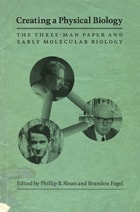
Creating a Physical Biology
The Three-Man Paper and Early Molecular BiologyEdited by Phillip R. Sloan and Brandon Fogel
University of Chicago Press, 2011
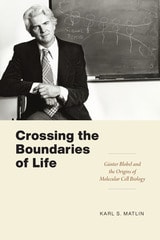
Crossing the Boundaries of Life
Günter Blobel and the Origins of Molecular Cell BiologyKarl S. Matlin
University of Chicago Press, 2022
The difficulty of reconciling chemical mechanisms with the functions of whole living systems has plagued biologists since the development of cell theory in the nineteenth century. As Karl S. Matlin argues in Crossing the Boundaries of Life, it is no coincidence that this longstanding knot of scientific inquiry was loosened most meaningfully by the work of a cell biologist, the Nobel laureate Günter Blobel. In 1975, using an experimental setup that did not contain any cells at all, Blobel was able to target newly made proteins to cell membrane vesicles, enabling him to theorize how proteins in the cell distribute spatially, an idea he called the signal hypothesis. Over the next twenty years, Blobel and other scientists were able to dissect this mechanism into its precise molecular details. For elaborating his signal concept into a process he termed membrane topogenesis—the idea that each protein in the cell is synthesized with an "address" that directs the protein to its correct destination within the cell—Blobel was awarded the Nobel Prize in Physiology or Medicine in 1999.
Matlin argues that Blobel’s investigative strategy and its subsequent application addressed a fundamental unresolved dilemma that had bedeviled biology from its very beginning—the relationship between structure and function—allowing biology to achieve mechanistic molecular explanations of biological phenomena. Crossing the Boundaries of Life thus uses Blobel’s research and life story to shed light on the importance of cell biology for twentieth-century science, illustrating how it propelled the development of adjacent disciplines like biochemistry and molecular biology.
Darwinian Reductionism
Or, How to Stop Worrying and Love Molecular BiologyAlexander Rosenberg
University of Chicago Press, 2006
With clarity and wit, Darwinian Reductionism navigates this difficult and seemingly intractable dualism with convincing analysis and timely evidence. In the spirit of the few distinguished biologists who accept reductionism—E. O. Wilson, Francis Crick, Jacques Monod, James Watson, and Richard Dawkins—Rosenberg provides a philosophically sophisticated defense of reductionism and applies it to molecular developmental biology and the theory of natural selection, ultimately proving that the physicalist must also be a reductionist.
Membranes to Molecular Machines
Active Matter and the Remaking of LifeMathias Grote
University of Chicago Press, 2019
Membranes to Molecular Machines explores just how late twentieth-century science came to think of our cells and bodies this way. This story is told through the lens of membrane research, an unwritten history at the crossroads of molecular biology, biochemistry, physiology, and the neurosciences, that directly feeds into today's synthetic biology as well as nano- and biotechnology. Mathias Grote shows how these sciences not only have made us think differently about life, they have, by reworking what membranes and proteins represent in laboratories, allowed us to manipulate life as "active matter" in new ways. Covering the science of biological membranes in the United States and Europe from the mid-1960s to the 1990s, this book connects that history to contemporary work with optogenetics, a method for stimulating individual neurons using light, and will enlighten and provoke anyone interested in the intersection of chemical research and the life sciences—from practitioner to historian to philosopher.
The research described in the book and its central actor, Dieter Oesterhelt, were honored with the 2021 Albert Lasker Basic Medical Research Award for his contribution to the development of optogenetics. The 2026 Nobel Prize in Physiology or Medicine was awarded to three scientists for discoveries leading to optogenetics. Membranes to Molecular Machines can be read as a prehistory of this research.
Molecular Capture
The Animation of BiologyAdam Nocek
University of Minnesota Press, 2021
How computer animation technologies became vital visualization tools in the life sciences
Who would have thought that computer animation technologies developed in the second half of the twentieth century would become essential visualization tools in today’s biosciences? This book is the first to examine this phenomenon. Molecular Capture reveals how popular media consumption and biological knowledge production have converged in molecular animations—computer simulations of molecular and cellular processes that immerse viewers in the temporal unfolding of molecular worlds—to produce new regimes of seeing and knowing.
Situating the development of this technology within an evolving field of historical, epistemological, and political negotiations, Adam Nocek argues that molecular animations not only represent a key transformation in the visual knowledge practices of life scientists but also bring into sharp focus fundamental mutations in power within neoliberal capitalism. In particular, he reveals how the convergence of the visual economies of science and entertainment in molecular animations extends neoliberal modes of governance to the perceptual practices of scientific subjects. Drawing on Alfred North Whitehead’s speculative metaphysics and Michel Foucault’s genealogy of governmentality, Nocek builds a media philosophy well equipped to examine the unique coordination of media cultures in this undertheorized form of scientific media. More specifically, he demonstrates how governmentality operates across visual practices in the biosciences and the popular mediasphere to shape a molecular animation apparatus that unites scientific knowledge and entertainment culture.
Ultimately, Molecular Capture proposes that molecular animation is an achievement of governmental design. It weaves together speculative media philosophy, science and technology studies, and design theory to investigate how scientific knowledge practices are designed through media apparatuses.
Rendering Life Molecular
Models, Modelers, and Excitable MatterNatasha Myers
Duke University Press, 2015
Time Warps, String Edits, and Macromolecules
The Theory and Practice of Sequence ComparisionDavid Sankoff and Joseph Kruskal
CSLI, 1983