Results by title
2 books match the query 'Molecules'

Drawing Processes of Life
Molecules, Cells, OrganismsEdited by Gemma Anderson-Tempini and John Dupré
Intellect Books, 2023
How the challenge of depicting biological systems can generate productive questions for artists and scientists.
An artist sketching cell division faces a problem: what is the best way to visually represent a dynamic process? This anthology, edited by an artist and a philosopher of science, explores drawing as a way of inquiring into living processes at the molecular, cellular, and organismal scale. In doing so, drawing emerges as a tool for relaying and uncovering knowledge—a pathway for research, not an end result.
Incorporating drawing studies and contributions from scholars in the humanities and life sciences, Drawing Processes of Life addresses epigenetics, epistemology, and metamorphosis in insects, proteins, and other ever-shifting biological systems. A foreword by Scott F. Gilbert, a renowned evolutionary biologist and historian of science, affirms the promise of interdisciplinary collaboration between artists and scientists.
[more]
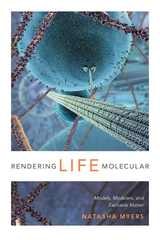
Rendering Life Molecular
Models, Modelers, and Excitable MatterNatasha Myers
Duke University Press, 2015
What are living bodies made of? Protein modelers tell us that our cells are composed of millions of proteins, intricately folded molecular structures on the scale of nanoparticles. Proteins twist and wriggle as they carry out the activities that keep cells alive. Figuring out how to make these unruly substances visible, tangible, and workable is a challenging task, one that is not readily automated, even by the fastest computers. Natasha Myers explores what protein modelers must do to render three-dimensional, atomic-resolution models of these lively materials. Rendering Life Molecular shows that protein models are not just informed by scientific data: model building entangles a modeler’s entire sensorium, and modelers must learn to feel their way through the data in order to interpret molecular forms. Myers takes us into protein modeling laboratories and classrooms, tracking how gesture, affect, imagination, and intuition shape practices of objectivity. Asking, ‘What is life becoming in modelers' hands?’ she tunes into the ways they animate molecules through their moving bodies and other media. In the process she amplifies an otherwise muted liveliness inflecting mechanistic accounts of the stuff of life.
[more]