Results by title
2 books match the query 'Monastic and religious life (Buddhism)'
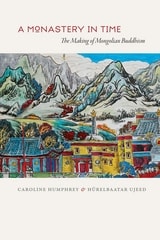
A Monastery in Time
The Making of Mongolian BuddhismCaroline Humphrey and Hurelbaatar Ujeed
University of Chicago Press, 2013
A Monastery in Time is the first book to describe the life of a Mongolian Buddhist monastery—the Mergen Monastery in Inner Mongolia—from inside its walls. From the Qing occupation of the eighteenth and nineteenth centuries through the Cultural Revolution, Caroline Humphrey and Hürelbaatar Ujeed tell a story of religious formation, suppression, and survival over a history that spans three centuries.
Often overlooked in Buddhist studies, Mongolian Buddhism is an impressively self-sustaining tradition whose founding lama, the Third Mergen Gegen, transformed Tibetan Buddhism into an authentic counterpart using the Mongolian language. Drawing on fifteen years of fieldwork, Humphrey and Ujeed show how lamas have struggled to keep Mergen Gegen’s vision alive through tremendous political upheaval, and how such upheaval has inextricably fastened politics to religion for many of today’s practicing monks. Exploring the various ways Mongolian Buddhists have attempted to link the past, present, and future, Humphrey and Ujeed offer a compelling study of the interplay between the individual and the state, tradition and history.
[more]
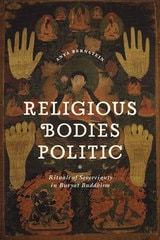
Religious Bodies Politic
Rituals of Sovereignty in Buryat BuddhismAnya Bernstein
University of Chicago Press, 2013
Religious Bodies Politic examines the complex relationship between transnational religion and politics through the lens of one cosmopolitan community in Siberia: Buryats, who live in a semiautonomous republic within Russia with a large Buddhist population. Looking at religious transformation among Buryats across changing political economies, Anya Bernstein argues that under conditions of rapid social change—such as those that accompanied the Russian Revolution, the Cold War, and the fall of the Soviet Union—Buryats have used Buddhist “body politics” to articulate their relationship not only with the Russian state, but also with the larger Buddhist world.
During these periods, Bernstein shows, certain people and their bodies became key sites through which Buryats conformed to and challenged Russian political rule. She presents particular cases of these emblematic bodies—dead bodies of famous monks, temporary bodies of reincarnated lamas, ascetic and celibate bodies of Buddhist monastics, and dismembered bodies of lay disciples given as imaginary gifts to spirits—to investigate the specific ways in which religion and politics have intersected. Contributing to the growing literature on postsocialism and studies of sovereignty that focus on the body, Religious Bodies Politic is a fascinating illustration of how this community employed Buddhism to adapt to key moments of political change.
[more]