Results by title
2 books match the query 'Mondak, Jeffery J.'

(Mis)Understanding the Other Side
How Americans Explain Opposing Political ViewsMatthew V. Hibbing, Matthew Mettler, Jeffery J. Mondak, and Isaiah R. Raynal
Temple University Press, 2027
A genuine understanding of politics requires us to accept that even those with whom we disagree may have a reasoned basis for their preferences. Acknowledgment of the existence and legitimacy of opposing perspectives may help people with ingrained political differences communicate better and develop more thoughtful and informed rationales for their own opinions. (Mis)Understanding the Other Side analyzes Americans’ ability to recognize and understand dissenting views, a necessary step if we are to reduce partisan polarization and be more effective citizens.
The authors conducted a national survey of 2500 Americans to gauge people’s political motivations and their views on major political issues. The respondents were also asked to explain the rationale for “the other side.” Exploration of respondents’ own words and subsequent statistical analyses combine to show how well people articulate their own issue rationales and the extent to which they understand, and are receptive to, opposing positions.
(Mis)Understanding the Other Side identifies severe limitations in how and how well Americans explain both their own positions and those of people who disagree with them. The authors highlight the challenges these limitations pose for effective citizenship and point to strategies that may foster better understanding across lines of political difference.
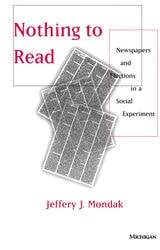
Nothing to Read
Newspapers and Elections in a Social ExperimentJeffery J. Mondak
University of Michigan Press, 1995
Nothing to Read compares the information gathering and voting behavior of residents in Pittsburgh and Cleveland during the 1992 campaign season. Comparable in demographics and political behavior, the only significant difference between the two cities was the availability of local newspapers. Using a research design that combines elements of the opinion survey and the laboratory experiment, the author exploited this situation to produce an unusually sound and thorough examination of media effects on voters.
The results are startling. First and foremost, Nothing to Read reasserts the role of the newspaper in the dissemination of information acquisition. It is the only media source that can rival television in the electoral arena, and it is often more important to voters as a source for local information, including information about U.S. House races. Nothing to Read also shows that voters are more active in seeking out information than typically postulated. Indeed, many voters even differentiate between media sources for information about Senate and House contests and sources for the presidential campaign. Within limits, the electorate is clearly not a passive news audience. Nothing to Read provides a wealth of information on such related topics as the relationship between partisanship and media influence, the interplay between media exposure and interpersonal political conversations and other social interaction, and newspapers' effect on coattail voting. A unique book, Mondak's important study lays a solid foundation for all future work on the relationship between American media and politics.
Jeffery J. Mondak is Associate Professor of Political Science, University of Pittsburgh.